

You've got the tab open, the dates are set, and the first quote looks fantastic. Then you click through and the “cheap” rental starts growing teeth, airport fees, fuel rules, a protection upsell at the counter, and a deposit that ties up more of your card than you planned. That's the trap, and car rental price comparison only works when you compare the trip cost, not the glossy daily rate.
| What You See | What You Actually Pay For |
|---|---|
| Advertised daily rate | Base rental only |
| Airport pickup | Concession and facility charges |
| Low rate at checkout | Taxes and mandatory fees |
| Cheap-looking quote | Mileage, fuel, and driver rules |
| Counter surprise | Protection and add-on sales |
Table of Contents
- Why Your Cheap Rental Quote Is Probably Lying to You
- The All-In Cost Framework for Comparing Rentals
- Sample Rate Tables for Common Rental Scenarios
- Major Brands Versus Local and Aggregator Suppliers
- Electric and Hybrid Rentals as a Separate Decision
- Tactics That Reliably Lower the Final Payable Total
- When to Book Direct and When to Trust a Comparison Engine
- Practical Questions Renters Ask After Comparing
Why Your Cheap Rental Quote Is Probably Lying to You
A traveler lands at an airport, sees a $25 a day quote, and books fast because the price looks lower than everything else. At the counter, the price doesn't stay low for long. Airport-related charges, fuel rules, extra-driver costs, and a protection upsell can turn that neat headline into something that feels much closer to a $60-a-day trip cost.
That gap is the whole game. The most dangerous quote is not the expensive one, it's the one that hides the actual cost until you're standing at the desk with luggage at your feet and no time to compare again. A smart booking starts by assuming the first number is incomplete.
What usually inflates the bill
The usual culprits are predictable. Airport concession and facility fees, vehicle-license recovery charges, taxes, mileage limits, fuel policies, extra-driver fees, age surcharges, and optional protection products all change the final payable amount. The problem isn't that these charges exist, it's that many search results don't line them up in a fair way.
Practical rule: never trust a quote until you know whether it's inclusive or only a base rate.
The cleanest way to avoid getting burned is simple. First, check whether the quote includes mandatory fees. Second, check the mileage and fuel rules. Third, estimate whether the counter will push protection or another driver charge onto the booking. If a result page can't answer those three things clearly, it's not a real comparison, it's a teaser.
The All-In Cost Framework for Comparing Rentals
A valid car rental price comparison has to normalize the whole trip, not just the headline rate. If one quote shows a clean daily price and another quote already includes mandatory fees, the “cheaper” result can be the most expensive option in reality. That's why the only useful comparison is the one built on equivalent inputs.
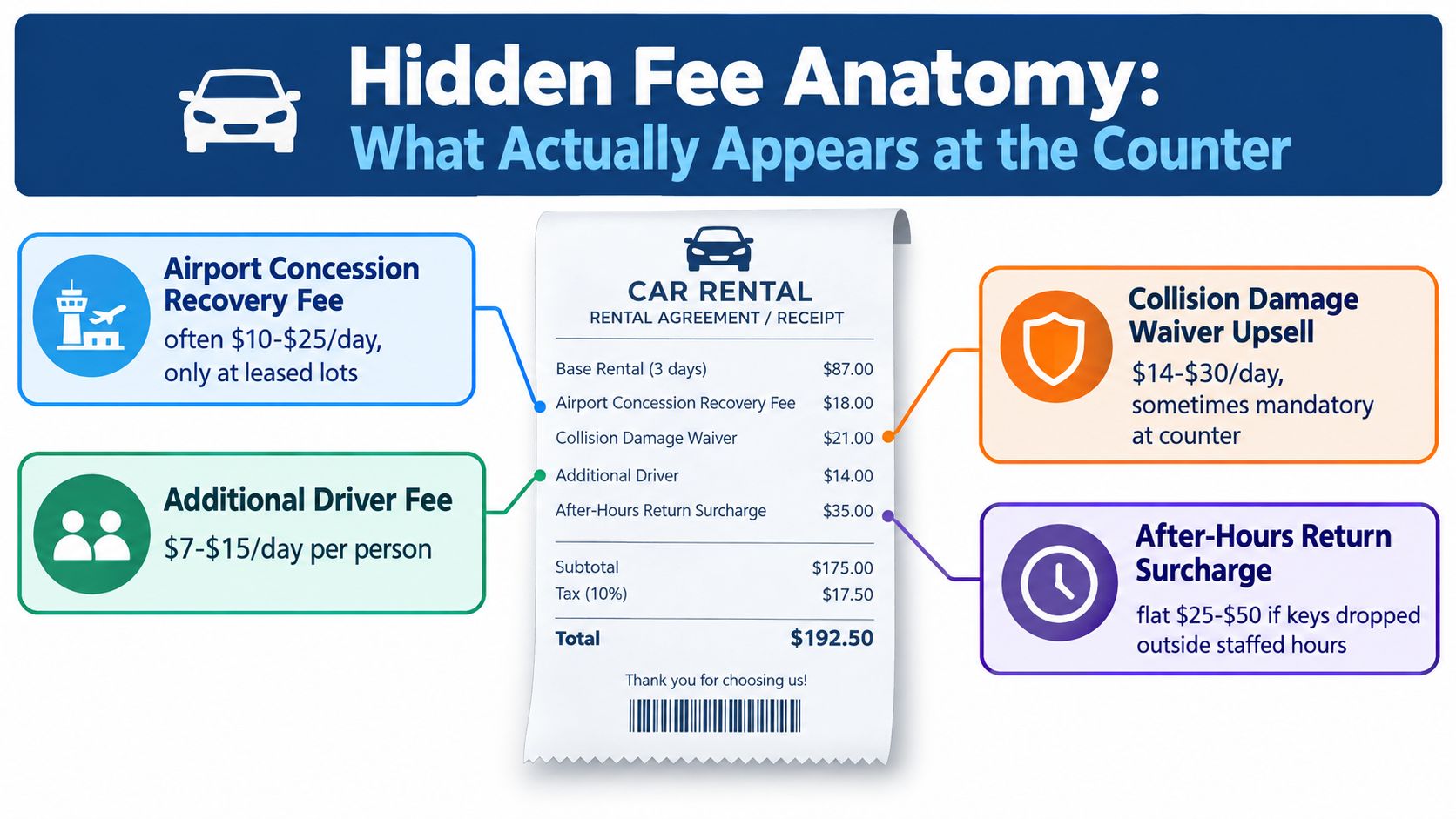
The comparison has to start with the base rate, then add every charge that affects the payable total. Airport concession and facility fees matter because they're location-driven, vehicle-license recovery fees can sit on top of the rental, and taxes change the final amount again. Mileage policy, fuel policy, additional-driver charges, young-driver surcharges, and optional protection products all belong in the same calculation.
The checklist that actually works
Use the same checklist on every result:
- Base rate: the starting price, not the final price.
- Mandatory airport charges: fees that show up because you're picking up at an airport location.
- Taxes and facility costs: these should never be hidden behind a cleaner-looking quote.
- Mileage policy: unlimited mileage is not the same as a low cap.
- Fuel policy: full-to-full is not the same as prepaid fuel.
- Driver rules: extra drivers and younger drivers can change the total quickly.
- Protection products: optional at booking, expensive at the counter.
The biggest mistake is comparing a fully inclusive quote with a base-only quote. That ranks the wrong offer as cheaper. A quote is only comparable when the pickup date, location, vehicle class, mileage allowance, and inclusions all match.
The internal logic matters as much as the math, so keep your transfer planning clean too. If airport pickup is just part of a bigger itinerary, the ground-transport choice can affect the whole booking flow, as covered in this airport transfer guide.
A real comparison tells you what leaves your card, not what looks pretty on the search page.
Sample Rate Tables for Common Rental Scenarios
A base-rate comparison loves to make the cheapest row look like the smartest choice. A trip-cost comparison does the opposite, it exposes how fast a small-looking booking can grow once real usage and policy rules show up. The point isn't to crown one vehicle class forever, it's to show how misleading the lowest daily rate can be.
Sample Weekly Rental Costs by Vehicle Class
| Vehicle Class | Base Rate (per day) | Typical All-In Total (7 days) | Worst-Case Total (7 days) |
|---|---|---|---|
| Economy | Low headline quote | Moderate once fees are added | High if protection and extra charges stack up |
| Midsize SUV | Mid-range headline quote | Higher, but often more realistic for families | Much higher if mileage and add-ons grow |
| Premium | Highest headline quote | Still climbs once policy costs are included | The most expensive once usage charges hit |
The lesson is blunt. The cheapest-looking vehicle is often the most fragile choice if you need an extra driver, plan a lot of mileage, or expect to buy protection at the counter. A better model is to rank offers by the all-in trip cost, then sort again by flexibility and policy clarity.
What the tables should tell you
A family road trip is rarely won by the lowest base rate. A city break with limited driving can tolerate a tighter quote, but only if the fuel and mileage rules are clean. One-way bookings are a different beast again, because the drop-off logic can overwhelm the headline price.
The cheapest rate on the screen is often the wrong question. The better question is, “What will this cost after the real trip is over?”
If you compare this way, you stop shopping for a number and start shopping for a usable rental. That's a much stronger position at the desk and a far better way to protect the budget.
Major Brands Versus Local and Aggregator Suppliers
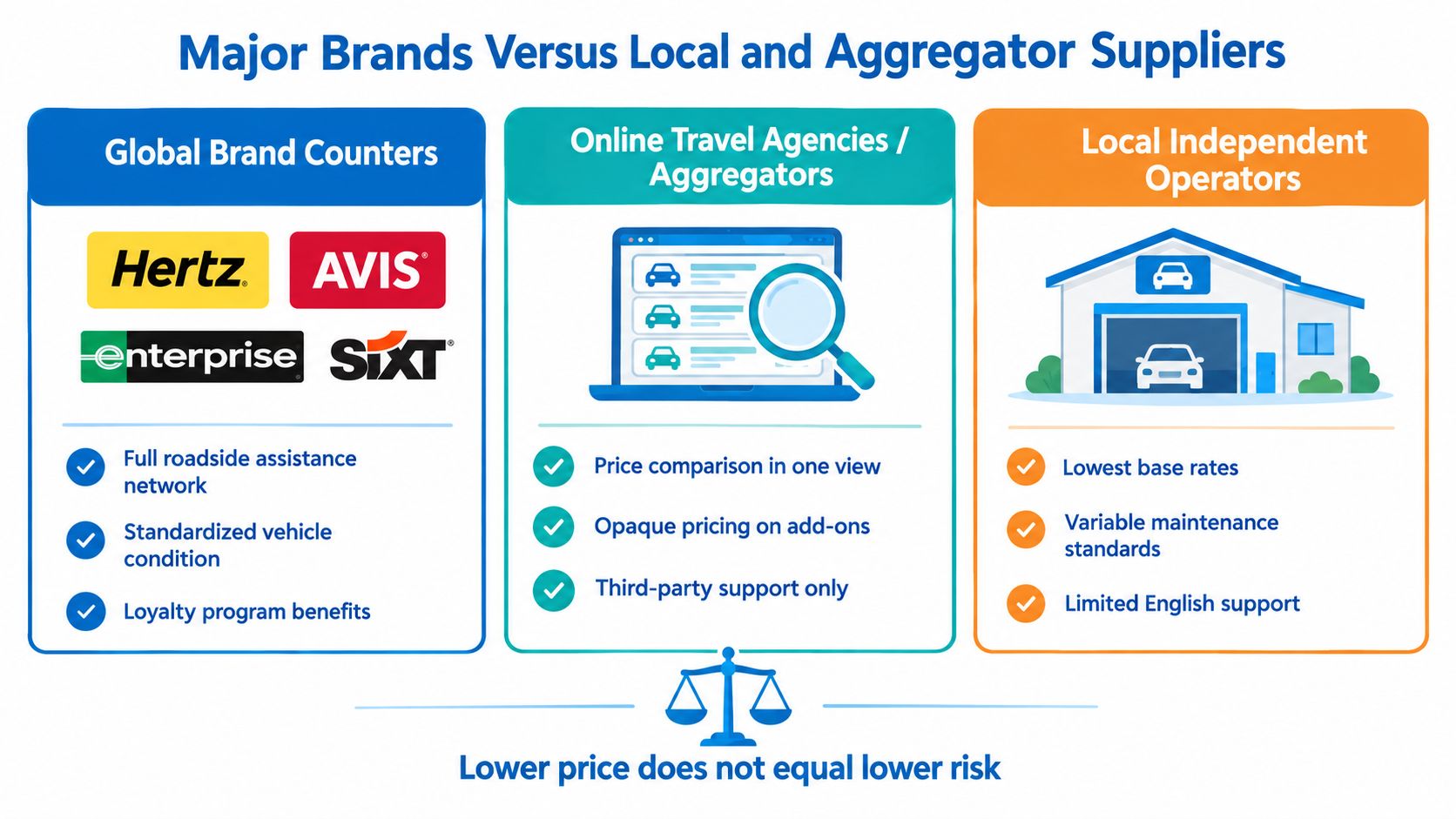
A cheap quote means little until you know who is behind it. Global brand counters, online aggregators, and local independents solve different problems, and the smartest choice depends on the trip, the pickup time, and how much friction you can handle if plans change.
Where each sourcing model shines
Global brand counters are the safer call when you want a familiar desk, standard procedures, and a broader roadside network. They suit late airport arrivals and one-way trips, where a predictable handoff matters more than squeezing out the last euro from the quote. Fleet condition also tends to be easier to gauge.
Online travel agencies and aggregators are the best place to start for price discovery. They let you compare multiple brands and local operators in one view, which is exactly what you need in a fragmented market. The catch is support. Once there is a dispute or a booking change, the chain of responsibility can get messy.
Local independent operators can beat the big names on base price, and that matters on a simple trip. A 1 a.m. arrival at a regional airport is a different story. You may save money, but only if the pickup desk is staffed, the car is ready, and the paperwork does not turn into a delay. Maintenance standards vary more, support is thinner, and English-language help is not always strong. That is not a dealbreaker. It just means the savings need to be worth the trade-off.
Pick the source based on the trip, not the logo
A business traveler with a fixed arrival time has a strong reason to favor the brand counter. A budget traveler comparing five similar airport rentals should start with an aggregator. A family booking a straightforward weeklong rental can consider a local operator if the quote is transparent and the vehicle category is clear.
Compare this way and you arrive at the desk with a rental you can use, not just a number that looked good.
The better question is, "What will this cost once the trip is over?"
Electric and Hybrid Rentals as a Separate Decision
EVs and hybrids can be smart rentals, but they need their own comparison lane. Treating them like ordinary gasoline cars is sloppy because cost depends on charging access, charging time, return rules, and battery-related risk. A cleaner-looking daily rate can still be the worse deal if the itinerary fights the vehicle.
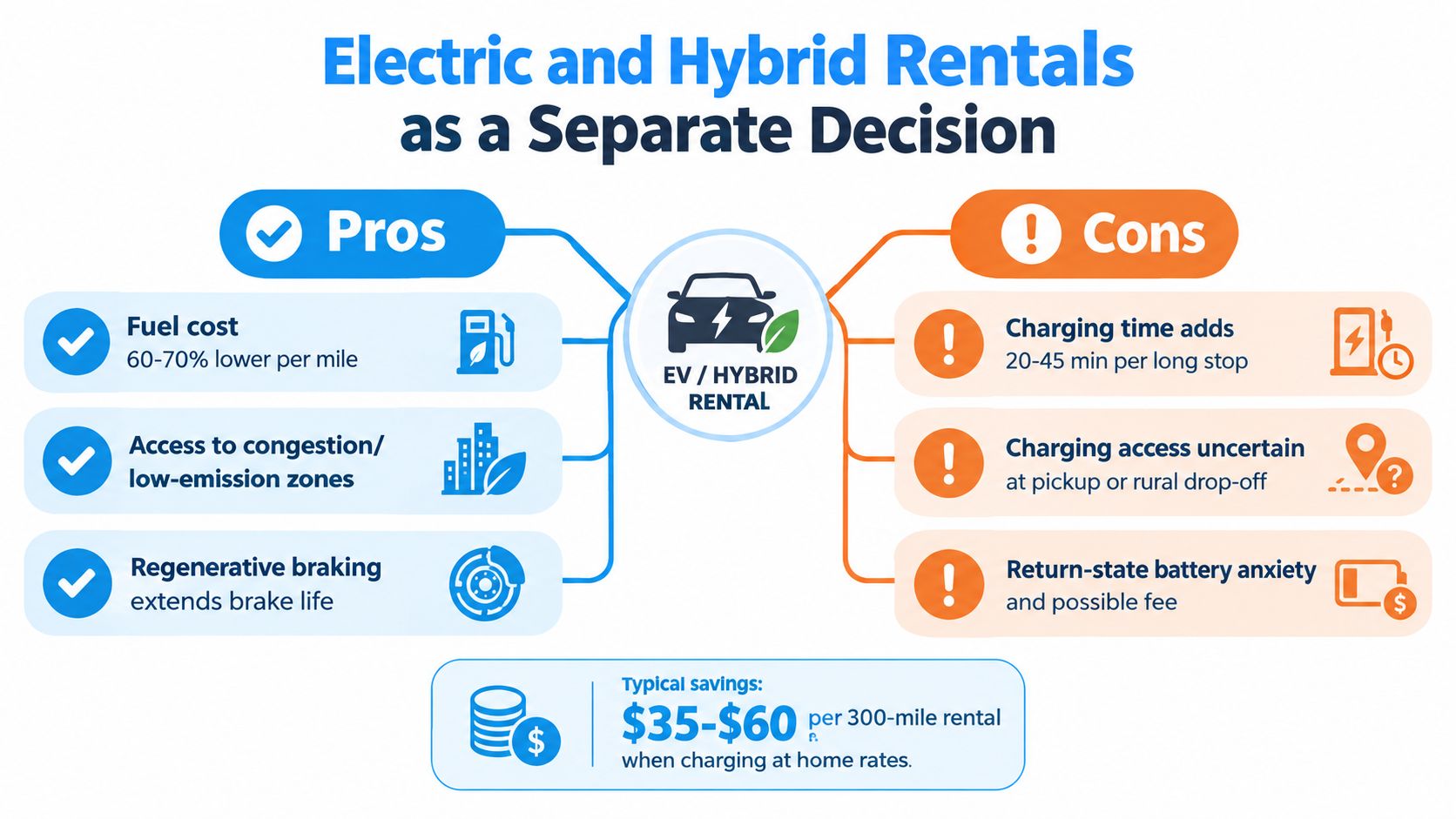
The upside is obvious. Energy cost can be lower, and hybrids or EVs can be useful in places where emissions rules matter or where parking incentives exist. The downside is just as real. Charging takes time, charging availability isn't always convenient at pickup or drop-off, and the return-state rules can make people nervous if the battery is low.
When the EV looks cheap but isn't
An EV can lose its value fast on short airport loops, rural routes, or one-way journeys with limited fast charging. In those cases, the time spent hunting for a charger and the uncertainty around return state can wipe out the savings from the lower rate. The same thing happens when the booking doesn't clearly state where charging is available or what battery level is required at return.
The battery risk is another issue travelers ignore until it matters. A vehicle that looks economical on paper can become expensive if damage or charging-related problems fall outside the coverage you expected. Hybrids are simpler, but they still deserve a check for actual trip fit instead of blind rate-chasing.
A cheaper EV rate can still cost more once charging time and policy risk are priced in.
Use an EV or hybrid when the route is charge-friendly and the rules are clear. Skip it when the trip is short, remote, or too tight on time to accommodate charging stops. That's not anti-EV, it's just honest arithmetic.
Tactics That Reliably Lower the Final Payable Total
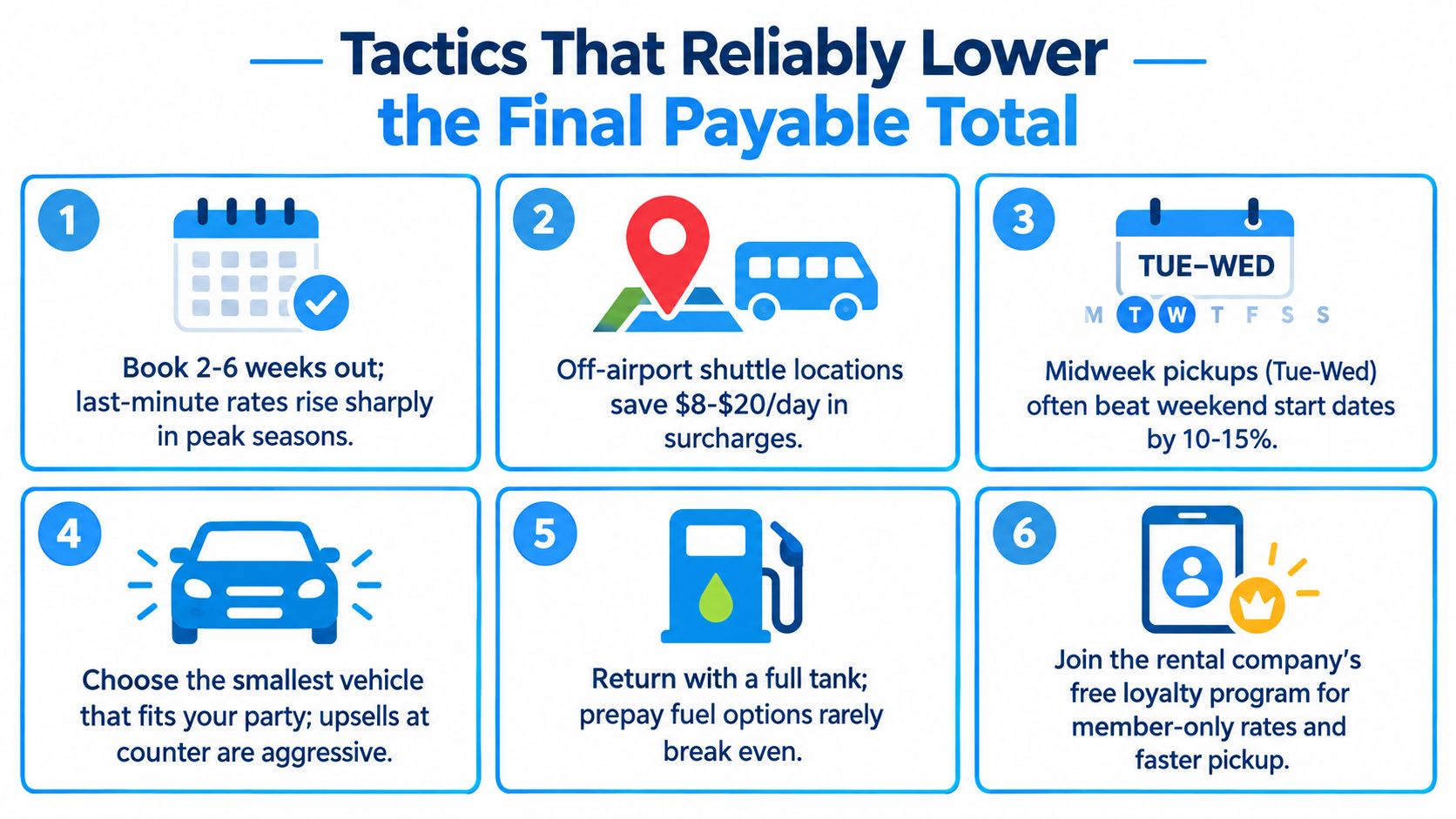
The fastest savings usually come from three decisions, where you pick up, when you book, and what you say no to at the counter. Travelers waste too much time hunting for mystical hacks. The actual gains come from removing bad costs, not chasing fantasy discounts.
Spend less by changing the right variables
Book earlier when the trip is fixed. Last-minute rates tend to be weak when supply tightens, so locking in the trip once your dates are set is the cleaner move. Waiting only helps if your schedule is flexible and the market is soft.
Check off-airport pickup only if the math works. Airport desks can look pricier because of the surcharge structure, but the full comparison has to include convenience and transfer time. If the off-airport branch saves real money, take it, but don't assume it wins automatically.
Avoid buying protection twice. Some travelers already have coverage through a card or a separate policy, and paying again at the counter is just dead money. Read the policy before you travel, then decide in advance what you're willing to decline.
Return the car with a full tank if that's the contract. Fuel prepay options sound tidy, but they often don't beat filling up yourself before drop-off. The same goes for extra add-ons, if you don't need them, don't let the counter convert convenience into margin.
For more money-saving tactics and booking habits, keep an eye on these car rental tips.
Use the lowest-friction savings first
The best savings don't require negotiation skills. They come from choosing the right location, the right date, and the right level of coverage before you click book. Then you show up at the counter with fewer open questions and fewer chances for the rental desk to inflate the bill.
When to Book Direct and When to Trust a Comparison Engine
Book direct when the trip is messy. That means status benefits, a complicated one-way route, or a pickup where you expect to need live support after arrival. Brand sites can be better for post-pickup issues because there's no extra middle layer between you and the rental company.
Use a comparison engine when the goal is price discovery. That's the better tool for first-time renters, simple itineraries, and any trip where you want to see major brands, OTAs, and local suppliers in one ranked view. The point is not to let the comparison site make the final decision, the point is to expose the market quickly and efficiently.
The best workflow is brutally practical. Compare equivalent quotes first, then verify the same pickup date, pickup location, vehicle class, mileage allowance, and fuel policy on the confirmation page before paying. If the result page is vague, treat it as a lead, not a booking.
Easy Travel Bookings can be useful here because a good metasearch result should surface the actual total, not just the teaser rate. If the final supplier page doesn't match the comparison screen, the supplier page wins.
Comparison engines are best for finding the right quote. The brand or local supplier's confirmation page is where you verify what'll actually be charged.
Practical Questions Renters Ask After Comparing
A credit-card hold can sit on top of the rental total and reduce available credit before you even leave the lot. Plan for that before you choose the car, because a cheap quote is useless if the authorization blocks the rest of your trip spending. If your card limit is tight, check the hold policy before you book.
One-way fees are usually tied to the route, not just the vehicle. They can change depending on pickup and drop-off city, so don't assume a one-way booking will price like a normal return rental. Cross-border rules can also be strict, especially when you're moving between countries in Europe or across the U.S. and Mexico, so check the contract before you commit.
If the quoted vehicle class isn't available at pickup, ask for the exact equivalent in writing before you accept the handoff. If the replacement is a downgrade, challenge it on the spot and don't give up your position too fast. The desk move that works best is the one where you stay calm, keep the booking visible, and insist on the promised category or a fair substitute.
Easy Travel Bookings helps travelers compare rentals the right way, by focusing on the total trip cost instead of the noisy headline rate. If you want a cleaner way to judge fees, fuel rules, and protection charges before you book, visit Easy Travel Bookings and compare your options with less guesswork.