

The reported U.S. national average was about $47 per day in 2025. At Newark, Fidelity lists economy base rates of $55 to $75 per day, before taxes and add-ons. These figures cover different measures and locations, so neither alone predicts the final price of your trip.
Your daily cost depends on the pickup location, vehicle class, driver profile and charges in the final agreement. To compare offers fairly, calculate the trip total, including protection, toll arrangements and any return-location charge, then divide by the rental days. That can show why a lower advertised rate may still lead to a higher daily cost.
Table of Contents
- What Car Rental Costs Per Day in 2026
- Typical Daily Rates by Vehicle Class
- Why the Base Rate Is Only the Starting Point
- Insurance, Taxes and Fees That Lift the Daily Price
- Location, Timing and Driver Profile Shift the Rate
- Three Trips, Three Daily Costs
- Cut Your Daily Cost and Confirm the Price Before You Book
What Car Rental Costs Per Day in 2026
A U.S. national average of about $47 per day in 2025 provides a useful reference point, not a quote for a 2026 trip. The rental-price report also notes that typical bookings lasted six days.
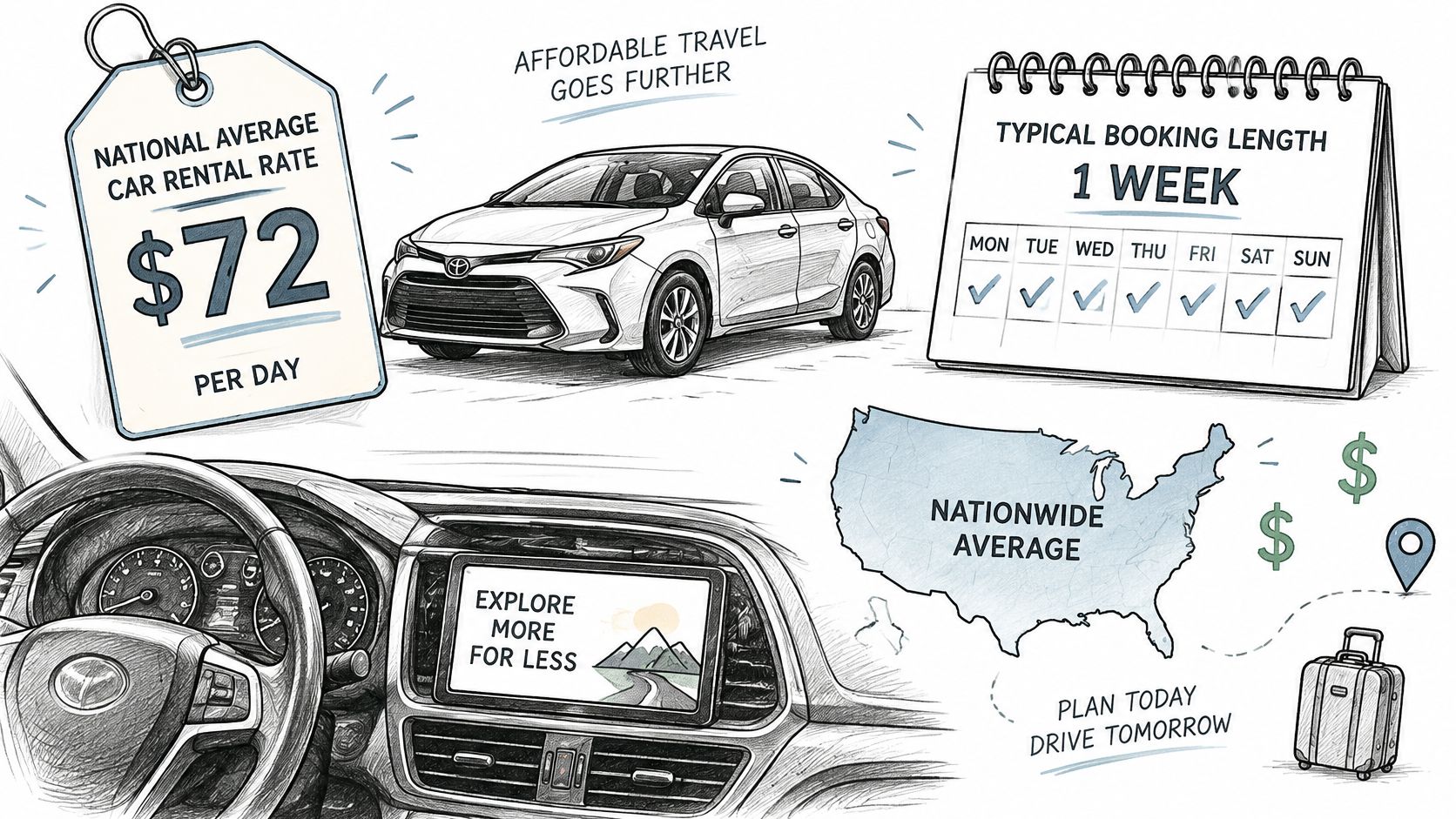
The illustration shows a different figure, so use the sourced 2025 average as the benchmark. Neither figure represents the full cost of a specific rental.
Why recent prices aren't a permanent baseline
Rental prices have shifted as vehicle supply and travel demand changed. Phocuswright reported that U.S. average revenue per rental day declined by a few percentage points in 2024. Revenue per rental day is an industry measure, not a quote for a particular itinerary.
Use the national average to check whether a quote seems broadly plausible. A rate above it may reflect the market, vehicle or dates, rather than an unusually high price. To judge the offer, compare the same pickup city, travel dates and vehicle category, then calculate the charges that apply to your rental.
Typical Daily Rates by Vehicle Class
| Vehicle class | Typical base rate per day | Best fit |
|---|---|---|
| Economy | $55–$75 | Solo travelers and short city trips |
| Compact | $55–$80 | Two passengers with light luggage |
| Midsize | $60–$85 | Couples or small families on road trips |
| Standard | $60–$90 | Extra legroom for longer drives |
| Full-size | $65–$95 | Four adults with luggage |
| Minivan | $150–$250 | Groups of five or more with large luggage |
These representative Newark Liberty International Airport base-rate ranges come from Fidelity's rental-cost guide, which also lists economy ranges of $55–$75 in Atlanta, $55–$80 in Tampa, $60–$85 in Chicago, $65–$90 in Seattle and Denver, $70–$95 in Las Vegas, and $75–$100 in Los Angeles. The table's best-fit column is a planning guide, not a guarantee of a particular model's seating or luggage capacity.
Economy is a sensible starting point when you need basic transport rather than extra space. But the lowest category isn't automatically the best value if your bags won't fit or passengers will be uncomfortable throughout a long drive.
Buy the space you'll actually use
Compare the specific vehicle description, not just the category name. Check passenger capacity, luggage guidance, transmission and whether the listing promises a model or a model “or similar.”
Midsize deserves a look when the upgrade is modest in your actual search results. The overlapping ranges show why it's worth comparing neighboring categories rather than assuming every larger car carries a substantial premium.
A minivan requires a different decision. You're paying for passenger and luggage capacity, so compare it with the practical alternative for your group, including the cost and inconvenience of splitting passengers between vehicles.
- For city stays: Consider whether parking and the amount you'll drive justify a car at all.
- For road trips: Prioritize enough usable luggage space to keep the passenger area clear.
- For groups: Confirm that all passengers and bags fit together, not just that the vehicle has enough seats.
For a compact destination where most outings are short, comparing bike rental costs can also help you decide which days require a car.
These are base rates, not guaranteed checkout totals. Taxes, location fees, protection products and driver-related charges still need to be included before comparing offers.
Why the Base Rate Is Only the Starting Point
A rental-car headline rate works like a hotel room price displayed before taxes and property charges. It tells you the starting price of the product, but it doesn't necessarily tell you what completing the stay or trip will cost.
Separate the rental into three cost layers. The base rate pays for the vehicle, mandatory charges include applicable taxes and location fees, and conditional costs depend on your choices and eligibility.
Build a comparable daily price
Use this formula:
All-in daily cost = [(base rate × rental days) + taxes and mandatory fees + selected add-ons + expected trip charges] ÷ rental days
For a clearly hypothetical example, suppose a car has a $60 daily base rate for five days, with an assumed 15% tax applied only to the base rental:
| Calculation | Illustrative amount |
|---|---|
| Base rental, $60 × 5 | $300 |
| Assumed tax, $300 × 15% | $45 |
| Rental subtotal | $345 |
| Daily equivalent, $345 ÷ 5 | $69 |
Now suppose you select collision coverage costing an illustrative $20 per day. That adds $100, taking the hypothetical total to $445, or $89 per day.
The advertised car hasn't changed. Your protection choice has changed the amount you need to budget.
Keep the calculation honest
This simplified example assumes no separate airport charge, fuel expense, toll charge or tax on the protection product. A real agreement may calculate taxable charges differently, so use the itemized checkout total when it's available rather than applying a blanket percentage yourself.
Also distinguish a refundable security deposit from a rental expense. Track it separately as money or card capacity you need available, rather than automatically adding it to the daily cost.
For comparisons, keep the boundary consistent. Don't include fuel in one offer while excluding it from another, and don't compare a protection-inclusive package with an unprotected base rate as though they provide the same product.
The number to compare across offers is the all-in daily cost, not the headline rate.
Insurance, Taxes and Fees That Lift the Daily Price
| Charge | Typical amount | When it applies |
|---|---|---|
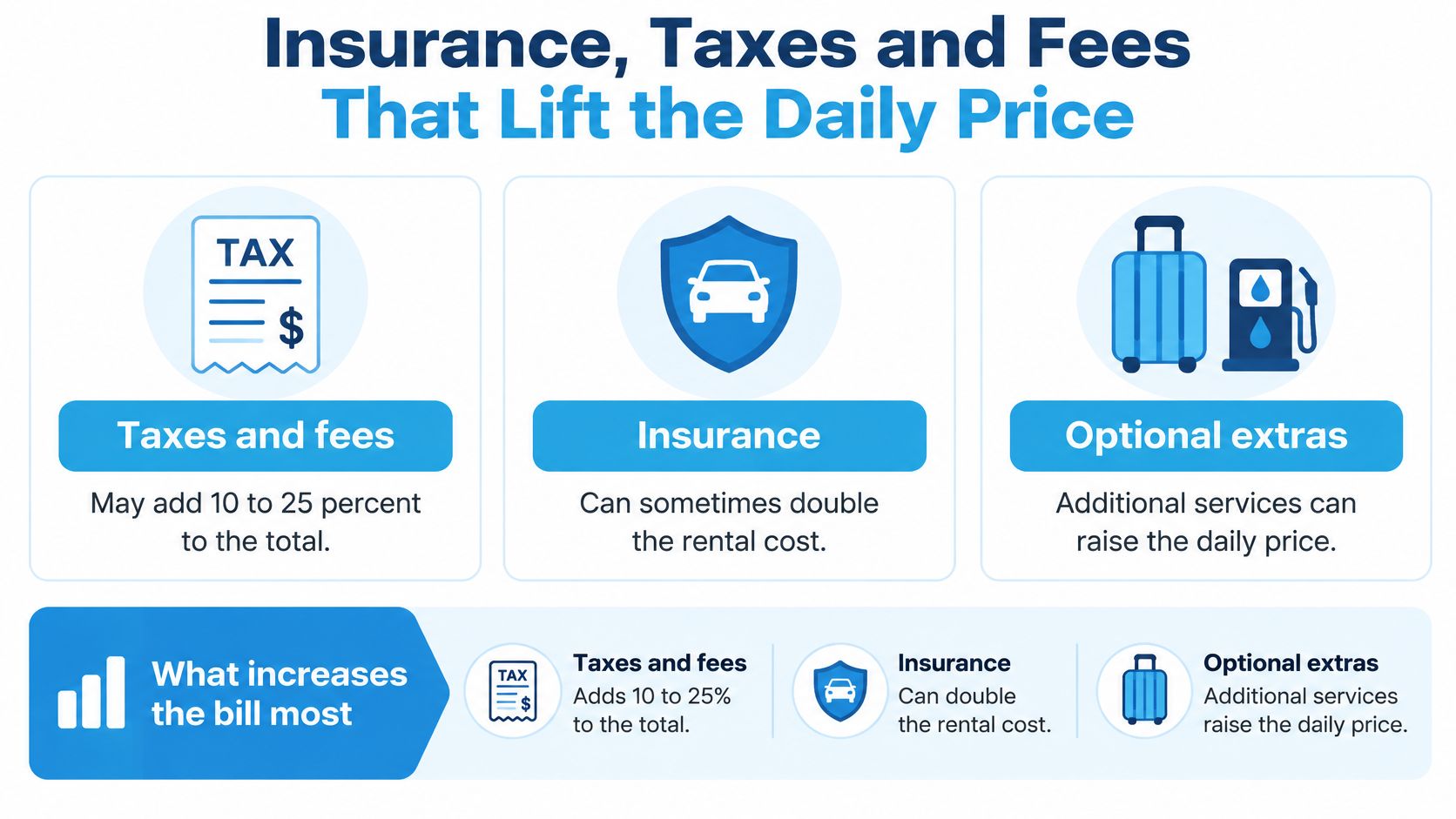
| Taxes and airport fees | Taxes and fees may add 10–25% | Applicable taxes and pickup-location charges |
| Collision damage coverage | $10–$30 per day | When you select the rental company's damage protection |
| Young-driver fee | About $20–$30 per day | When a driver falls within the company's surcharge age band |
| One-way drop fee | $45–$200 or more | Returning the car to a different location |
| Toll transponder | $5–$10 per day | Enrolling in the rental company's toll program |
| Mileage overage | $0.10–$0.25 per mile | Exceeding a limited-mileage allowance |
| Additional driver | Check the agreement's named-driver charge | Adding another authorized driver |
| Fuel refill | Check the stated refill rate and service charge | Returning below the required fuel level |
The charge ranges summarized in Skyscanner's car-rental cost guidance include taxes and fees adding 10–25%, collision coverage at $10–$30 per day, young-driver charges around $20–$30 per day, one-way fees of $45–$200 or more, toll programs at $5–$10 per day, and mileage overages of $0.10–$0.25 per mile. Treat these as budgeting ranges, not maximum charges or a substitute for the booking terms.
Protection needs a coverage check
Before accepting or declining damage protection, examine any relevant personal auto policy and credit-card benefit terms. Confirm the destination, vehicle type, eligible drivers, exclusions, deductible and payment requirements.
Don't assume damage protection also resolves every liability question. Read what each product covers, and identify what financial exposure remains if you decline it.
The table doesn't assign a reliable range to additional-driver charges or fuel refills. Those lines require the actual agreement, including any applicable exemption or service charge.
Watch the charging method
A toll program can include both tolls and an administrative or device charge. Check whether enrollment triggers charges only on usage days or across the rental period, and whether a permitted direct-payment alternative exists.
Mileage needs the same attention. Compare the included allowance with your planned route, including airport travel, sightseeing detours and the return drive, rather than only the distance between overnight stops.
For young drivers, use the company's actual eligibility and surcharge terms rather than assuming a universal age rule. For one-way trips, confirm the fee against the exact return branch, since “same city” and “same location” aren't interchangeable booking instructions.
Location, Timing and Driver Profile Shift the Rate
Pickup location changes more than convenience. An airport branch and a downtown branch can attach different charges to otherwise comparable rentals, so compare their final totals rather than assuming the off-airport option wins.
Include the cost of reaching the alternative branch. If you're considering a separate journey from the terminal, understanding how airport transfers work helps you judge the full transport arrangement.
Compare convenience with the complete trip
An off-airport booking needs workable opening hours and a realistic pickup plan. A lower rental total isn't useful if your arrival time leaves you unable to collect the car.
Timing and availability also matter. If your itinerary is flexible, compare nearby pickup dates and times before fixing the booking, while keeping the return time and vehicle requirements consistent.
Don't interpret every cheaper result as a like-for-like saving. A changed collection time, shorter rental period or different cancellation condition can explain the difference.
- Location test: Compare the same class at an airport branch and a practical off-airport branch.
- Timing test: Repeat the search for an alternative schedule you could use.
- Access check: Add transfers and confirm branch hours before ranking the options.
Price the actual drivers
Driver profile is part of the product you're buying. Enter the correct age and identify everyone who needs authorization to drive before relying on a total.
A result priced for a different driver profile isn't a useful budget, even if the vehicle and dates match. Keep the same driver details across searches so eligibility and surcharges remain comparable.
Our search includes both the largest booking websites and small local systems to find the lowest prices. That broadens the comparison, but the winning offer still needs to fit your collection arrangements and driver requirements.
Use a two-by-two test: compare the same class at two workable pickup points and on two feasible schedules. Choose using the complete cost, including access expenses and driver charges, rather than the most attractive search-result number.
Three Trips, Three Daily Costs
| Trip profile | Base rate per day | Taxes and fees per day | Protection and surcharges per day |
|---|---|---|---|
| Downtown weekday midsize, 5 days, own coverage | $60 | $9 (15%) | $0 assumed; $69 all-in per day |
| Airport economy, collision waiver and tolls | $65 | $13 (20%) | $27 ($20 collision and $7 tolls); $105 all-in per day |
| Under-25 one-way midsize, airport, 5 days | $70 | $14 (20%) | $54 ($20 collision, $25 young-driver fee and $9 allocated one-way fee); $138 all-in per day |
These are hypothetical worked examples, not quotes. The inputs illustrate how the rate and charge categories interact; they aren't claims about a particular downtown branch, airport, date or driver's eligibility.
For simplicity, each example applies its assumed tax percentage only to the base rental. Fuel, deposits and any unlisted charges are excluded, while the airport economy example treats its toll amount as the complete assumed daily toll expense.
A downtown renter with suitable existing coverage
The first traveler books a hypothetical midsize car for five days and has verified suitable existing coverage. The arithmetic is $60 + ($60 × 15%) = $69 per day, producing a $345 rental total.
That result depends on the assumptions holding. It doesn't establish that downtown rentals always carry that tax rate or that existing coverage eliminates every risk.
An airport renter buying protection and using tolls
The second traveler starts with a hypothetical economy base rate and selects a collision waiver plus a toll arrangement. The calculation becomes $65 + $13 + $20 + $7 = $105 per day.
The useful comparison isn't economy versus midsize. This traveler has purchased a different package of services, so the smaller car can still produce the larger bill.
A younger renter returning elsewhere
The third traveler needs a hypothetical one-way midsize rental and falls within the assumed young-driver surcharge band. Spread the illustrative $45 one-time return fee over five days, giving a $9 daily equivalent.
The resulting calculation is $70 + $14 + $20 + $25 + $9 = $138 per day, or $690 over five days. Under these assumptions, that's exactly twice the downtown scenario, despite both travelers choosing midsize cars.
Budgeting insight: Vehicle class alone can't explain the final price. The combination of driver eligibility, protection and return arrangements can matter more.
To price your trip, replace every assumed input with the corresponding checkout line. Allocate one-time charges across the rental's billed days, and keep recurring charges separate so you don't accidentally count them twice.
Cut Your Daily Cost and Confirm the Price Before You Book
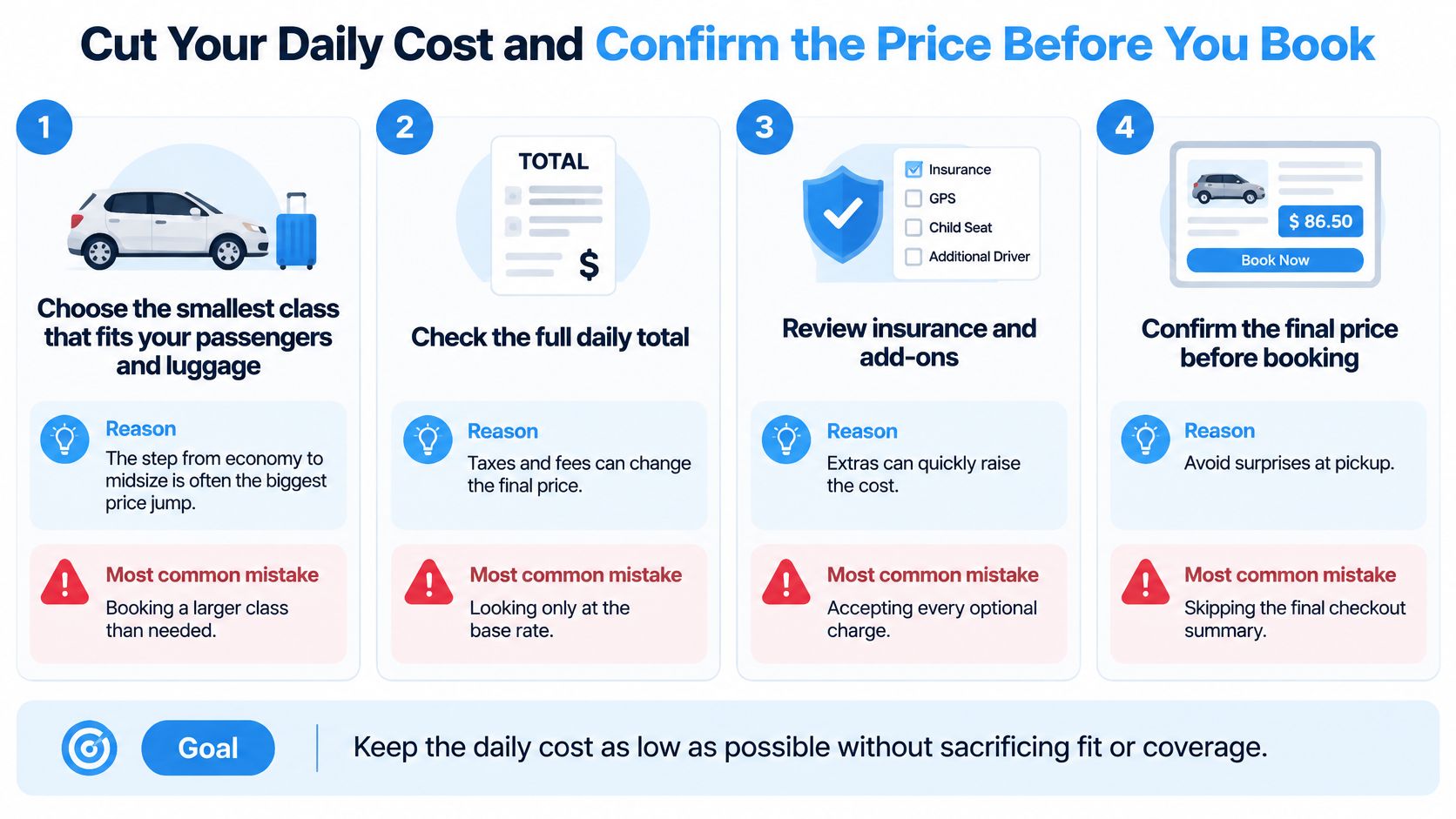
Choose the smallest class that fits. Check passenger and luggage requirements before paying for additional space. The common mistake is choosing a larger category by habit, or choosing an undersized car that won't accommodate the trip.
Compare airport and off-airport collection on equal terms. Add the cost of reaching each branch and use matching return arrangements. Don't compare a downtown base rate with an airport checkout total.
Verify existing protection before selecting a waiver. Read the relevant policy or card-benefit wording and confirm exclusions. Declining without checking is as poorly informed as automatically accepting every product.
Remove an unnecessary one-way return. Test a same-location itinerary if it doesn't create an impractical backtrack. Don't save on the advertised daily rate while overlooking a return-location charge.
Match the mileage allowance to the route. Include likely detours and local driving, not just the main journey. A restricted allowance isn't a bargain if your itinerary exceeds it.
Read the toll program's charging rules. Check enrollment, daily administration charges and permitted alternatives. Don't assume the amount collected is only the toll-road operator's charge.
Compare equivalent offers together. Use our car rental price comparison to enter your destination and travel dates, then review the returned prices and offers. Keep vehicle requirements and driver details consistent rather than choosing solely by list position.
Check the agreement before paying
Use the checkout summary and rental conditions as your final worksheet:
- Included charges: Confirm that the quoted total accounts for applicable taxes and airport fees.
- Fuel terms: Record the required return level and the stated refill or service charge.
- Branch details: Verify the exact pickup and return addresses, opening hours and return instructions.
- Deposit requirements: Check the amount, accepted payment method and release conditions separately from the rental expense.
- Driver eligibility: Confirm that every intended driver is authorized and that any age-related surcharge is included.
We charge no booking fee and no mark-up on bookings. That doesn't remove the need to distinguish the rental supplier's included services from conditional expenses you might incur during the trip.
Finally, divide the complete expected trip cost by the billed rental days. Compare that result with equivalent offers first, then use broad market benchmarks only as context. The right car rental cost per day is the lowest complete price that meets your space, coverage and itinerary requirements.
Enter your destination and travel dates at Easy Travel Bookings to compare car rental prices and offers, then use the all-in calculation to check your shortlist before booking. We also list hotels, flights, airport transfers, bike rental and eSIM options, so you can coordinate the rest of your trip alongside the car.