
No, standby isn't a cheaper way to buy a brand-new ticket, but it can be cheaper than a same-day confirmed change: American lists eligible standby at $0 versus confirmed changes from $60, while Delta has contrasted free standby with a $75 confirmed change. You're avoiding an extra charge on a ticket you already own, not buying a secret discount fare.
The familiar advice to turn up at the airport and ask for a cheap leftover seat skips the part that matters: you generally need a reservation first.
Say you're flying from Dallas to Chicago after a work trip. Your afternoon meeting ends early, you reach the airport ahead of schedule, and an earlier departure appears on the board. Joining its waitlist could get you home for dinner without another payment. But if you need to be home for something you can't miss, a seat you can count on may be worth more than a free request.
Table of Contents
- Are Standby Tickets Cheaper Than a Same-Day Change
- What Standby Really Means at the Gate
- Who Qualifies for Free Standby and Why Seats Run Out
- How to Request Standby Step by Step
- What a Standby Day Actually Costs
- When to Stand By and When to Buy a Confirmed Seat
Are Standby Tickets Cheaper Than a Same-Day Change
A standby request can cost nothing and still leave you waiting at the gate. Its value is the chance to avoid paying extra for an earlier flight, not a discounted ticket or a guaranteed seat.
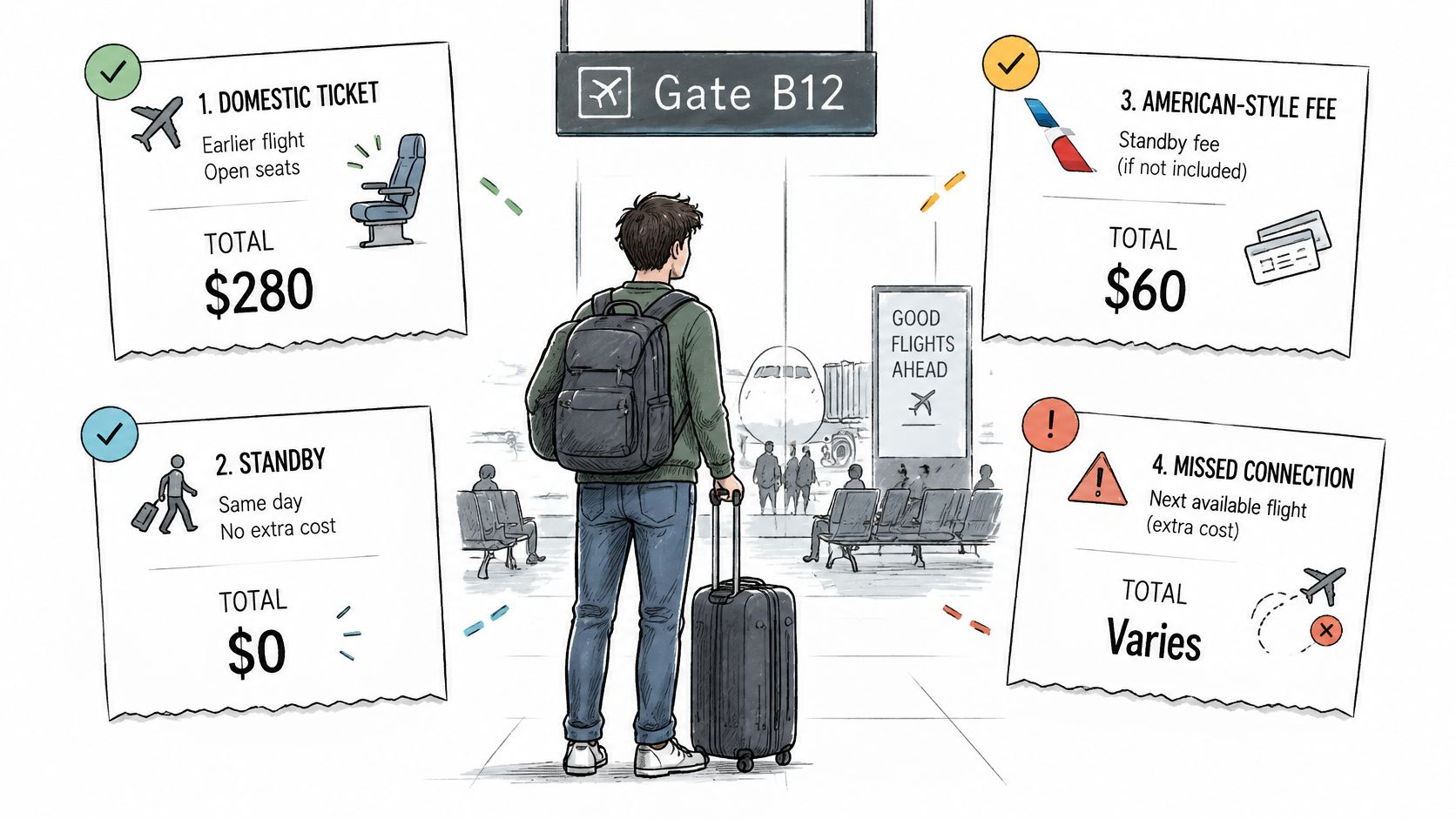
For eligible domestic travel within the United States, Puerto Rico, and the U.S. Virgin Islands, American Airlines lists standby at $0 and confirmed same-day changes starting at $60. That's at least $60 more for confirmation. Either way, you need a ticket already, and standby does not guarantee a seat.
Standby fee versus same-day confirmed change
| Airline | Standby cost | Confirmed same-day change | Seat guaranteed | Notable limit |
|---|---|---|---|---|
| American Airlines | $0 for eligible travelers | Starting at $60 | No for standby; yes if confirmed | Listed coverage includes the U.S., Puerto Rico, and U.S. Virgin Islands |
| Delta | Free standby may be available to eligible travelers | $75 when the fare and flight qualify | No for standby; yes if confirmed | Eligibility and fare restrictions apply |
| Southwest | Fare-based access; eligible fares and qualifying elite members can use standby without a fare difference | Depends on the fare and applicable change terms | No for standby; yes if confirmed | Many Basic fares are excluded |
The free option buys flexibility, not certainty. A standby list may be worth joining if getting home earlier would be nice, but you can accept the later flight if no seat opens. When arrival time matters, paying for a confirmed change may be the better value.
Who actually saves money
Say you're flying Dallas to Chicago after a work trip. Your afternoon meeting ends early, and you'd like to get home sooner. If you're eligible, standby could let you try for an earlier departure without paying the confirmed-change price.
Now suppose you haven't bought a ticket yet. Standby isn't a bargain fare you can purchase for that trip. Compare the confirmed fares available for your itinerary instead.
The useful comparison: Weigh standby against the cost of changing the ticket you already hold, not against the price of a new ticket.
Before joining the list, check whether your fare or loyalty benefits include a confirmed change. If you can confirm another flight without an additional charge, the waitlist may offer little financial advantage.
What Standby Really Means at the Gate
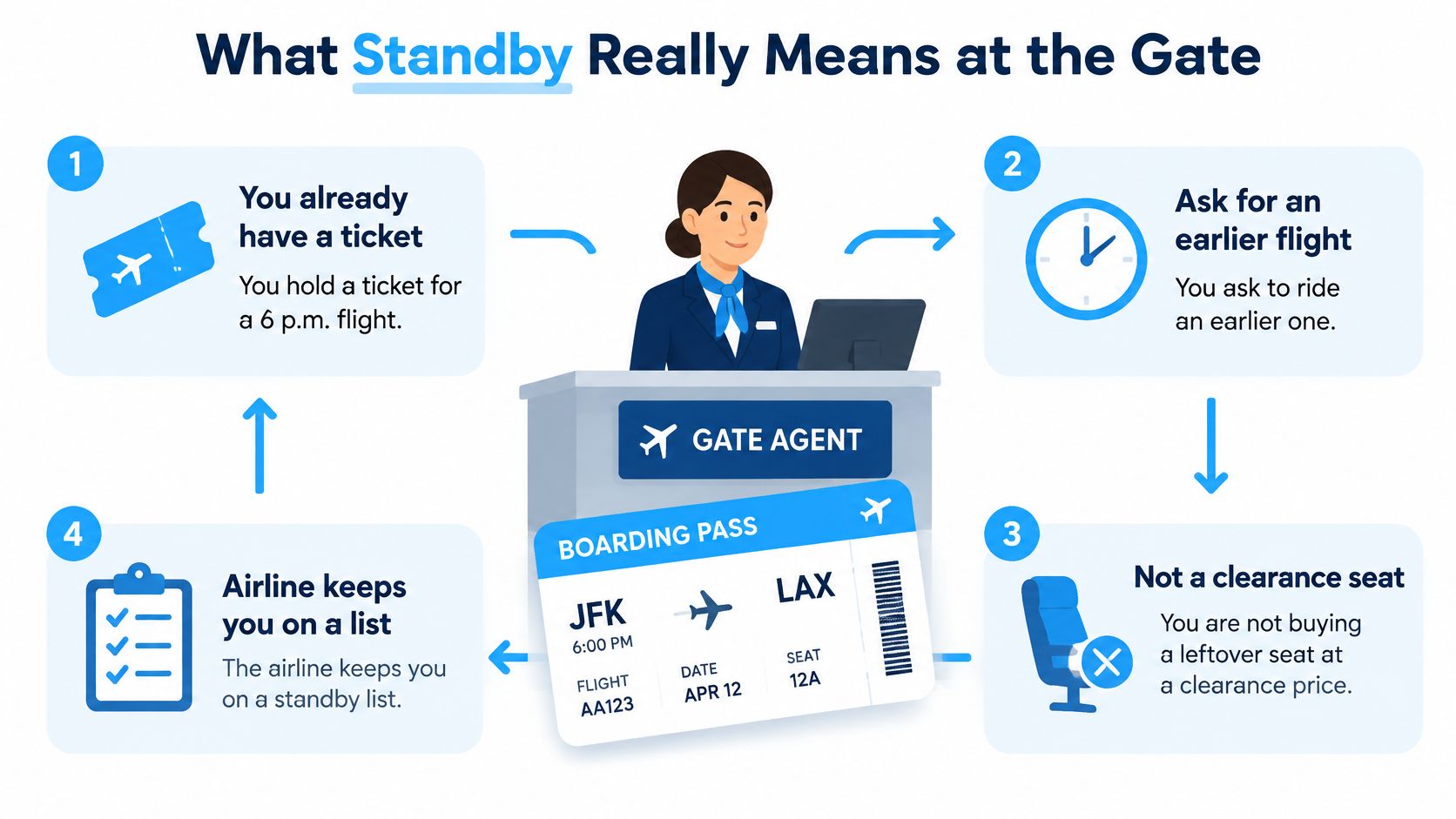
You reach the Dallas departure gate with your Chicago boarding pass on your phone. An earlier flight is boarding nearby, and you ask whether you can take it.
The agent checks your reservation and adds you to a standby list. You sit down within earshot of the counter, watching passengers walk down the boarding bridge. You haven't bought a discounted seat. You're waiting for the airline to decide whether it can accommodate you.
This is the process behind that apparently simple request.
An empty-looking seat isn't an offer
A seat map isn't a promise that the airline can give you a seat. Some passengers may not yet have assignments, and the airline still has to apply its eligibility and priority rules.
The practical difference is visible in Southwest's same-day standby guidance, which ties access to fare type and loyalty status rather than offering every traveler a last-minute bargain. Certain higher-fare customers and qualifying elite members can use standby without a fare difference, while most Basic-fare customers are excluded from free same-day standby.
You might see space and still not qualify. You might qualify and still not clear. Neither outcome means the agent has a hidden discount available if you ask differently.
Similar names, different arrangements
People use standby ticket for several arrangements that shouldn't be confused:
- Consumer standby is normally a request attached to an issued ticket, conditional on eligibility and available capacity.
- Airline-industry travel can involve employee or other industry privileges. It isn't an ordinary leisure fare you can assume is available for purchase.
- A same-day confirmed change moves you to another departure with a confirmed place, subject to the airline's terms.
The difference becomes obvious when boarding finishes. A confirmed passenger has a place on that departure. A standby passenger may still be sitting beside the counter, holding a phone that shows a request rather than permission to board.
Cheaper here means avoiding the change charge, not reducing the fare you already bought.
Before you settle into that seat by the gate, find out whether the airline will let you join the list at all. The name of your fare matters more than how early you arrived or how politely you ask.
Who Qualifies for Free Standby and Why Seats Run Out
Your companion booked the same route and sits beside you at the airport. You both want the earlier departure, but only your ticket qualifies for free standby.
That can happen because airlines sell different benefits alongside the journey itself. Fare type is the branded package you purchased, while booking class is an airline inventory category that can also affect which changes are allowed. Neither is another name for your seat's location.
Run the eligibility test before you travel
Delta's announcement introducing free same-day standby allowed eligible customers to request an earlier same-day flight within 24 hours of departure, contrasting that option with a $75 confirmed change when a seat was available in the originally purchased fare class.
The important detail isn't merely that standby became free. The alternative departure and the request still had to meet specific conditions. Delta's voluntary standby terms also depend on same-cabin availability, don't guarantee transportation, and may exclude basic fares or restricted booking classes.
Use this checklist against your own reservation:
- Issued ticket: Make sure you have an actual ticket, not just a saved itinerary or an unfinished booking.
- Eligible fare: Read the benefits attached to your fare name, especially if it includes Basic or similar restrictions.
- Permitted departure: Confirm whether the airline allows the particular flight you want, including whether it must leave earlier.
- Allowed route: Check the origin, destination, and routing requirements rather than assuming nearby airports are interchangeable.
- Matching cabin: Don't assume an empty premium-cabin seat can satisfy an economy standby request.
- Request deadline: Find out when you can join the list and when the airline stops accepting requests.
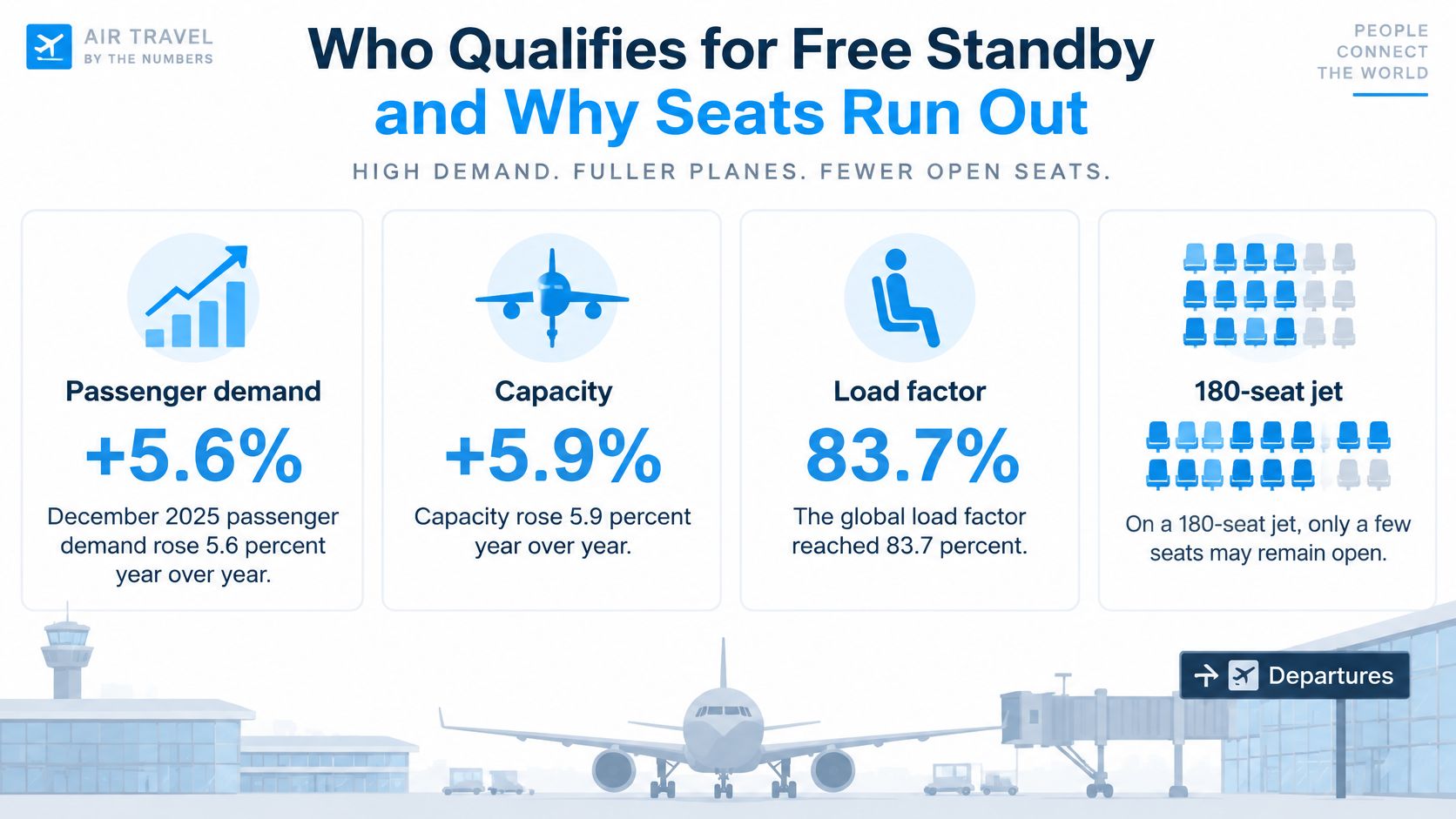
This dashboard gives the broader capacity context, not your personal probability of getting aboard.
Eligibility doesn't create capacity
Passing every eligibility check gets you considered. It doesn't reserve space.
Other travelers may also be waiting, and the airline applies its own priority rules. Loyalty status can affect access or position, but it can't produce an additional seat on a full aircraft. A relatively empty terminal isn't evidence of a lightly booked departure either.
Ask the airline operating the flight how it will handle your request, especially when your reservation displays a partner airline's name. Confirm any taxes or fees before agreeing to the change.
If your fare or route fails the eligibility test, don't build your travel day around persuading a gate agent to make an exception. Compare a permitted confirmed change with a new ticket while you still have time to make a calm decision.
How to Request Standby Step by Step
Your meeting ends early, and you're considering that earlier Dallas departure. Start with your reservation, not a taxi to the airport. Finding out that your fare is excluded after you've arrived only adds waiting to the day.
Get the reservation details straight
Open your confirmation and ticket details. Note the original departure, airports, cabin, fare name, and operating airline. Check the entire itinerary if you have a connection, because changing the first flight can affect what follows.
Read the airline's same-day travel instructions. Look for fare exclusions, permitted routes, the request window, and the deadline. Check baggage conditions too, particularly if your checked bag has already been accepted for the original flight.
Submit through an accepted channel. Use the airline app, website, or airport counter if the policy offers that method. Save the waitlist confirmation and read its wording carefully. A submitted request isn't the same as a confirmed change.
Do this before your original departure and any earlier applicable cutoff. Don't assume a standby listing protects you from the consequences of missing the flight you booked.
Manage the wait without losing your fallback
Confirm what happens to your original booking. Ask explicitly whether it stays available while you wait and what action you must take if you don't clear. Don't cancel it yourself because the earlier flight looks promising.
Stay available for boarding instructions. Monitor the airline app and gate display, keep notifications enabled, and remain close enough to respond. Tell the agent if you need clarification about where to wait.
If you clear, inspect the new boarding pass. Check the departure, destination, boarding instructions, and any onward connection. Confirm any additional charges and ask about checked baggage before leaving the counter.
If you don't clear, act on the fallback immediately. Return to your original flight if the airline confirms it remains available, allowing time to reach its gate before boarding closes. If you've missed a cutoff, contact the airline promptly rather than assuming the next departure will accept you.
For the rest of the airport routine, our practical tips for easier air travel can help you organize the details around your request.
Before leaving the counter: Know which flight you're currently confirmed on, where you need to be, and what happens if standby fails.
What a Standby Day Actually Costs
You clear the earlier departure, put your bag overhead, and message home that you'll arrive sooner. That's the clean win: the fare was already paid, and the waitlist added no charge.
The less cheerful version starts with the same free request and ends with you pricing a hotel from an airport chair. Compare the whole day, not just the cost of joining the list.
From an easy saving to an expensive wait
The easy saving happens when you already have an eligible ticket, you're at the airport anyway, and the airline clears you onto the earlier departure. You gain useful time without paying for a confirmed change.
The new-trip shopper has a different problem. Without an existing reservation, compare purchasable itineraries rather than budgeting for a standby bargain. If you're making a spontaneous trip, use flight deals for this weekend as a starting point, then check the actual route, dates, and fare conditions.
The full-flight wait is where the economics become less friendly. IATA's December 2025 passenger-market report put the global load factor at 83.7%, meaning airlines used roughly 84% of available passenger capacity across that global measure. That isn't a seat-availability forecast for your departure, but it's a reason not to assume airlines have abundant spare space.
If you don't clear, an airport meal may be the only additional expense, provided your original flight remains usable. If you abandon that fallback and later need accommodation, ground transport, and a replacement ticket, the free request can become an expensive decision.
The missed cutoff adds another risk. Missing the required deadline or your original departure can trigger no-show treatment under the airline's rules, potentially putting unused ticket value or onward travel at risk.
Standby day versus buying certainty
| Situation | What standby adds | Confirmed alternative | Usually cheaper |
|---|---|---|---|
| Eligible ticket, earlier same-day seat likely open | No standby fee if eligible; original fare already paid | Applicable same-day confirmed-change charge | Standby if you clear without extra spending |
| No ticket yet, shopping a new trip | No separate discount fare to purchase | Available confirmed total fare | Shop confirmed fares |
| Flights are full and you don't clear | Meals, possible hotel and transport, plus any ticket value lost | A confirmed seat at the available price | Confirmation can cost less than a failed wait |
| Request made after the original flight has left | Possible no-show consequences and lost ticket value | Airline-assisted rebooking or a new fare | Act before departure rather than relying on standby |
For another look at the airport side of the decision, watch the travel video below.
Write down your personal comparison: standby charge + additional meals + lodging + transport + lost work time + any replacement fare. Keep the original fare visible in your total trip budget, but don't count it again as a new expense when comparing alternatives that use the same ticket.
When to Stand By and When to Buy a Confirmed Seat
Stand by when arriving earlier would improve your day, but failing to do so wouldn't damage it.
For the Dallas-to-Chicago traveler whose only plan is dinner at home, waiting can be reasonable. For someone trying to reach a cruise departure, an important connection, or a meeting that can't move, the same uncertainty has a very different cost.
The conditions for a sensible attempt
Choose standby when all of these are true:
- Your ticket qualifies. You've checked the actual fare and route, not relied on a general description of the airline's benefits.
- Your fallback is protected. The airline has explained what happens to your original booking, and you can still reach that flight if the earlier option fails.
- You can afford the wait. You have enough time, energy, and schedule flexibility to leave the airport later than you hoped.
The important word is fallback. Trying an earlier departure while keeping a workable original flight is different from giving up a confirmed itinerary and hoping something opens later.
Set your limit before you join the list. Decide which departure you must catch, when you'll stop waiting, and what additional spending would make the attempt no longer worthwhile. That's easier to do before you're hungry, tired, and staring at a closing boarding door.
When certainty deserves the money
Choose a confirmed seat when an uncertain arrival would expose you to a larger loss. A separate onward ticket, a prepaid event, or the last practical departure can make paying for confirmation the more economical choice.
Traveling with small children or someone who needs a predictable day can also change the calculation. You're not just comparing fares; you're deciding whether your group can comfortably manage repeated gate changes and a departure that remains undecided until boarding.
If you haven't booked yet, use your flexibility during the search instead of saving it for the gate. Compare nearby departure times and consider whether a different travel date works. Our guide to the best day of the week to book flights can help you think through the shopping decision without treating airport standby as a booking strategy.
A free waitlist is useful when failure means taking your original flight, not rebuilding your trip.
Before planning a day at the gate, make a confirmed-fare check. At Easy Travel Bookings, our search includes both the largest booking websites and small local systems to find the lowest prices, with no booking fee and no mark-up.
Then compare the available confirmed price with the consequences of not clearing. If the price difference is modest and your arrival matters, buy certainty. If you already hold an eligible ticket and can comfortably keep your original travel plan, standby can be a useful flexibility perk.
At Easy Travel Bookings, we help you compare hotel and flight offers worldwide, with potential savings of up to 60%. Enter your destination and travel dates, check the confirmed options, and compare that price with what a failed standby attempt could cost before you head to the airport.