
You've landed, your driver is waiting somewhere outside, and your phone still won't load the pickup instructions. You bought a travel eSIM because it looked cheaper than roaming, but now you're toggling settings while everyone else heads for the exit. The best eSIM for travel is the plan that gets you connected without that scramble, not the one with the largest allowance on its sales page.
Table of Contents
- Why Picking the Best eSIM for Travel Starts Before You Click Buy
- How Travel eSIMs Actually Work
- The Four Decision Factors That Matter Most
- Provider Categories and How to Read Their Trade-Offs
- Device Compatibility and Pre-Departure Setup
- Matching Providers to Real Trip Types
- Beyond the Cheapest Plan What Separates a Good eSIM From a Great One
- Quick Checklist and Answers to Questions Most Guides Skip
Why Picking the Best eSIM for Travel Starts Before You Click Buy
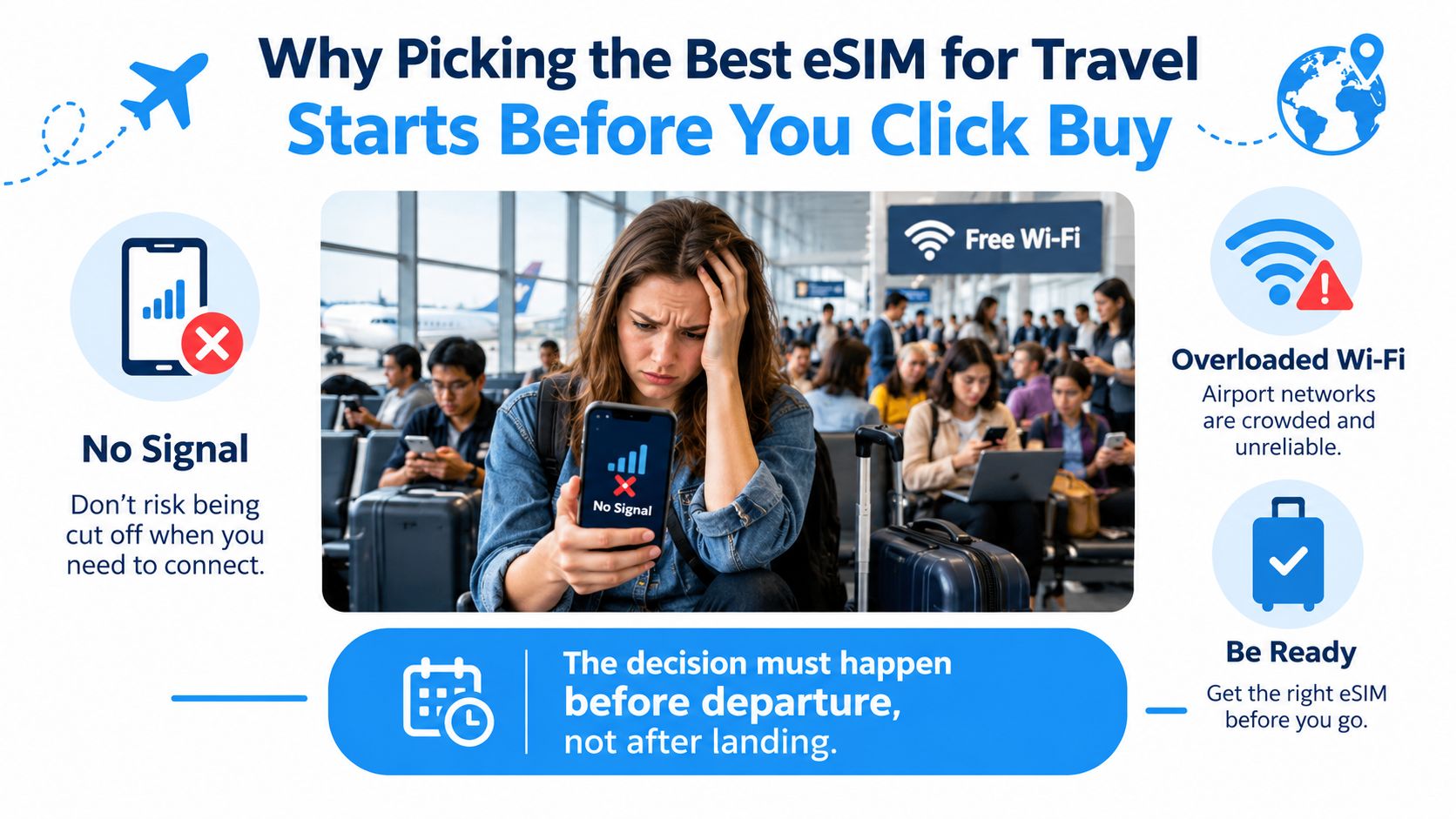
Consider a family arriving in Tokyo. They need maps, hotel details, and enough connectivity to coordinate if they split up. A remote worker landing in Lisbon has a different priority: a connection responsive enough for calls and laptop work, not just messaging.
These are hypothetical trips, but they expose the same purchasing mistake. A bargain plan isn't a bargain if the handset rejects it, the itinerary includes an excluded destination, or the provider sends internet traffic through a distant routing hub.
Make the decision before you're standing in this situation.
Start With the Trip, Not the Brand
Use this quick filter before comparing prices.
| Your immediate need | What to prioritize | What not to trust alone |
|---|---|---|
| Maps and arrival coordination | Destination networks and reliable setup | A long destination list |
| Laptop work and calls | Routing transparency and hotspot permission | A high-speed badge |
| Border crossings | Coverage for every stop under the same plan | A broad regional label |
| Keeping your home number | Compatible dual-SIM operation | A promise of easy installation |
Connectivity is widespread, but that doesn't mean every destination offers an equivalent experience. The ITU's global subscription figures recorded 95 mobile-broadband subscriptions per 100 inhabitants worldwide in 2024, while mobile-cellular subscriptions averaged 138 per 100 inhabitants in high-income economies versus 71 in low-income economies.
Those figures aren't coverage maps. They reinforce why you should investigate the networks serving your actual route rather than treating countries as interchangeable entries in a catalog.
Buying rule: Reject a plan that fails your phone, itinerary, or intended use before you compare its price.
My recommendation is straightforward: settle those requirements alongside your other pre-departure travel preparations. Then compare the total cost of suitable plans, including any top-ups or extensions you expect to need.
How Travel eSIMs Actually Work
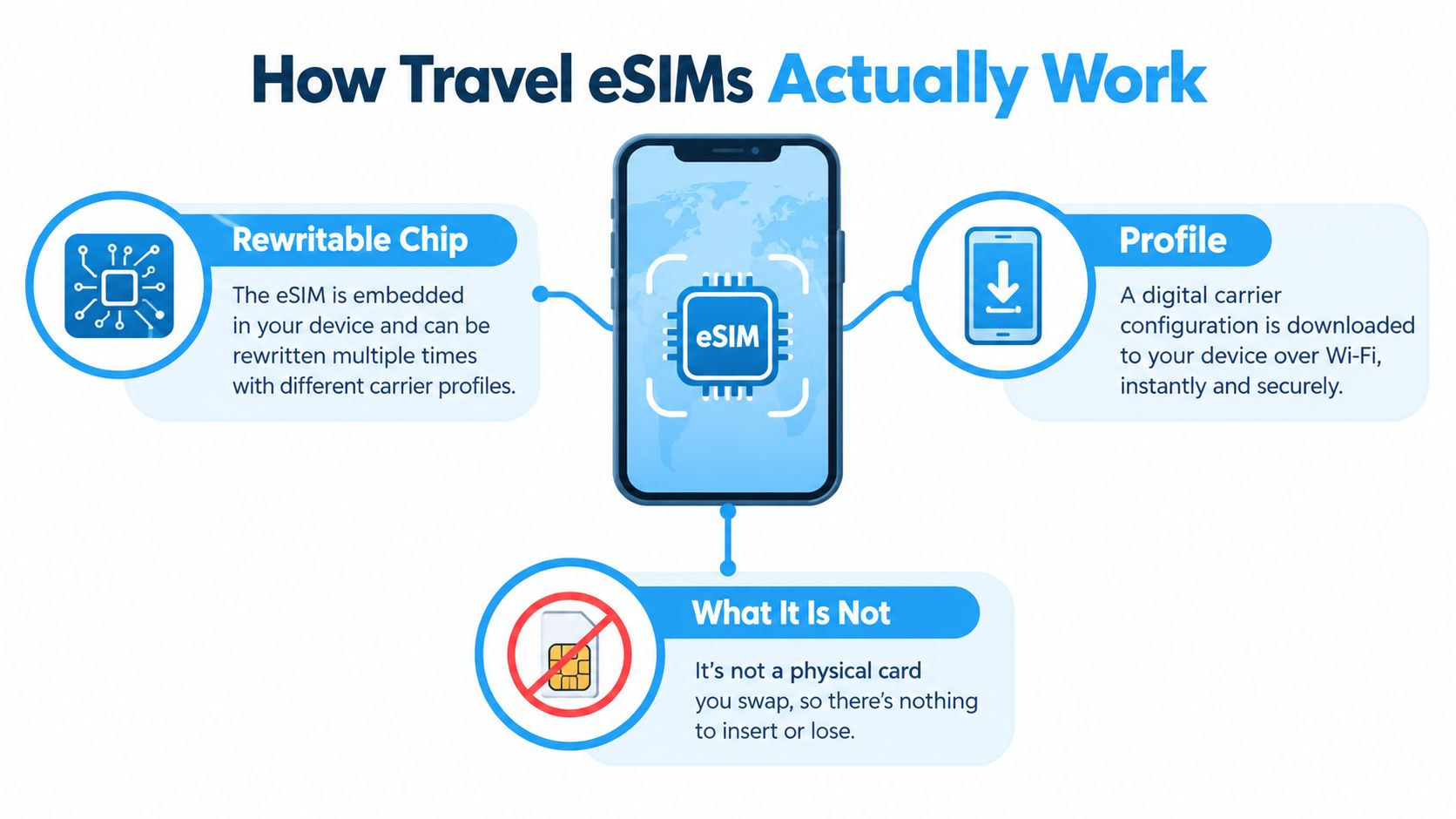
Think of an eSIM as built-in SIM hardware that accepts a downloadable carrier configuration. The profile is that configuration, not the data allowance itself. Buying another package and installing another profile aren't necessarily the same action, so check how your chosen service handles subsequent purchases.
The useful mental model is a digital access pass: your phone holds the pass, while the provider determines where you can use it.
The Local Network Isn't the Whole Service
A roaming partner is the mobile network your travel profile uses at the destination. Its coverage determines whether your phone can establish a useful radio connection where you're standing.
Behind that connection sits the provider's core network. Your traffic may travel elsewhere before reaching the public internet, so the local operator's name doesn't tell you everything about responsiveness.
Read the product description as a chain of requirements:
- Destination eligibility: Your exact country or territory must appear in the purchased package.
- Network access: Look for named partners and the access technology available under that plan.
- Usage conditions: Find the high-speed allowance, speed restrictions, sharing rules, and validity trigger.
- Service type: Confirm whether you're buying internet access only or also cellular calling and SMS.
Data Doesn't Replace Your Home Number
A data-only plan supplies an internet connection. It doesn't transfer your existing phone number to the travel provider or automatically receive messages addressed to that number.
For cellular calls and SMS, choose a plan that explicitly includes those services or retain your home line under suitable roaming terms. Internet messaging and calling apps are a separate option, not evidence that the eSIM includes cellular voice.
Travel is already a substantial eSIM use case: GSMA Intelligence's consumer research found that 51% of eSIM users had used the service abroad for leisure or personal travel during the previous 12 months.
For a visual explanation of the installation concept, watch the accompanying video.
The Four Decision Factors That Matter Most
Don't score providers by marketing polish. Compare coverage architecture, package structure, performance conditions, and activation flow using the same questions for every candidate.
The profiles below are hypothetical purchasing examples, not measured provider results. A global service can outperform a regional one, and a regional label doesn't prove direct carrier relationships.
Quick Comparison of Two Realistic Provider Profiles
| Decision factor | Global aggregator profile | Regional specialist profile |
|---|---|---|
| Coverage architecture | Broad roaming arrangement across destinations; ask which networks each package permits | Region-focused arrangement; ask whether carrier relationships and fallback networks are disclosed |
| Data-package structure | Global or regional bundle for varied itineraries | Country or regional package for a concentrated route |
| Speed and routing | Verify egress location, restrictions, and hotspot terms | Apply the same checks; specialization isn't proof of low latency |
| Activation flow | Check profile reuse and destination activation requirements | Check installation instructions and whether crossing borders needs another package |
Coverage architecture comes first. Ask which network the specific package uses, whether alternatives are available, and whether network selection is automatic or configurable. A household-name carrier on a product page is useful information, but it isn't a guarantee of indoor reception at your accommodation.
Package structure comes next. Choose country coverage for a fixed destination, regional coverage for a concentrated itinerary, and broader coverage when your route justifies it. Don't assume a regional bundle is cheaper or a country plan is faster without checking the actual offer.
Compare What Happens After Purchase
Performance conditions deserve their own review. The relevant questions are whether the plan restricts speed, applies a fair-use threshold, permits your intended tethering, and provides credible destination-specific routing information.
Activation is equally concrete. Does validity begin at purchase, installation, manual activation, or first destination-network connection? Can you prepare the profile ahead of time without consuming the travel window?
Prefer the provider that answers operational questions clearly over the provider that gives you another slogan.
If a seller can't distinguish installation from activation, don't experiment with a time-sensitive package. Get written confirmation before purchasing, especially when you're buying well ahead of departure.
Provider Categories and How to Read Their Trade-Offs
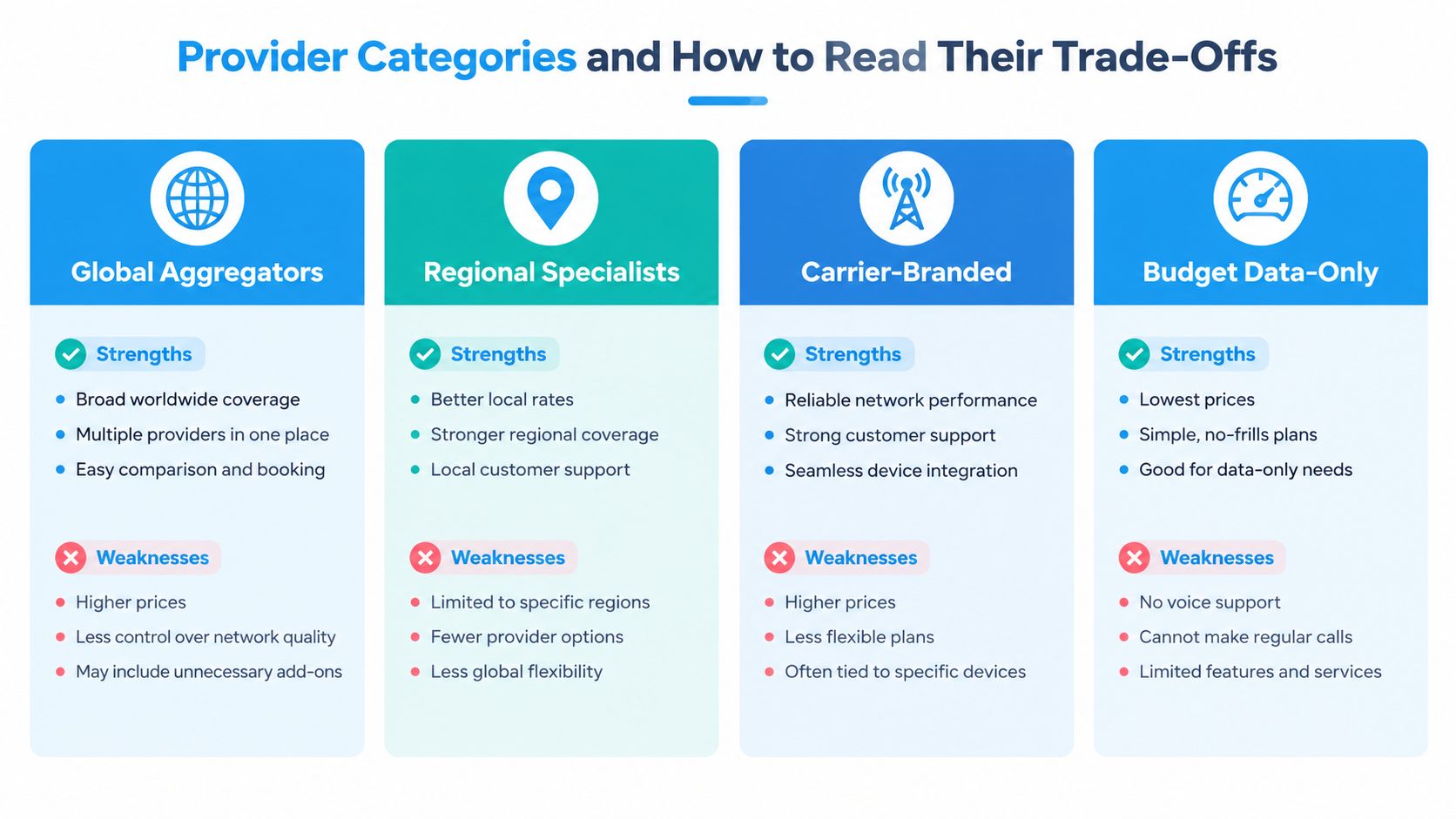
Provider categories help you shortlist, but they don't establish a performance ranking. Treat them as business-model clues, then inspect the package underneath.
A recognizable storefront may sell access supplied by another company. Conversely, a less familiar specialist may publish detailed network information that makes its offer easier to evaluate.
Use this category overview as a starting point, not a substitute for destination-specific terms.
Broad Reach Versus Destination Focus
Global aggregators suit travelers who want to manage a complicated route through a common storefront. Their appeal is administrative simplicity: fewer separate purchasing decisions and potentially a package spanning the itinerary.
My caution is about visibility. Find out who supplies connectivity, which destination networks are accessible, and who handles faults. Don't infer poor performance from the aggregator model, but don't infer quality from its destination count either.
A regional specialist is my preferred starting point for a trip concentrated within a region. A focused catalog can make relevant packages easier to compare, although the provider still needs to demonstrate that its coverage, pricing, and routing suit your stops.
For an extended stay in a fixed destination, investigate a local-operator plan or a resold domestic profile. The key question is whether you're purchasing a domestic service or merely a travel package carrying a familiar network name.
Convenience Isn't a Network Specification
An eSIM bundled through an airline, accommodation seller, or booking service can simplify checkout. However, the company selling your trip isn't necessarily the company responsible for restoring a failed connection.
Before choosing a bundle, establish the support chain:
- Connectivity provider: Identify who supplies and administers the mobile service.
- Fault handling: Confirm where installation and connection problems should be reported.
- Commercial terms: Check whether extensions, cancellations, and refunds follow separate rules from the main booking.
Budget data-only is better understood as a package style than a distinct network architecture. It can be entirely appropriate for maps and messages, but a low entry price says nothing about routing or support.
Choose the category that simplifies your trip. Choose the individual package only after its technical and commercial details pass inspection.
Device Compatibility and Pre-Departure Setup
Check the exact handset before spending anything. A product-family name isn't enough: eSIM availability can differ by model and sales market, while a carrier lock creates a separate obstacle.
The uncertainty is substantial. A YouGov survey published by BICS, covering 6,625 adults in the United States, United Kingdom, and China in 2025, found that 42% were unsure whether their phone supported eSIM.
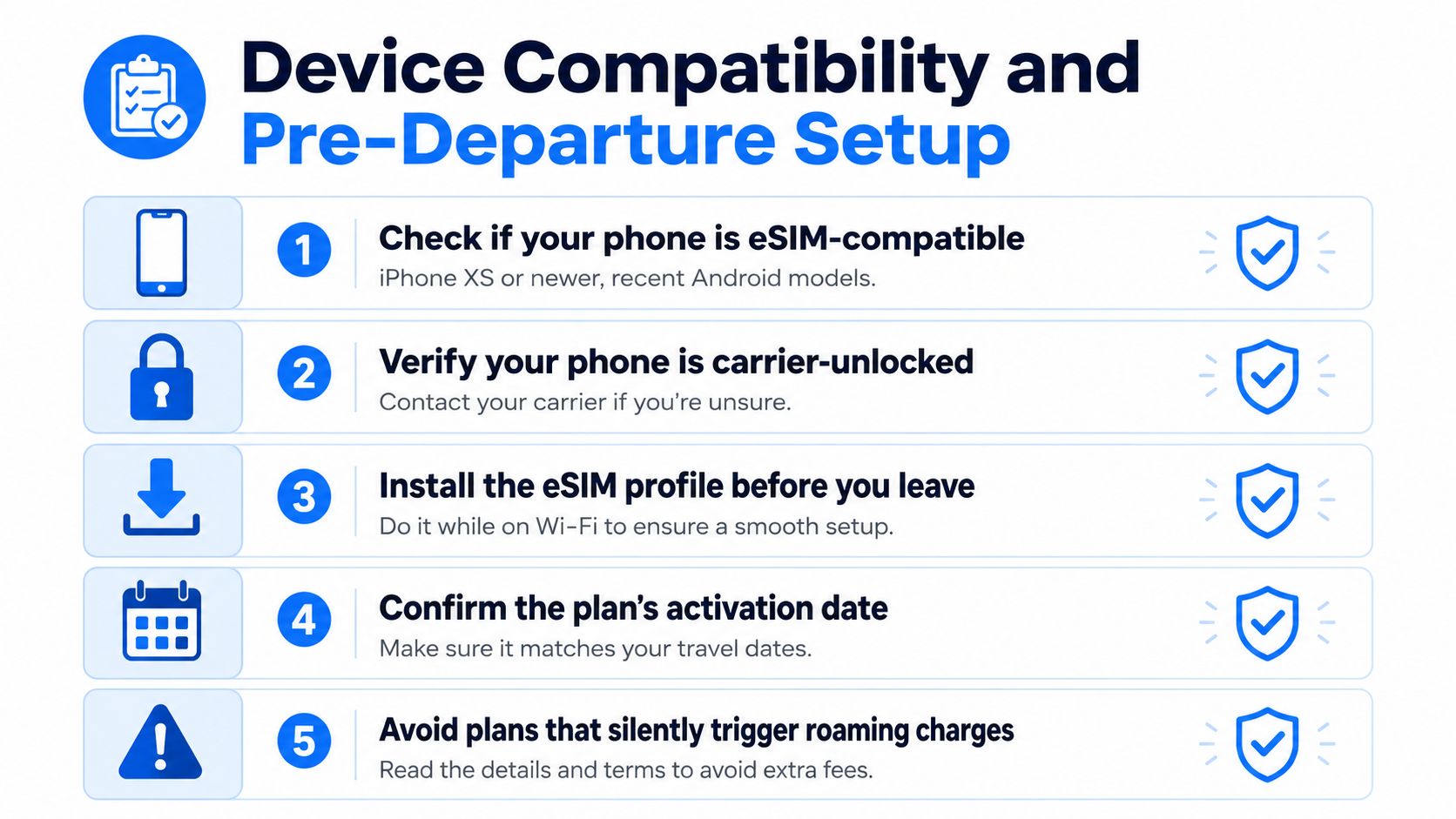
Use the checklist as a reminder, but verify your particular device rather than relying on broad model shortcuts.
Follow a Fixed Preparation Routine
- Confirm capability: Look for an Add eSIM option in the phone's mobile-network settings, then check the manufacturer's documentation for the exact model.
- Verify readiness: Ask your home carrier if the handset can accept another provider's profile. Having finished a payment contract isn't a substitute for confirmation.
- Check the regional variant: Match your model identifier and sales market to the provider's compatibility requirements. Check destination radio-band support separately; there are no special “eSIM bands.”
- Install under the right conditions: Use dependable Wi-Fi before departure, provided installation will not prematurely start validity. Save the provider's instructions and purchase details somewhere accessible offline.
- Configure both lines deliberately: Label them clearly, assign mobile data to the travel line, and disable automatic data switching where available.
Avoid the Home-Line Roaming Trap
If you retain your home SIM for authentication or calls, keep home-line data roaming off. Follow the travel provider's instructions separately, since its profile may require roaming enabled to use destination partners.
Keeping your home number active doesn't mean every call or message is free. Check your carrier's roaming charges, including any conditions affecting incoming calls and authentication access.
Before you pack: Know which line handles data, which handles calls, and what action starts the travel plan's validity.
Build this into your air-travel preparation routine. Don't promise yourself you'll sort it out after landing, when you need the connection to retrieve the instructions.
Matching Providers to Real Trip Types
Match the plan to what you'll really do, not the destinations you might visit someday. My recommendations below are starting points for comparison, not claims that a provider category always wins on speed or price.
A short city break and an extended work stay can share a destination while requiring very different packages. Likewise, a convenient regional bundle becomes unsuitable if it excludes a stop you assumed was included.
Which Provider Type Fits Which Trip
| Trip pattern | Best provider archetype | Feature to verify | Common mistake |
|---|---|---|---|
| Single-city weekend | Local-operator or country-plan seller | Coverage near accommodation and arrival points | Buying unnecessary global coverage |
| Multi-country European tour | Regional specialist | Every stop included in the same package | Assuming the regional label covers the itinerary |
| Multi-continent itinerary | Global aggregator | Package continuity across the entire route | Confusing storefront coverage with package coverage |
| Long remote-work stay | Regional specialist or local operator | Hotspot permission, routing, and renewal terms | Buying for phone use when the laptop is the priority |
| Cruise or transit-heavy trip | Flexible regional or daily-plan seller | Port coverage and how paid days start | Assuming land coverage includes service at sea |
Choose for the Most Demanding Part of the Trip
For a single-city weekend, start with a modest country package. If your intended use is directions, restaurant searches, and messages, don't pay for a work-oriented allowance just because it looks reassuring.
For a European tour, favor a regional bundle that explicitly includes the route. Verify territories and stopovers individually, especially if your itinerary mixes destinations that sellers group differently.
A multi-continent itinerary is where broader coverage becomes genuinely useful. Compare its total trip cost against separate packages, then decide whether simpler management justifies any premium.
For remote work, investigate the mobile service around the accommodation and your working requirements. Favor documented hotspot permission and suitable routing, and arrange an independent backup rather than making a phone connection your only way to attend an important meeting.
Arrival and Port Days Need Special Attention
Cruise travelers should treat each port as a destination check. Don't assume a terrestrial travel package supplies onboard or offshore connectivity; buy any maritime service only when it's explicitly described.
For stopovers, confirm whether a daily plan charges on connection, usage, or another trigger. A flexible label isn't enough to establish that you can pause unused days.
Coordinate arrival connectivity with your airport transfer arrangements. Save the pickup location and driver instructions offline so a connection delay doesn't become a transport problem.
Beyond the Cheapest Plan What Separates a Good eSIM From a Great One
A strong signal and a generous allowance don't guarantee a responsive connection. For travelers working online, the overlooked question is where the provider sends traffic before it reaches the internet.
Ookla's travel eSIM performance analysis, covering more than 50 brands and approximately 190 destinations, found median latency for brand–destination combinations ranging from 1.5× to 30× local-user latency; on Japan's au network, otherwise comparable connections measured 54 ms with local egress versus 543 ms when routed through Madrid.
That's why I wouldn't choose a remote-work plan on its 5G badge alone. Radio access and end-to-end responsiveness are different things.
Buy Usable Performance, Not an Unlimited Label
Ask whether the provider offers in-country or regional traffic breakout for your destination. If it doesn't disclose routing, look for relevant destination-specific performance evidence rather than a generic speed promise.
An undisclosed route isn't proof of bad service. It is a reason not to pay a performance premium without supporting evidence.
The same discipline applies to unlimited data:
- High-speed terms: Find the threshold or fair-use conditions and what happens afterward.
- Reduced-speed usability: Judge the restriction against your actual applications, not whether the provider technically keeps you connected.
- Hotspot rules: Confirm whether sharing has a separate allowance or other restrictions.
- Renewal mechanics: Establish whether an extension adds data, extends validity, or requires a replacement profile.
Don't buy unlimited to avoid reading the conditions. Buy it only when those conditions fit the way you expect to use the connection.
Support and Recovery Are Part of the Price
A good provider also explains what happens when installation or service fails. Look for a published refund policy, clearly identified support channels, and useful troubleshooting instructions.
Ask a specific pre-purchase question, such as whether your exact package supports laptop tethering. The clarity of the answer is more useful than a support badge, though a quick sales response doesn't guarantee equally quick fault resolution abroad.
A cheaper plan isn't cheaper if you have to abandon it and buy another connection mid-trip.
My preference is a transparent fixed allowance over an ambiguous unlimited promise. I'll pay more for a plan whose restrictions, recovery options, and destination service are clear, but I won't pay more merely because its branding suggests reliability.
Quick Checklist and Answers to Questions Most Guides Skip
Your shortlist should contain only plans that pass the practical checks. Once they do, price becomes a sensible tie-breaker rather than a distraction.
Keep this checklist with your travel documents. It should record decisions you've already made, not become another task at the departure gate.
Your Purchase and Departure Checklist
- Handset cleared: Exact model, sales market, carrier-status, and dual-SIM capability checked.
- Route covered: Every destination and relevant stopover verified against the purchased package.
- Use matched: Allowance, validity, performance conditions, and sharing terms suit the trip.
- Setup understood: Installation completed when appropriate, with the activation trigger recorded.
- Home line controlled: Data assignment and roaming settings deliberately configured.
- Recovery prepared: Support details, purchase reference, and renewal instructions saved offline.
- Arrival backed up: Accommodation address, maps, and transfer instructions available without mobile data.
Questions That Deserve Plain Answers
Can the travel eSIM receive banking SMS sent to my home number?
A data-only travel profile doesn't receive SMS addressed to your home number. Keep the home line active if you need those messages, check its overseas service conditions, and prepare an alternative authentication method where your bank permits one.
Can I tether a laptop or share with a companion?
Only rely on tethering when the specific package permits it. Check both sharing restrictions and the overall data conditions; permission to enable a hotspot isn't a promise of unrestricted laptop use.
Can I refill the plan instead of installing another profile?
Check the package's renewal path before departure. A top-up might add allowance without extending validity, while another product may require a new purchase or profile, so ask exactly what continues working.
Will unused data be refunded?
Don't assume so unless the published policy says it will. Distinguish unused allowance, a canceled purchase, failed installation, and unavailable destination service, because the provider may treat those situations differently.
My final recommendation: Choose the least expensive plan that meets your verified requirements, with clear terms and a workable recovery path. Skip the universal winner lists; your phone and itinerary determine the right answer.
Easy Travel Bookings brings hotel and flight comparisons together with airport transfer and eSIM options, helping you organize the trip and its practical extras. Visit Easy Travel Bookings to compare your travel choices, then use this checklist to select connectivity that fits your handset, route, and arrival plans.