
Hopper's 2026 Holiday Travel Index put the average domestic round-trip airfare for Thanksgiving at $402, up $95, or 31%, from the prior year. That figure reflects relatively low available fares, not the average of every ticket sold.
That distinction matters. You aren't budgeting for an abstract average. You're choosing specific travel days for real people, often with bags, children, work schedules, and little room for a missed connection. The cheapest ticket on screen can carry the highest risk of a ruined return.
A better decision weighs three things together. What does the fare cost. How crowded and disruption-prone is the travel day. What will the completed trip cost once baggage, seats, transfers, and schedule risk are counted. Those answers often point to different itineraries, and that's the point.
Table of Contents
- Why Thanksgiving Airfare Spikes Every Year
- What Thanksgiving Airfare Typically Costs by Travel Day
- How Booking Windows Change Your Fare
- Strategies for Finding Cheaper Thanksgiving Tickets
- Balancing Fare Against Travel-Day Disruption Risk
- The True Cost of a Thanksgiving Ticket Beyond the Fare
- Your Next Step Before Booking Thanksgiving Flights
Why Thanksgiving Airfare Spikes Every Year
A family of four wants to fly home on the Sunday after Thanksgiving. Grandparents need the morning for goodbyes. The parents need Monday back at work. The children need Monday back at school. One afternoon looks perfect.
Millions of families make the same calculation. That's the problem.
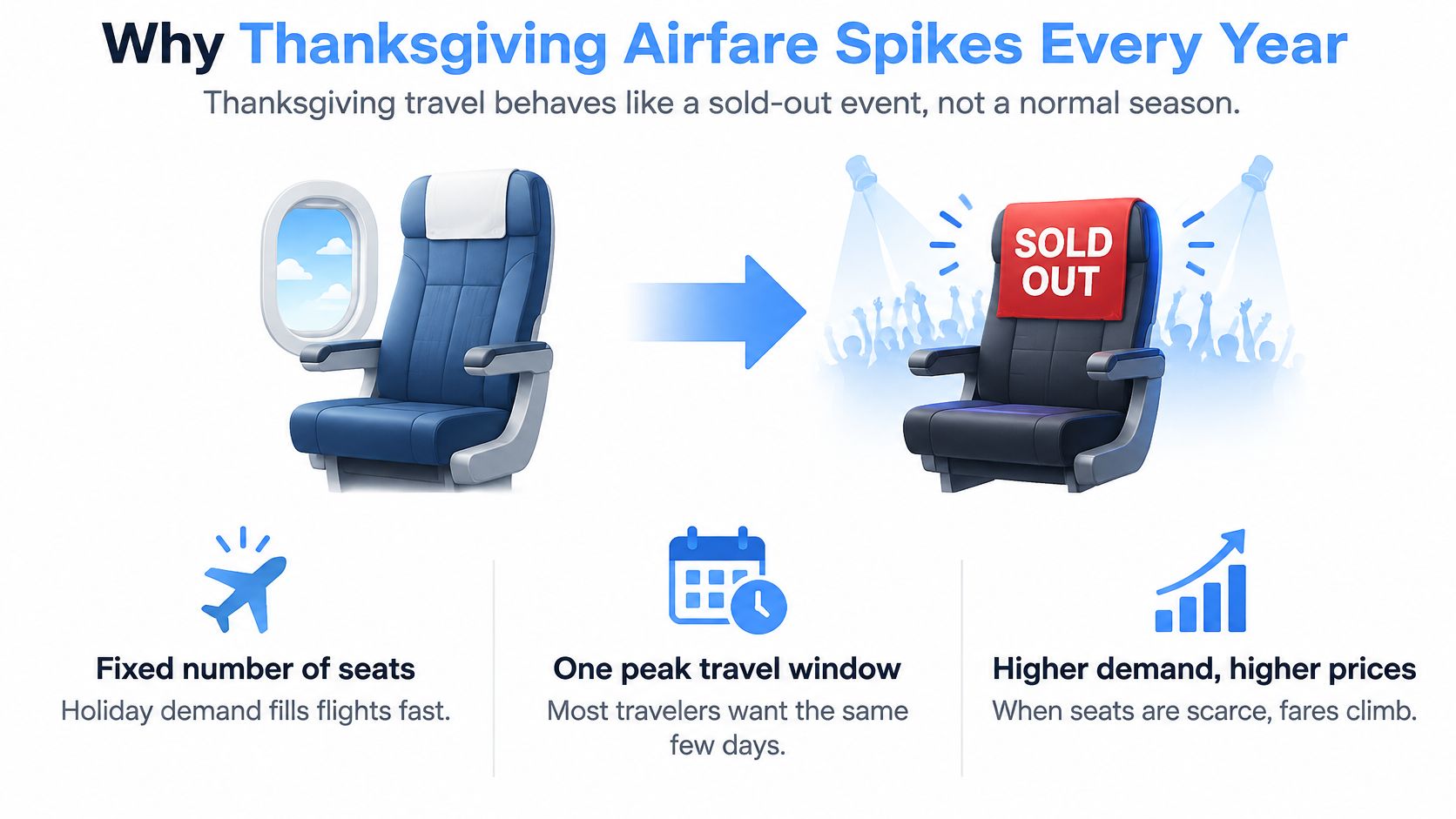
Think of Thanksgiving seats like one sold-out concert night, not a show that runs all year. Airlines have a fixed number of seats on each flight. They can't add a second seating because demand looks strong. When many more travelers want the same few departures, airlines raise prices to allocate scarce seats.
The Crowd Is Concentrated, Not Spread Out
On November 19, 2024, the Transportation Security Administration projected it would screen 18.3 million people from Tuesday, November 26, through Monday, December 2, a forecast described in the TSA Thanksgiving travel release. That projection represented about 6% more travelers than the comparable 2023 period and 17% more than 2022, based on the same release.
The pressure wasn't evenly distributed. TSA identified the Tuesday and Wednesday before Thanksgiving and the Sunday after as the busiest days. Its forecasts topped 2.8 million screenings on Tuesday, 2.9 million on Wednesday, and more than 3 million on Sunday, according to that same TSA projection.
- Outbound peak: Travelers crowd into Tuesday and Wednesday because they want to arrive before Thursday without using too much leave.
- Return peak: Sunday compresses the homeward trip into one day because work and school resume Monday.
- Capacity limit: Airlines can adjust fares quickly, but they can't create unlimited seats, gates, crews, or runway slots.
The Recovery Made the Peak Harder to Avoid
The pandemic dip shows the change clearly. TSA screened just 9.1 million people during the 2020 Thanksgiving period, then more than 20.2 million over ten days in 2021, only 11.5% below the 22.8 million screened in the comparable 2019 period, based on the historical figures in that TSA release.
Demand came back. The calendar stayed narrow.
Simple model: Thanksgiving fares spike because a fixed seat supply meets synchronized demand on a few dates.
That model gives you the first decision rule. Don't judge a Thanksgiving fare against a normal autumn fare on the same route. Judge it against other Thanksgiving dates first. The calendar is doing much of the pricing work before airline, airport, or booking day enters the conversation.
What Thanksgiving Airfare Typically Costs by Travel Day
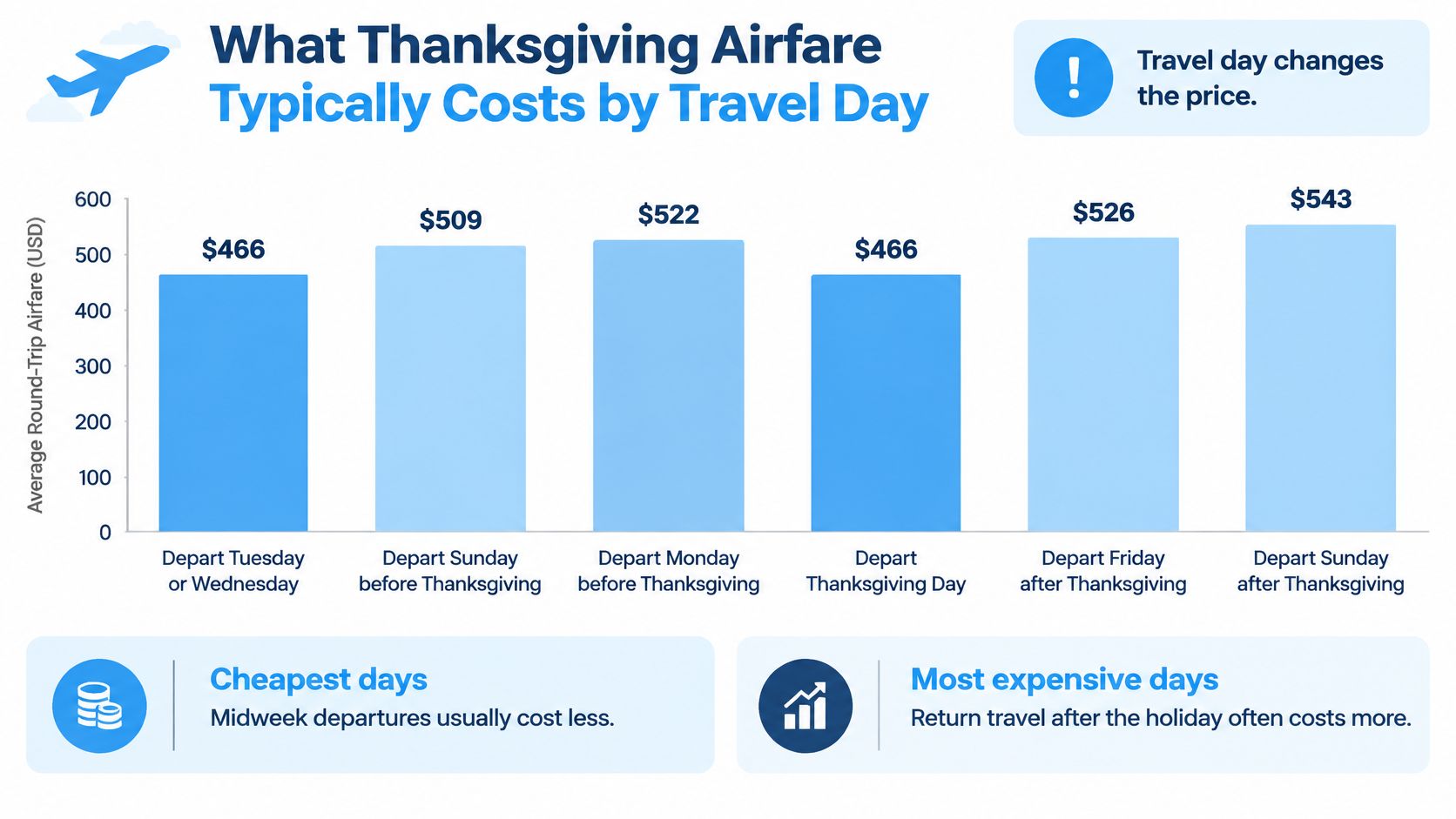
The headline number is useful only if you understand what it measures. Hopper's 2026 Holiday Travel Index put the average domestic round-trip fare at $402, up $95, or 31%, from the previous year, in the reported Hopper Thanksgiving fare index. The estimate used a demand-weighted average of the lowest 10% of fares available during the search period, according to the same report.
Read $402 as a low-fare benchmark. It isn't the price every passenger paid. If your route, times, or baggage needs push you away from the lowest available inventory, your realistic fare can sit higher.
The Return Date Drives the Widest Gap
Departing Monday, November 23 averaged about $370 round trip, while traveling on Thanksgiving Day averaged approximately $371, based on the day-level figures in the same Hopper report. Those two options ask for a tradeoff. Monday means leaving earlier. Thanksgiving Day means less time at your destination before the meal, or a very carefully timed arrival.
Returning Sunday, November 29 was projected to average $604 round trip, one of the most expensive travel-day averages of the year in that Hopper report. Returning Monday or Tuesday could reduce the average fare to roughly $350, according to the same figures.
- Monday departure: About $370 in the cited Hopper data, useful if you can start the trip early.
- Thanksgiving Day travel: About $371 in the same data, potentially attractive if a late arrival still works.
- Sunday return: About $604 in the same data, reflecting the strongest synchronized return demand.
- Monday or Tuesday return: Roughly $350 in the same data, showing how sharply the average can fall after Sunday.
How to Use These Numbers
Don't treat these averages as quotes for your route. Use them as a decision range. If Sunday is your first choice, price Monday and Tuesday before you book anything. If Wednesday looks expensive, price Monday and Thanksgiving Day. A one or two day shift can matter more than switching between similar flight times on the peak day.
The family example makes the stakes concrete. A round-trip difference for one traveler becomes a much larger household difference when you buy several seats. Check whether an extra night, one more vacation day, or a later Thanksgiving arrival costs less than the fare gap. Sometimes it will. Sometimes work and school remove the choice. Either way, you should know the price of staying on the peak date before you pay it.
How Booking Windows Change Your Fare
When should you buy. The honest answer is less tidy than most fare advice suggests.
AAA's multi-year booking analysis found that the lowest average didn't appear in the earliest window. It appeared closer to departure. But an average can hide the risk you face when the specific flight you need sells out.
Average Domestic Thanksgiving Fare by Booking Window
| Booking window (days before departure) | Average domestic fare |
|---|---|
| 28 to 60 days | $543 |
| 21 to 27 days | $501 |
| 7 to 14 days | $474 |
| 0 to 6 days | $525 |
The table reflects AAA's analysis of domestic Thanksgiving booking windows, which reported approximately $543 at 28 to 60 days, $501 at 21 to 27 days, $474 at 7 to 14 days, and $525 within 0 to 6 days. Those are averages across bookings, not a promise that your route will follow the same path.
Why Waiting Can Look Cheaper and Still Hurt
Airline revenue management explains the pattern. Airlines open and close fare classes as demand develops. If bookings look weak, lower-priced inventory may remain available later. If seats fill quickly, that inventory can disappear and prices can rebound.
AAA also warned that discounted inventory can be scarce close to departure. Remaining flights may sell out. The seats left may involve less convenient schedules and longer connections, according to the warning in that AAA analysis.
That's the counterintuitive tradeoff. Waiting may expose you to a lower average. It also narrows your choice of departure times, nonstop flights, nearby airports, and seats together. For a solo traveler with flexible plans, that gamble can be reasonable. For a family that must arrive before dinner and sit together, it's a different bet.
Don't ask only whether fares might fall. Ask whether the itinerary you'd still accept will exist.
A Practical Buying Rule
Start monitoring early. Pick a target fare based on the travel days you can use. If a suitable itinerary reaches that target, book it instead of waiting for a perfect bottom you can't identify in advance.
Avoid leaving the purchase to the final week unless your schedule is highly flexible. Prices can rise quickly once low-fare seats vanish, and rebooking options shrink across the whole market. If weekday purchase theories distract you from that bigger window, this guide to the best day of the week to book flights can help separate purchase-day habits from the more important choice of travel date.
Your aim isn't to win a forecasting contest. It's to secure an acceptable itinerary before availability affects the price.
Strategies for Finding Cheaper Thanksgiving Tickets
Start with the size of the obstacle. An academic analysis of nearly 15 million U.S. airfares estimated travel premiums of 5.0% to 81.3% on and around major national holidays, including Thanksgiving, in the academic analysis of holiday airfare premiums. The premium was structurally larger on longer-distance routes, journeys where driving is impractical, flights involving slot-controlled airports, leisure-oriented markets, and ultra-low-cost carriers, based on that analysis.
That range tells you something useful. There isn't one Thanksgiving markup. Your exposure depends on route, airport, competition, and dates. Your search should widen every one of those variables you can control.
Start by comparing flexible dates and nearby airports side by side, as in this planning image.

Search in This Order
- Move the return first: Test Monday and Tuesday returns before hunting for small savings on Sunday.
- Move the departure second: Compare Monday, Tuesday, Wednesday, and Thanksgiving Day instead of locking in the obvious outbound date.
- Add nearby airports: Price alternates at both ends, including ground transport time and cost.
- Test departure times: Early, late, and connecting options may draw from different remaining inventory.
- Compare complete combinations: A cheap outbound paired with a peak Sunday return may cost more than a balanced itinerary on quieter days.
Why Each Tactic Works
Each step moves you away from the highest-demand departure and return banks. It also increases the number of seat inventories competing for your purchase. That doesn't guarantee a lower fare. Savings depend on remaining inventory and route competition, a limitation consistent with the academic premium analysis cited above.
Nearby airports deserve special attention on slot-controlled or heavily leisure-driven routes. The main airport may be the most convenient, but it may also concentrate the demand. Compare the drive. A lower fare isn't a bargain if it adds expensive parking, a long transfer, or a risky late-night arrival.
This short video walks through the search mindset before you commit to one airport or date.
Set price alerts for more than one itinerary. Track your first-choice dates, a Monday or Tuesday return, and at least one nearby-airport option. You'll see which variable creates the saving. You can also use lessons from other peak weekends, including these flight deals for Labor Day weekend, because the same flexible-date logic applies when leisure demand clusters around a holiday.
Don't use a normal-season fare as your benchmark. Build your target from Thanksgiving options that your group can take.
Balancing Fare Against Travel-Day Disruption Risk
A low fare answers only one question. Will this itinerary probably complete the trip as planned. That's another question, and Thanksgiving makes the gap unusually wide.
Recent U.S. data puts the contrast bluntly. Thanksgiving Day had an average disruption rate of about 7% to 8% across 2024 to 2025, while the Sunday after Thanksgiving reached 49% in 2025, according to the analysis of airport delay and disruption data. Sunday, November 30, 2025 also became the busiest day in TSA history, with approximately 3.13 million passengers screened, based on the passenger figure in that same analysis.
Two Itineraries, Two Different Risks
Consider a simple choice. The first itinerary returns Sunday with a short connection. It costs less and gets everyone home before Monday. The second returns Monday on a nonstop or with a longer connection buffer. It may cost more, or require another night away.
Price sorting puts the first option on top. Risk sorting can reverse the order.
- Sunday return: Highest crowding pressure and, in the cited 2025 data, much higher disruption exposure.
- Monday or Tuesday return: More schedule disruption to work or school, but less exposure to the peak return crush.
- Thanksgiving Day flight: Lower disruption in the cited data, but it may cut into the holiday itself.
- Short connection: Saves elapsed time when flights run normally, but leaves little room when the first flight arrives late.
Why a Missed Connection Costs More at Thanksgiving
A delay on a quiet Tuesday may lead to a seat on the next flight. A delay during the peak return can leave fewer open seats across the network. Rebooking a whole family together is harder than rebooking one traveler. Weather exposure, airport crowding, missed connections, and full later flights combine into total trip risk.
That's why shifting the return by one or two days can be more valuable than saving a small amount on the ticket. The money comparison is visible before purchase. The disruption cost appears only after something goes wrong, when hotel rooms, ground transport, meals, and missed work enter the bill.
A fare isn't cheap if it depends on every flight, queue, and connection working on the year's most crowded return day.
Compare Price and Risk Together
Build a shortlist with three columns. Fare. Route quality. Travel-day risk. Under route quality, note nonstop versus connecting, connection length, arrival time, and whether another flight exists later that day. Under risk, flag Sunday returns and tight connections through busy hubs.
Then decide what you're buying. Sometimes Sunday is unavoidable. In that case, reduce other risks. Choose an earlier departure, a nonstop if available, or a longer connection. Avoid the final flight of the day if being stranded overnight would be especially costly.
The best Thanksgiving itinerary isn't always the cheapest one. It's the one with an acceptable price and enough margin to get your group home.
The True Cost of a Thanksgiving Ticket Beyond the Fare
The displayed fare is an incomplete price. It can exclude the costs that decide whether a family trip works.
The scale of the holiday explains why resilience has value. TSA screened more than 3.13 million people on the peak Sunday in 2025, while the FAA forecast more than 360,000 flights across the nine-day period, according to Reuters reporting on the record Thanksgiving screening total. High volume makes spare seats, easy rebooking, and calm connections harder to assume.
Build a True-Cost Total
Use this framework for every serious option.
- Base fare: The ticket price for every traveler, not just the lead passenger.
- Checked baggage: Bags for gifts, winter clothing, food items you can legally carry, and child equipment.
- Seat selection: Adjacent seats when children or older relatives shouldn't be separated.
- Airport access: Parking, rides, rental cars, fuel, tolls, and transfers at both ends.
- Change flexibility: The cost or restrictions involved if work, illness, or family plans shift.
- Disruption exposure: Possible overnight accommodation, meals, extra ground transport, and lost holiday time.
A basic, unbundled ticket can still win after this calculation. It just has to win on the full total, not the first number displayed.
Where Families Get Caught
Families rarely buy one independent seat. They coordinate several travelers who need to arrive together. They may need checked bags because carry-on space disappears quickly. They may need seats together because a child can't sit alone. They may also need a car seat, stroller, or extra time between flights.
Those needs change the value of options. A nonstop flight can remove a connection risk for everyone at once. A longer buffer can protect the whole group. A flexible ticket can matter more when one illness affects every ticket. Paying more upfront can be rational if it reduces several downstream costs.
Payment timing is separate from trip value, but it can affect how you manage a larger family total. If spreading the upfront payment helps you choose the itinerary you need, review how book now, pay later flights work and compare the total obligation before using that option.
Cheapest ticket and lowest-cost completed journey are different products. Buy the second one.
Before you book, write down the full cost for your top two itineraries. Include every traveler and every bag. Then ask which option still works if the first flight leaves late. The answer is often clearer than the fare ranking suggests.
Your Next Step Before Booking Thanksgiving Flights
Turn the analysis into a sequence. Don't start with a single date and hope the market cooperates.
Your Booking Sequence
- Mark your flexible days: Decide which departure and return dates your group can use.
- Flag the risky return: Treat Sunday as the expensive, crowded option until prices and schedules prove otherwise.
- Set a target fare: Base it on acceptable Thanksgiving itineraries, not on a normal-season price.
- Search nearby airports: Compare full door-to-door time and transfer costs.
- Shortlist by resilience: Note nonstop options, connection buffers, departure times, and later backup flights.
- Calculate true cost: Add baggage, seats, transfers, flexibility, and likely disruption costs for every traveler.
- Book before choice collapses: If an itinerary meets your target and fits your risk limits, secure it.
Make One Decision at a Time
First choose the travel-day range. Then choose airports. Then compare flight quality. Price comes into each step, but it shouldn't erase the other two. This order prevents a common mistake. You won't spend hours comparing similar Sunday connections if a Monday return solves both cost and risk.
Set alerts for several combinations. Watch your preferred dates and at least one lower-risk alternative. If prices move, you'll know whether the change affects the whole market or only one itinerary.
Also decide your walk-away conditions before searching. You might reject the last flight of the day, a very short connection, separated family seating, or an airport transfer that makes arrival impractical. Clear limits make the final choice faster.
The best airfare for Thanksgiving isn't just the lowest number attached to a seat. It's the fare that gets your whole group there, keeps the return manageable, and still looks reasonable after the full trip is counted.
Start your flexible-date search with Easy Travel Bookings, where you can compare flights from multiple airlines and travel providers in one place. Check peak and shifted Thanksgiving dates side by side, review the complete itinerary before you commit, and book the option that fits both your budget and your tolerance for disruption.