

It's Friday at 4 p.m. in Phoenix, and you need to be in Los Angeles by Saturday morning. The headline fare looks cheap until bags, parking, and a one-way rental show up. The drive looks simple until you price fuel for four people and a Friday-night crawl out of the Valley. Arizona to California trips fail when you rank options by mileage or airfare alone. Rank them by total door-to-door time and cost, and the winner often flips.
Table of Contents
- Arizona to California Travel Options Compared
- Driving Routes and Stops Between the Two States
- Flights, Airports and Backup Options When Routes Change
- Bus and Train Options Without a Car
- Total Cost of Driving Versus Flying
- Three Itineraries With Stops Worth Making
- Book Your Crossing and Check Conditions Before You Leave
Arizona to California Travel Options Compared
You have a Phoenix address, a Saturday-morning meeting in Los Angeles, and five realistic ways to get there. Most of those crossings still run on Interstate 10, so the decision is how you travel, not whether a road exists. The corridor stays busy because California is Arizona's largest named out-of-state visitor group: the Arizona Office of Tourism recorded about 8.5 million visitors from California in 2023, against 2.6 million from Texas in the same origin-state data.
Treat the figures below as typical ranges, not quotes. Fares, fuel, and one-way fees move by season, day, and how early you book. If you fly, the best day of the week to book flights matters more than the city pair.
| Mode | Door-to-door time | Typical cost | Best fit |
|---|---|---|---|
| Drive your own car | 5.5 to 6 hours | Fuel about $45 to $60 one way | Families, groups, flexible stops |
| Rent a car one way | About 6 hours | $60 to $100 per day plus one-way fees | Visitors without a car |
| Nonstop flight (PHX to LAX) | About 1 hour 15 minutes in the air, 3.5 to 5 hours door to door | $90 to $250 one way plus bag fees | Solo travelers with carry-on only |
| Greyhound or FlixBus | 6 to 8 hours | $30 to $70 | Budget solo trips |
| Amtrak train plus connecting bus | Often longer than the drive, set by the published day | Date-specific rail fare, usually above the bus | Scenic, relaxed travel |
A solo traveler with a carry-on should fly. A family with bags should drive. A visitor who lands without a car should price the one-way drop fee before celebrating a low daily rate. The rule this guide defends is simple. Compare the full door-to-door total, not the number in the ad.
Practical rule: If the "cheap" option needs a second paid leg at each end, it isn't the cheap option.
Driving Routes and Stops Between the Two States
For Phoenix to Los Angeles, take Interstate 10. It runs west through San Bernardino and Palm Springs, then crosses into Arizona and continues through Phoenix. I-10 spans about 391.99 miles in Arizona, according to Interstate 10 in Arizona. The California stretch includes the western part of this drive, but you do not need to cover the full route between the two states.
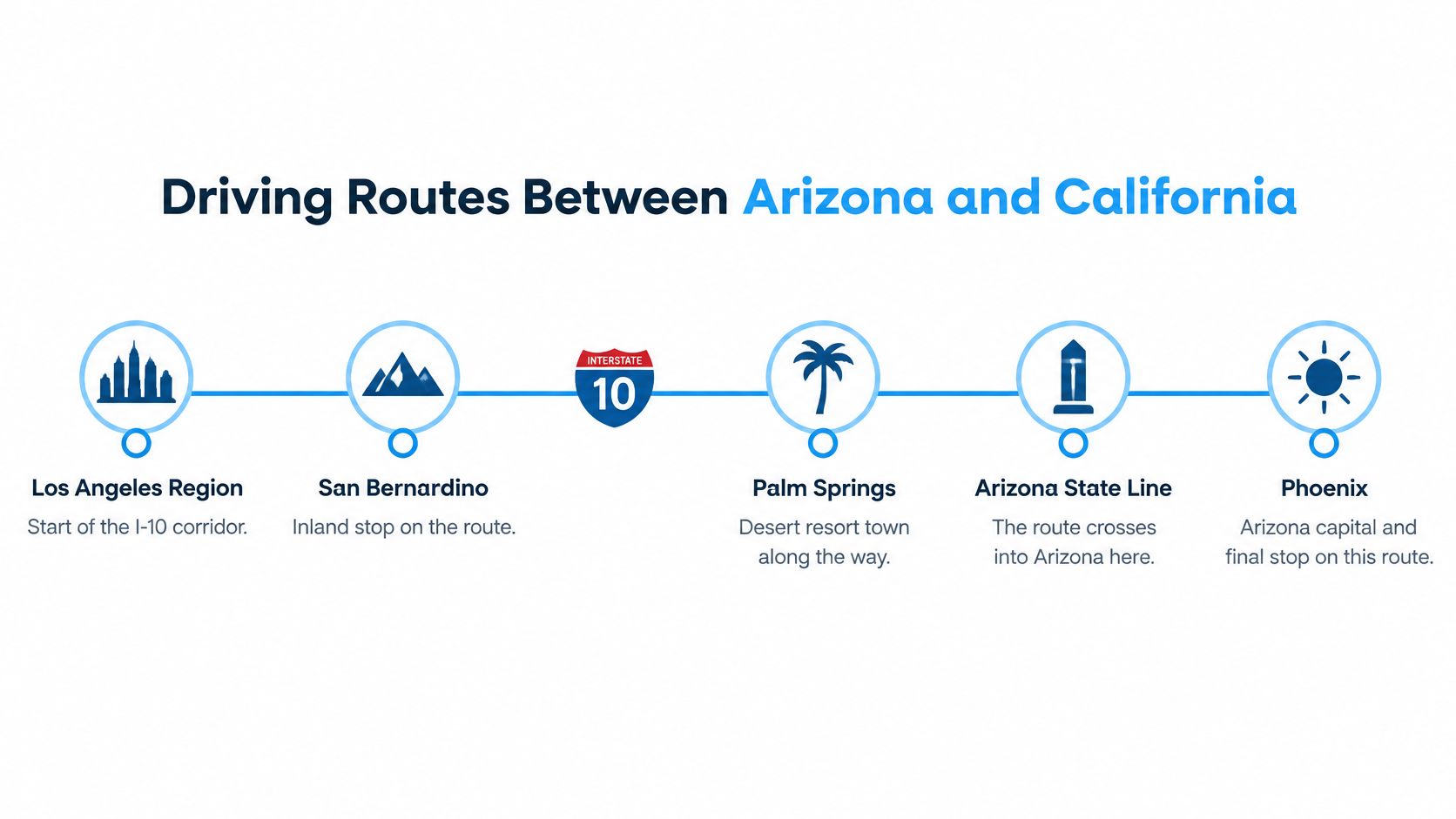
| Route | Key stops | Typical drive time |
|---|---|---|
| I-10 Phoenix to Los Angeles | Quartzsite, Blythe, Indio, Palm Springs, San Bernardino | 5.5 to 6 hours |
| I-10 Phoenix to Palm Springs | Quartzsite, Blythe, Indio | 3.5 to 4 hours |
| I-10 Tucson to Los Angeles | Phoenix, Quartzsite, Blythe, Palm Springs | 7 to 7.5 hours |
| I-8 Yuma to San Diego | El Centro, Imperial Valley, Pine Valley | 2.5 to 3 hours |
The desert gap
Services thin out between Blythe and Indio. Fill up in Blythe or Quartzsite before continuing west. Driving an electric vehicle? Check that a charger on the route is working the night before. Do not wait until you reach an exit to find out.
Plan around city traffic, not just the highway miles. Phoenix and Los Angeles traffic can bookend an I-10 drive, and a Friday departure at 3 p.m. can add an hour. Set your departure time with that delay in mind.
Choose the route for your actual destination:
Los Angeles, Palm Springs, or the Coachella Valley: stay on I-10.
San Diego or the Imperial Valley: take I-8 from the Yuma side. These routes serve different destinations, so choose by where you need to arrive, not by treating them as alternatives to the same trip.
Flights, Airports and Backup Options When Routes Change
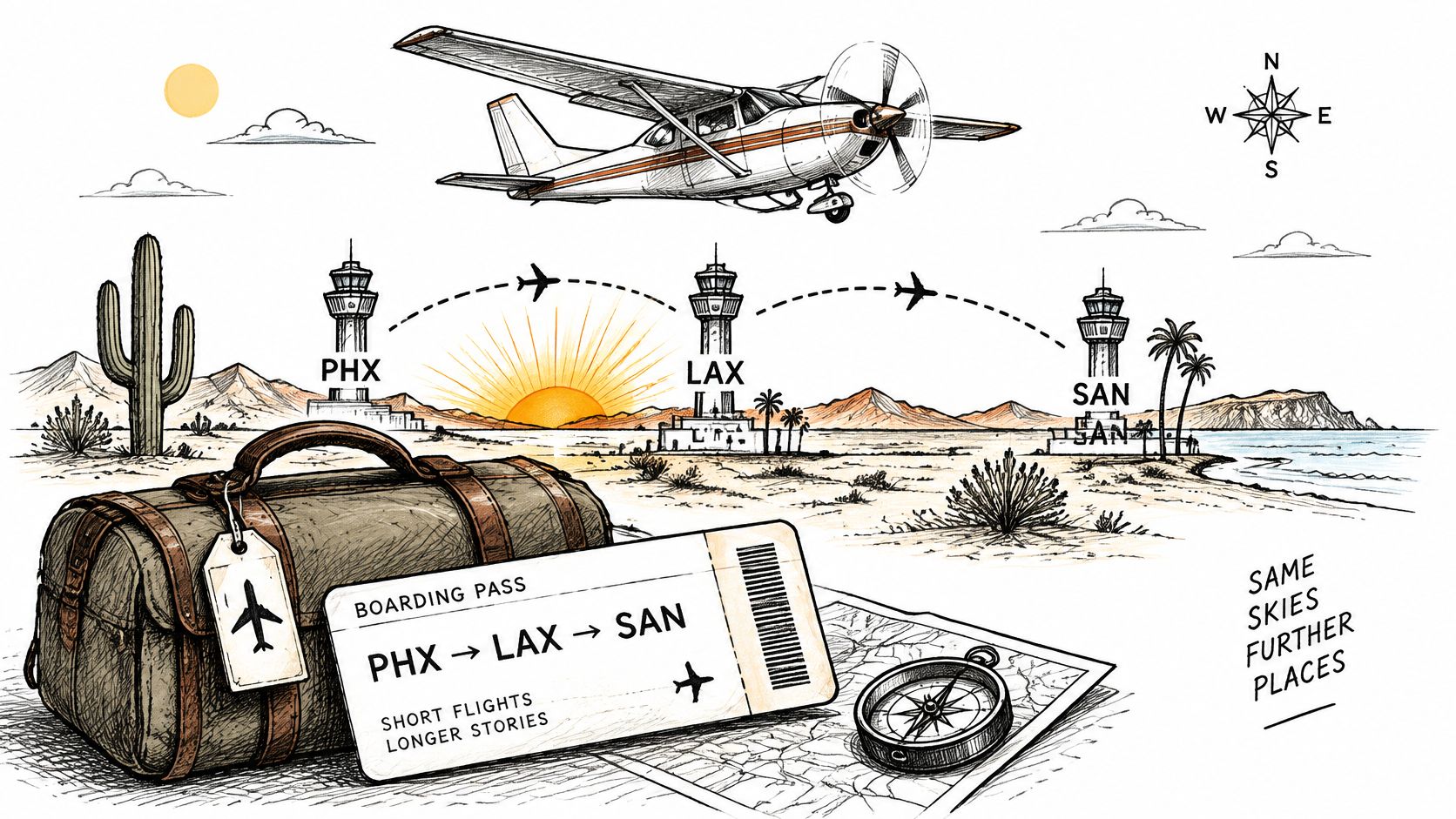
A short hop is still a long afternoon once you count the ride to the terminal, security, and the ride out the other side. Block time is the honest number. These are typical nonstop patterns, not a promise for your Tuesday.
| Airport pair | Typical nonstop flight time | Schedule note |
|---|---|---|
| Phoenix (PHX) to Los Angeles (LAX) | About 1 hour 15 minutes | Many daily departures |
| Phoenix (PHX) to San Diego (SAN) | About 1 hour 20 minutes | Several daily departures |
| Phoenix (PHX) to Ontario (ONT) | About 1 hour 10 minutes | Seasonal, confirm the month |
| Tucson (TUS) to Los Angeles (LAX) | About 1 hour 20 minutes | Fewer flights, check each date |
| Phoenix (PHX) to Palm Springs (PSP) | About 1 hour 10 minutes | Seasonal, confirm before booking |
When the nonstop disappears
Schedules move by season and by market. Snowbirds, Canadian travelers, and anyone using a smaller airport feel it first. Travel and Tour World reported that Canadian transborder traffic at Vancouver International Airport fell 5.4% in August 2025 and 10.6% by November, as carriers shifted capacity toward the Caribbean and Mexico, with knock-on cuts that touched California and Arizona service. Overall demand can rise while your exact city pair loses its nonstop. Confirm the flight on your dates, not last winter's memory.
Road travel still wins the holiday crowd even when planes are an option. AAA projected that 85% of Independence Day travelers would drive, while only 8% would fly. That split is a preference, not a verdict for your party size.
Use a backup airport when the nonstop is gone or priced like a long-haul.
- Tucson, Palm Springs, Ontario, San Diego, Burbank, and Los Angeles: check all six before you accept a connection.
- A farther airport plus a rental: compare that total against a one-stop ticket, including the airport transfer service if you won't drive yourself out of the terminal.
- Winter and holiday weeks: recheck frequency a week before departure. A seasonal route can drop to a handful of days without a press release in your inbox.
Fly nonstop when the door-to-door block stays under five hours and you aren't paying for a car on both ends. Otherwise the desert interstate is the more honest plan.
Bus and Train Options Without a Car
A train on this corridor is a slow ferry. You give up speed for a seat you can stand up in and a long look at the desert. That trade is worth it for some trips and a waste for a Saturday deadline.
Greyhound and FlixBus are the budget default between Phoenix and Los Angeles or San Diego.
- Time and fare: plan on 6 to 8 hours and a typical fare of $30 to $70, the lowest cash outlay of the five modes.
- The hidden legs: stations sit downtown or on the edge of town. Budget a rideshare or a transit ride at each end, or the "cheap" ticket grows.
- Best fit: one person, one bag, no need for a car after arrival.
Amtrak is the relaxed option, not the fast one.
- Where it stops: the Sunset Limited runs between Los Angeles and New Orleans several times a week and serves Arizona at Tucson and Maricopa, near Phoenix. Most Phoenix travelers pair the train with a connecting bus.
- Time: Los Angeles to Tucson by rail often takes longer than driving the same cities. Don't book it to beat a car.
- Best fit: you want to read, work, or sleep, and you don't want to pay for a vehicle.
Before you pay, verify five things.
- Station location at both ends, including how you'll leave it after dark.
- Connecting bus times, so a late train doesn't strand you in Maricopa.
- Baggage allowance, which is tighter than a car trunk.
- Reservation rules, including whether your fare is changeable.
- Seat versus luggage, so a suitcase isn't your footrest for eight hours.
Choose rail over the bus when the schedule matches your day and comfort matters more than the last twenty dollars. Choose the bus when the only goal is a low fare and you can handle the station transfers.
Total Cost of Driving Versus Flying
The cheaper Arizona to California option flips with party size, luggage, and how you value your hours. Headline airfare hides the fees that decide it.
This worked example is one adult, Phoenix to Los Angeles, one way. Every dollar figure is a typical range, not a quote for your date.
| Cost item | Drive | Fly |
|---|---|---|
| Fuel | About $45 to $60 (about 370 miles at 28 mpg and about $4 a gallon) | $0 |
| Airfare | $0 | $90 to $250 per person |
| Rental car at destination | $0 with your own car | Add a daily rate if you need wheels in L.A. |
| Checked bag | $0 | $35 to $40 each way |
| Airport parking | $0 | $15 to $60 per day if you leave a car at PHX |
| Rideshare to and from airport | $0 | About $25 to $45 each way |
| Time door to door | 5.5 to 6 hours | 3.5 to 5 hours |
A second adult with a checked bag doesn't double the fuel. That person does add another ticket, another bag fee, and often another rideshare share that doesn't shrink as fast as you'd hope. Parking is a daily charge whether one person flies or four do. That's why a family of four with bags usually drives, and a solo traveler with a carry-on usually flies.
Run the break-even on your dates
- Add every line for your party. Count people, bags, parking days, and a rental if nobody has a car waiting. One-way drop charges belong in this total. Compare categories on a car rental price comparison before you assume the drive is "free."
- Price your hours. If the flight saves you two hours and those hours are worth more than the fare gap, fly. If you're on vacation and the hours aren't billable, don't pretend they are.
- Recheck the morning you book. A $110 fare with two bags and two airport rides can land above the fuel cost for a couple. A $180 fare with carry-on only can beat the car for one person who lands at LAX and takes transit.
A $99 fare is not a $99 trip. Add the bag, the parking day, and both rides before you call it a win.
Skip the rental at the destination only if your California plans stay on transit. The moment you need a car in Los Angeles for three days, put that rental on the flying side and run the totals again.
Three Itineraries With Stops Worth Making
The direct run is the fastest way across the state line. The desert and southern routes spend the same border crossing on places worth stopping. Pick the trip by what you want to see, not by which line looks shorter on a map.
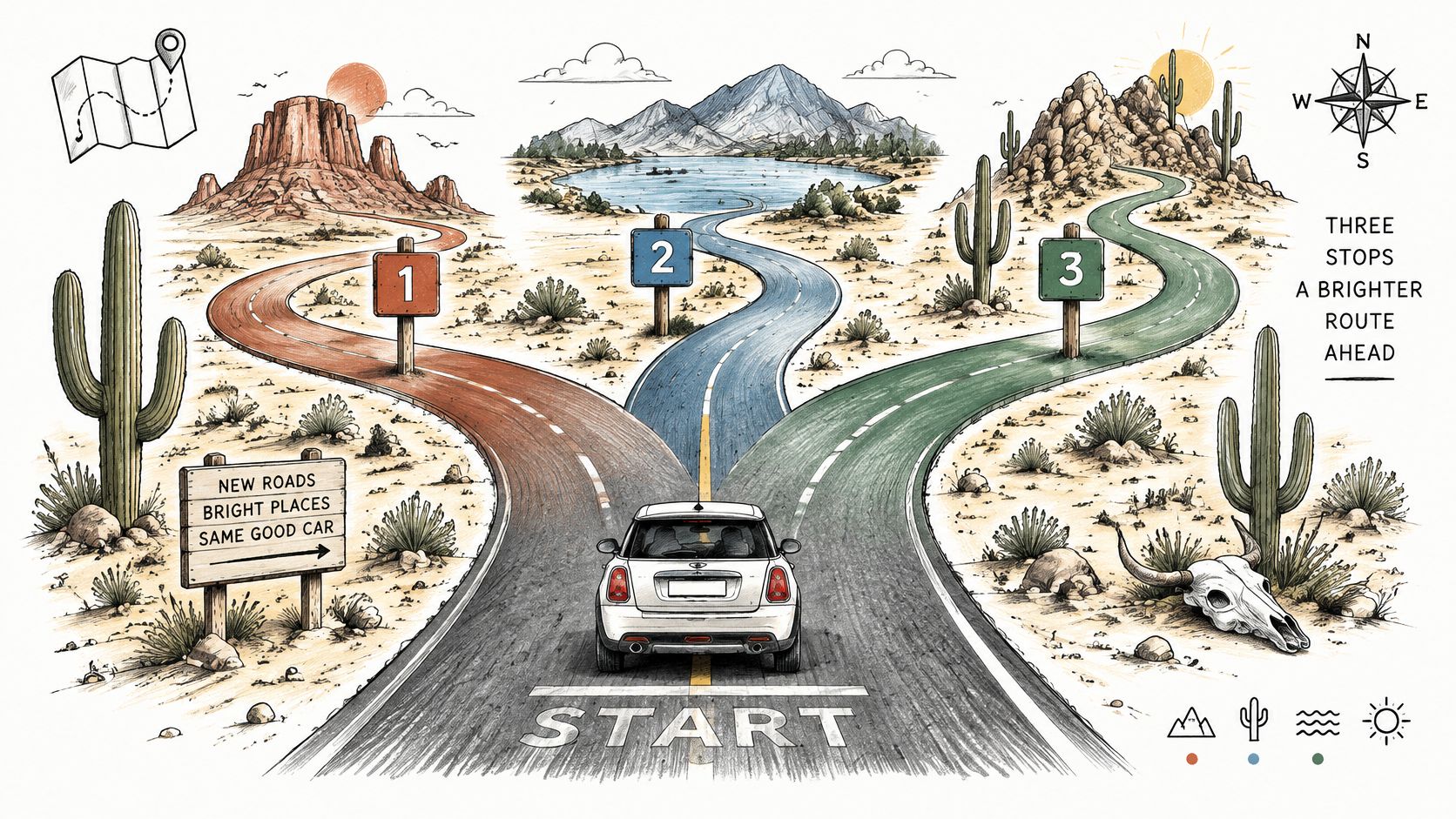
- Direct run. Phoenix to Los Angeles in one day, 5.5 to 6 hours of driving. Break at Quartzsite. Fuel at Blythe. Don't sightsee. This is the Saturday-morning option.
- Desert loop. Phoenix to Palm Springs in one day, about 4 hours, then Joshua Tree National Park and Los Angeles the next day, about 2 hours of driving. You trade one long day for a park morning.
- Southern run. Tucson to San Diego over two days via Yuma and I-8, 6.5 to 7.5 hours of driving in total. Stops worth the miles: Organ Pipe Cactus National Monument, Yuma, the Imperial Sand Dunes, and Anza-Borrego Desert State Park.
One timing tip per route
- Direct run: leave Phoenix before the evening rush. A 6 a.m. start puts you in Los Angeles before the worst inbound traffic.
- Desert loop: leave Phoenix before 7 a.m. so you reach Palm Springs before the afternoon heat, then do Joshua Tree early the next morning.
- Southern run: don't cross Yuma at the peak of a holiday afternoon. The Arizona Department of Transportation reports about 51,000 vehicles a day on I-8 in the Yuma area, falling to about 14,000 near Casa Grande. Congestion and incidents cluster near Yuma and the big interchanges, not on the empty middle.
Volume isn't the whole risk. Crashes, construction, weather, and event traffic don't show up in a daily average. Check live conditions the morning you roll.
If you want a sense of the desert miles before you commit to the southern run, this drive shows the kind of open highway you're signing up for.
Do the direct run when the clock matters. Do the desert loop when Joshua Tree is the point of the trip. Do the southern run when San Diego or the Imperial Valley is the destination, not a detour on the way to Los Angeles.
Book Your Crossing and Check Conditions Before You Leave
Choose your mode by the full door-to-door cost and time, then book it.
- Solo, carry-on only: fly nonstop from PHX to LAX or SAN if the flight, airport access, and ground transport beat the driving total.
- Family or group with bags: drive your own car. Count fuel and parking before comparing it with airfare.
- No car at the destination, and you won't rent: take the bus or train with its connecting bus, and book that second leg before leaving home.
- Imperial Valley or Yuma: drive I-8. Flying into Los Angeles and backtracking adds time and ground costs.
I-10 is a freight road, not a scenic parkway. The Federal Highway Administration identifies Interstate 10 as a 2,460-mile southern-tier route from Santa Monica to Jacksonville, passing near Los Angeles and Phoenix. Heavy truck traffic on I-10 slows merges and can stretch the effect of an incident. Leave outside Friday and Sunday peaks, and before the Phoenix and Los Angeles rush, to protect your arrival time.
Heavy trucks don't care about your ETA. Leave early or accept the delay.
On travel morning, check the details that can change the door-to-door winner:
- Flights: confirm the nonstop still operates in your season.
- Roads: check live traffic before pulling out of the driveway.
- Fuel: top off in Blythe or Quartzsite on the desert run.
- Ground transport: reserve the rental or airport ride with a fixed drop-off time, rather than relying on a rideshare in a holiday queue.
Price the whole trip, not the headline fare. Compare flights, car rentals, and airport transfers on your actual dates, then add bags, parking, and fuel for your party size. Keep the option with the lower total cost and workable arrival time. Fares and schedules shift by season, so book the option that wins for your dates, not the one that looked cheapest earlier.
Easy Travel Bookings compares hotels, flights, car rentals, and airport transfers from trusted providers in one search. Use it to compare a nonstop flight, a one-way rental, and the transfer on your actual dates, including the costs that headline fares leave out. Visit Easy Travel Bookings and compare the full trip before locking in the weekend.