

An airport transfer is a pre-booked ride between the airport and your destination at a fixed, confirmed price with a designated driver. The tricky part is that people use the term loosely, so this guide clears up whether taxis, ride-hailing, and shared shuttles count, and which booking situation each one suits.
You know the scene. You've just landed, you're tired, your phone battery is low, and the airport exit is crowded with drivers holding signs, shuttle desks, taxi queues, and app pickups in different directions. In that moment, a pre-booked airport transfer feels less like a travel extra and more like a seat already reserved at the table.
A useful way to think about it is as the travel version of a restaurant reservation. You're not walking in, hoping for a spot, and arguing over the menu when you arrive. You already know who's meeting you, what kind of vehicle you're getting, and roughly what the ride will cost.
That matters because the category is broader than many travelers expect. It can mean a private sedan, a shared shuttle, a limousine, a minibus, or an executive car, depending on how the provider defines the service. It can also overlap with taxis and ride-hailing in casual conversation, which is exactly where the confusion starts.
Table of Contents
- Landing in a New City With Luggage and No Plan
- What Makes a Ride an Airport Transfer
- The Main Types of Airport Transfers Compared
- Pricing Expectations and Honest Pros and Cons
- When to Book and Choosing the Right Option
- Key Takeaways for Your Next Airport Transfer
Landing in a New City With Luggage and No Plan
A long flight ends the same way in most cities. You step off the plane, follow the signs, collect your bag, and then face a small wall of decisions while you're still half in another time zone. That's usually when travelers start asking what is an airport transfer, because the answer suddenly matters.
In plain terms, it's a pre-booked ground transport service that connects the airport to a hotel, city center, office, or other destination at a confirmed price. Recent market research puts the global pre-book airport transfer market at USD 11.67 billion in 2026, rising from USD 10.11 billion in 2025 and forecast to reach USD 20.62 billion by 2030, a 15.3% CAGR. The broader airport ground transportation market is estimated at USD 52.3 billion in 2026 and projected to reach USD 94.7 billion by 2034. Airport transfer market trends and projections
That scale explains why the category keeps showing up in trip planning. It's no longer just a backup option for people avoiding a taxi queue. It's a standard part of how many travelers solve the last mile between a terminal and a bed.
Practical rule: if the ride is booked ahead, priced in advance, and tied to your flight or arrival time, you're probably looking at an airport transfer.
The term still gets used loosely, though, and that creates booking friction. Some sites use it for almost any point-to-point airport ride. Others mean only a fixed-price service with a driver assigned in advance, which is why travelers compare options and still end up unsure.
If you're sorting a trip on the fly, a quick guide like last-minute travel made easy can help, but the bigger win is knowing the category before you start searching. Once the label makes sense, the choices get much easier.
What Makes a Ride an Airport Transfer
A ride becomes an airport transfer through its booking arrangement. The pickup time, meeting point, and fare are set before you travel, so you are not negotiating at the curb or waiting to see which driver accepts the trip.
The pieces that make it a transfer
A typical airport transfer has pre-arranged booking, fixed all-in pricing, and a designated driver linked to your arrival details. The service may also promise terminal pickup, a particular vehicle class, and clear baggage arrangements. What is airport transfer, according to Navan
A taxi or ride-hailing trip can fit the broader meaning of airport transfer when it takes you between an airport and another destination. The booking experience differs, though. You usually request that ride after landing, and the fare may change with traffic, distance, or demand. A pre-booked transfer settles those details earlier.
Shared shuttles create another point of confusion. A shuttle with reserved airport pickup and a known fare fits the category, even when other passengers share the vehicle. The deciding factor is the planned service, not whether you have the vehicle to yourself.
Arrival transfers often include a free-wait period. That gives you room for passport control, baggage claim, or an ordinary flight delay before extra charges apply. Departure transfers are scheduled around your flight and check-in buffer, helping you reach the terminal with time to spare. Flight-aware scheduling belongs to the service itself.
Some providers use the term narrowly for a fixed-price, pre-arranged ride. Others apply it to private sedans, shared vans, executive SUVs, and wider point-to-point airport transport. Both usages appear in booking pages, which explains why two services carrying the same label can feel very different.
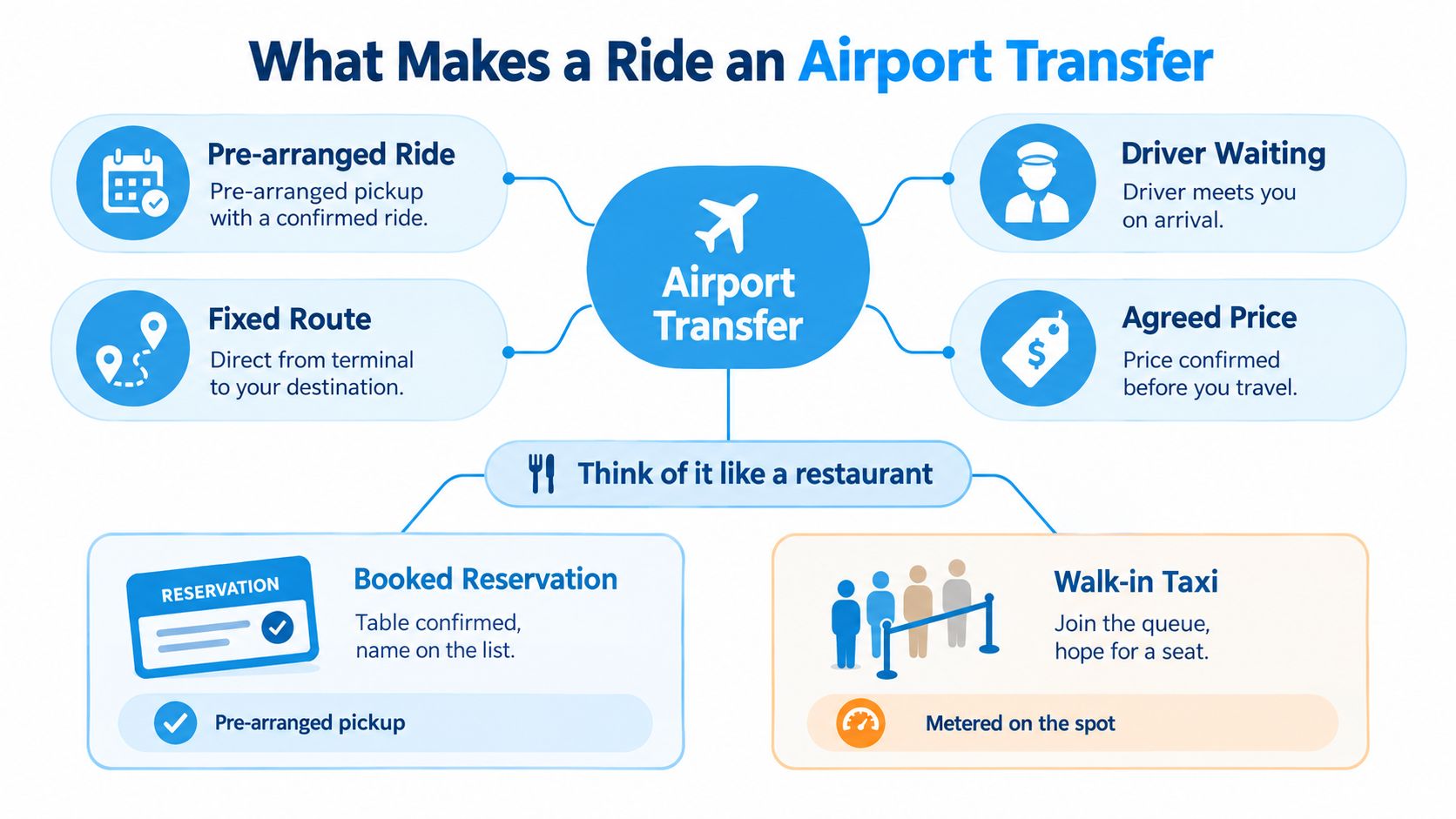
A useful working definition is an airport transfer is a pre-booked airport ride with a confirmed pickup plan and a price agreed before travel.
Why the term gets messy
Airport transfers sit within ground transportation, a broad category that includes private cars, SUVs, executive vehicles, shared shuttles, minibuses, and coaches. A practical ground transportation guide for travelers
One company may send a private driver with a name sign. Another may reserve a shuttle seat with several stops. A third may offer a minibus for a family or group. The label stays the same, while the waiting time, privacy, routing, and luggage setup change.
Book the details rather than the label. Check the pickup point, vehicle class, baggage allowance, waiting policy, and whether the fare includes all expected charges. Those answers show whether the service matches the kind of airport ride you need.
The Main Types of Airport Transfers Compared
The easiest way to sort the category is by who you're traveling with and how much flexibility you want. A solo traveler with one bag doesn't need the same setup as a family with car seats or a business traveler arriving late at night. That's why the same umbrella term covers a few very different products.
Shared, private, taxi, and group options
A shared shuttle is the budget-friendly version. You ride with other passengers, trade speed for savings, and may make a few stops along the way. It fits travelers who care more about cost than getting directly to the door in the shortest possible time.
A private transfer is the cleaner, more predictable option. The vehicle is reserved for you or your group, so you get direct routing, a known vehicle class, and less waiting. That's the version many people picture when they hear airport transfer, and it's the closest match to the restaurant reservation analogy.
An airport taxi or app-based ride is the flexible option. You can usually get moving fast, but the fare may depend on distance, traffic, and demand, which makes the final cost less certain. It suits spontaneous travelers who value immediacy more than price certainty.
A coach or minibus works best for larger parties. Families, tour groups, and corporate teams often use it because the per-person experience can be more organized than splitting into several smaller cars.
| Transfer Type | Fare Structure | Privacy | Best For |
|---|---|---|---|
| Shared shuttle | Usually set per person in advance | Low | Solo travelers, budget trips |
| Private transfer | Usually fixed per vehicle or trip | High | Families, business travel, late arrivals |
| Airport taxi | Often metered or variable | Medium | Spontaneous trips, short notice |
| Coach or minibus | Usually arranged per group | Medium to high | Groups, events, family travel |
If you're trying to compare options for a trip, a broader search like car rentals and travel comparison can help you judge whether point-to-point transport, self-drive, or another choice fits best.
Simple test: if you need privacy, baggage space, and a guaranteed pickup, lean private. If you just need the cheapest seat from A to B, shared usually makes more sense.
That's also why the word “transfer” causes confusion in the first place. It doesn't describe one vehicle type. It describes a booking style, then the service type gets layered on top of it.
Pricing Expectations and Honest Pros and Cons
Airport transfer pricing makes more sense once you separate it from taxi pricing. A transfer is normally fixed in advance, often priced per vehicle or per person, while a taxi meters by distance and time. That difference is the whole point for travelers who want to know the bill before the trip starts.
What moves the price
The biggest price drivers are the ones you'd expect. Distance matters, vehicle class matters, and one-way versus round trip can change the quote. Night pickups and destination city also affect what you see, especially where airport demand is heavier or service is more specialized.
That's why two airport transfers can feel completely different even if they both say “private car.” A compact sedan for one traveler, a larger SUV for a family with luggage, and a premium car for a business pickup are not interchangeable products. The service level is different, so the price usually is too.
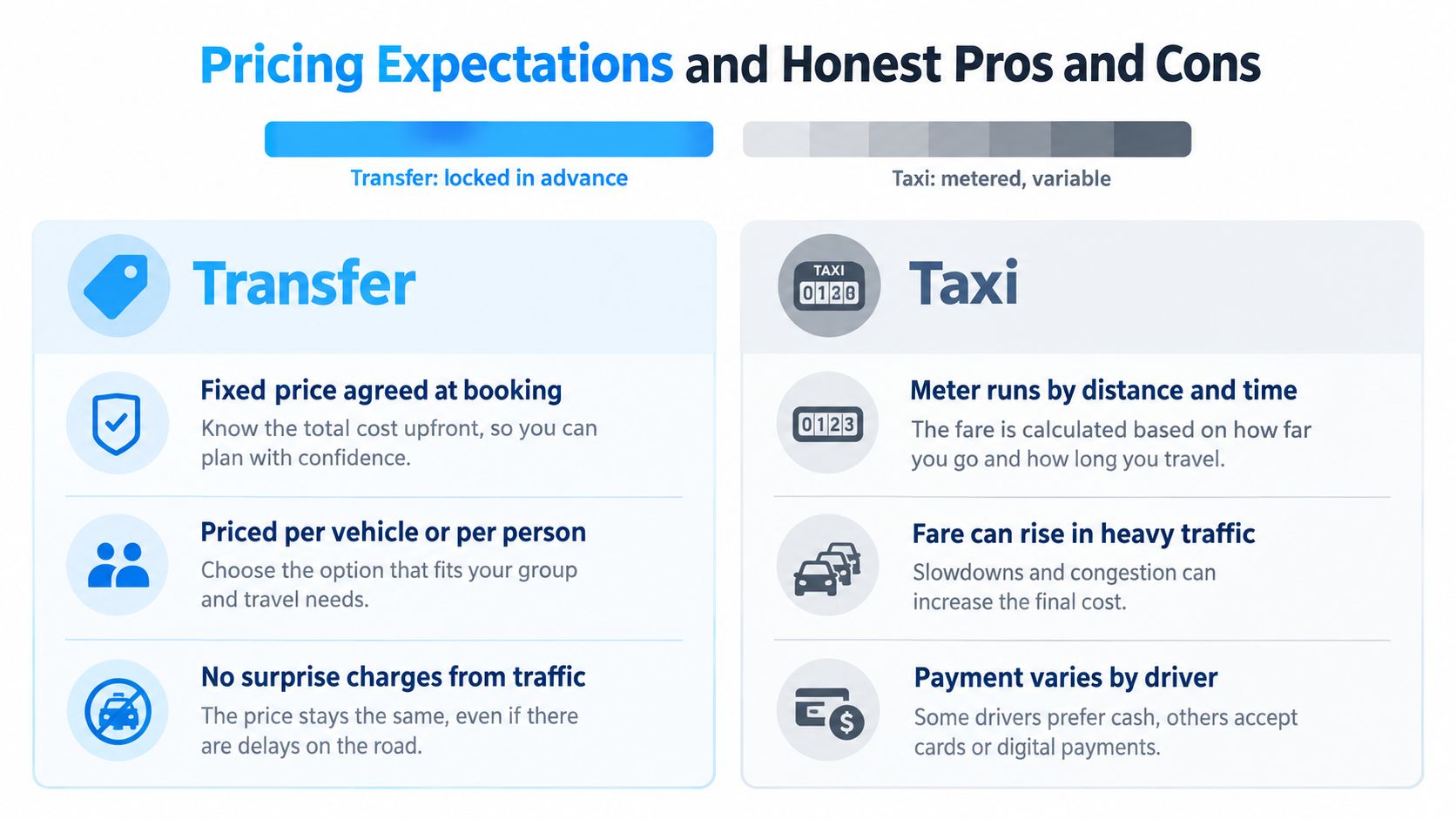
The real trade-offs
The upside is easy to feel. You get predictability, no haggling, flight monitoring, and a pickup plan that doesn't depend on finding the right queue after baggage claim. That's especially useful when you arrive late, travel with children, or land in a place where public transit isn't the easiest answer.
The downside is just as real. A transfer can cost more than a metered taxi on a short ride, and it's less forgiving if your plans change at the last minute. If you miss the pickup window because you changed terminals or ignored the instructions, you may have to sort it out quickly.
Watch for the all-in total. Confirm whether luggage, tolls, meet-and-greet, waiting time, and night service are already included before you pay.
This is also why the category has become so standardized. Pre-booked airport transport is now a major travel product, not a niche substitute. Once a service matures, the good providers tend to spell out pricing, vehicle class, and waiting rules more clearly, which is good for travelers who hate surprises.
When to Book and Choosing the Right Option
Booking ahead is the easiest way to make an airport transfer work in your favor. You lock in availability, you know who's meeting you, and you don't have to sort out transport while you're standing under fluorescent airport lights with a rolling suitcase. That matters most for early departures, late-night arrivals, family trips, and cities where getting from the airport to town isn't straightforward.
Matching the transfer to the trip
Solo budget travelers usually get the most value from a shared shuttle, especially if they don't mind a few extra stops. Families and groups often do better with a private transfer, because splitting one vehicle can be simpler than managing several fares and multiple pickup points. Business travelers tend to value punctuality and flight monitoring, which makes pre-booked private service a strong fit.
Spontaneous travelers can still choose a taxi or ride-hailing car, but they should accept the uncertainty that comes with it. That trade-off is fine on some short trips. It's less appealing when the arrival itself is already stressful.
A small planning checklist keeps the booking clean:
- Confirm the pickup point: Make sure the instructions say curbside, arrivals, baggage claim, or another exact spot.
- Check luggage allowance: A sedan that looks fine on paper may be tight once you add multiple suitcases.
- Ask about child seats: Don't assume they're included unless the booking says so.
- Verify the free-wait period: Know how long the driver will wait before extra charges start.
- Read cancellation terms: Flexible plans need flexible rules.
If you want a broader planning habit that helps beyond ground transport, the best day of the week to book flights is a useful companion topic for trip budgeting and timing.
The reason this category became standard across the U.S., Europe, Asia, and the Middle East is simple. Millions of passengers need a reliable last-mile connection every day, and organized ground transport solves that problem in a way that feels repeatable. Airport transfer services market context
Book before you fly when the trip has any moving parts. The more luggage, people, or timing pressure involved, the less you want to improvise after landing.
Key Takeaways for Your Next Airport Transfer
An airport transfer is defined by pre-booking and a fixed, agreed price, not by one specific vehicle. That's why private cars, shared shuttles, taxis, and larger vehicles can all sit near the same category while still serving very different travel needs.
The best choice depends on the trip, not on habit. A shared shuttle fits a lighter budget, a private transfer fits comfort and certainty, and a taxi or ride-hailing car fits last-minute flexibility when you can tolerate price variation.
The practical questions are always the same. Where do you get picked up, how much luggage do you have, how long can the driver wait, and what happens if your flight shifts? If those answers are clear, the booking usually goes smoothly.
Once you understand the category, choosing a transfer becomes one of the simplest parts of trip planning. You stop guessing at the curb, and you start booking the kind of ride that matches the way you really travel.
If you're comparing airport transfers alongside flights, hotels, and other trip add-ons, Easy Travel Bookings makes that easier in one place. Visit Easy Travel Bookings to compare travel options and build a trip plan that feels organized before you even leave home.