

A 2026 Expedia Air Hacks update says Friday is now the most cost-effective day to book, with domestic fares about 14% cheaper than Sunday and international fares about 8% cheaper than Sunday. That sounds like a definitive answer to the question of the best day of week to book flights, but it hides the more important fact: the winning day keeps changing.
The useful conclusion isn't “always book on Friday.” It's that booking-day timing can create a modest, route-dependent advantage, while the day you fly may matter more. Treat the calendar as one signal, not a rule. Use it alongside departure-date flexibility, advance planning, and fare alerts that monitor the route you care about.
Table of Contents
- The Quick Answer Travelers Want Right Now
- What the Data Actually Shows About Booking Days
- Why the Day You Fly Often Beats the Day You Buy
- Domestic Versus International Booking Patterns
- Timing Your Purchase Beyond the Day of the Week
- Using Fare Alerts to Capture Real Drops
- Putting It All Together on Your Next Trip
The Quick Answer Travelers Want Right Now
If you want the freshest answer, start by checking Friday. The 2026 Expedia reporting found that Friday bookings were about 14% cheaper domestically and 8% cheaper internationally than Sunday bookings, making Friday the current headline winner in that dataset. The comparison is against Sunday, not a guaranteed discount on every itinerary, so it shouldn't be read as a promise that every Friday search will produce a lower fare. (The Hill's report on Expedia's Air Hacks data)
The second answer is more useful: there is no permanent best booking day. Expedia's earlier data named Sunday as the cheapest booking day, while older Google Flights analysis found that Tuesday, Wednesday, and Thursday were only about 1.9% cheaper on average than Saturday or Sunday. A separate Hopper test found Tuesday was cheapest only 1% of the time, which weakens the classic Tuesday rule. (Yahoo's report on the Google Flights and Hopper findings)
Use this three-part decision:
- Search Friday if your dates and route are already fixed. It's the strongest current calendar signal, but not a guarantee.
- Compare departure days before changing purchase days. Moving the trip itself can produce a larger difference than waiting for a particular weekday to search.
- Set a fare alert and judge the actual price. Your route's inventory matters more than a generic national average.
For practical flight research, you can compare flight options and booking providers rather than relying on a single calendar tip. The goal is to find a fare that fits your route, dates, baggage needs, and schedule. If a suitable price appears on a Wednesday, waiting for Friday may save nothing and could cost you the itinerary you want.
What the Data Actually Shows About Booking Days
The major studies don't disagree because one must be useless. They measure different booking periods, routes, travelers, and market conditions. Their changing answers show that airline pricing responds to demand and available inventory rather than following a permanent weekly reset.
The comparison below keeps the findings in view without turning them into a universal rule.
Cheapest Booking Day Across Major Studies
| Source | Year | Cheapest Booking Day | Reported Average Savings |
|---|---|---|---|
| Google Flights analysis | 2022 | Tuesday, Wednesday, or Thursday | About 1.9% cheaper than Saturday or Sunday |
| Expedia Air Hacks data | 2025 | Sunday | About 6% cheaper than booking on Monday or Friday for domestic tickets |
| Expedia Air Hacks update | 2026 | Friday | About 14% cheaper than Sunday for domestic fares and 8% cheaper for international fares |
The 2025 Expedia analysis added an important scale comparison. On a $300 domestic fare, a 6% difference would equal roughly $18, while international booking-day savings reached as much as 17%, depending on when the ticket was purchased. (Forbes Advisor's summary of the 2025 Expedia analysis)
That table exposes the central problem with articles that crown one weekday. The same Expedia source has pointed to different winners in successive reports, and Google's result showed a much smaller advantage for the historically favored midweek days. The shifting winner matters more than the name of the winner because it tells you the pattern isn't stable enough to replace route-level monitoring.
Practical rule: Use the reported cheapest day as a tie-breaker when two searches are otherwise equal. Don't postpone a good itinerary solely because the calendar hasn't reached the “right” weekday.
The evidence supports a narrow claim: booking day can influence the average fare. It doesn't support a stronger claim that Tuesday, Friday, or Sunday will reliably be cheapest for your specific flight. A route with limited inventory can behave differently from a high-frequency route with many competing carriers, and a holiday period can overwhelm a small weekday effect.
Why the Day You Fly Often Beats the Day You Buy
Travelers usually ask when to open the booking page. The larger financial decision may be when to board the aircraft.
Google Flights analysis found that Monday-to-Wednesday departures were about 13% cheaper than weekend departures, a difference that can exceed the modest booking-day effect found in several studies. The same analysis also identified Saturday departures as a lower-cost option in some U.S. itineraries, reinforcing the broader pattern that less popular travel days can offer better fares. (Thrifty Traveler's analysis of Google Flights data)
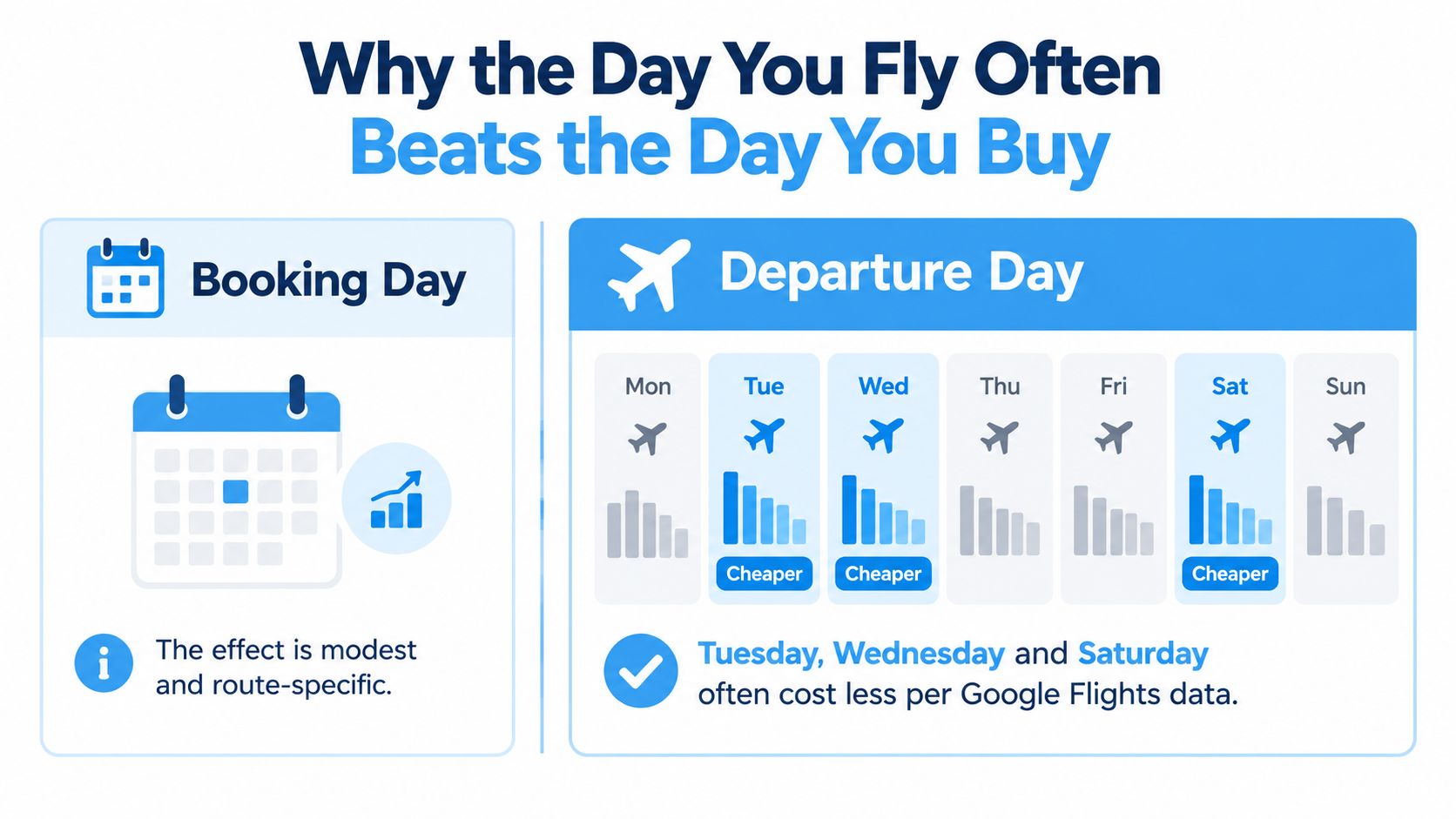
Expedia's 2026 data points in the same direction, but with a different ranking by route. Tuesday was the cheapest domestic day to fly, while Friday was the cheapest international departure day. Earlier Expedia findings also identified Saturday as a favorable day for some U.S. itineraries and Thursday for some international trips. Those differences aren't a contradiction. They show why departure-day results need to be interpreted by market rather than copied as a global formula.
A better order of decisions
Start with the dates that define the trip, then test nearby departures. If you can leave on Tuesday instead of Sunday, or return midweek instead of at the weekend, compare those options before spending time testing Tuesday versus Friday as the purchase day.
This matters especially for leisure travelers, families, and remote workers. A small adjustment to the itinerary can change the demand profile of the flight, while changing the day of the search may only expose you to a different fare snapshot.
The best booking day can help you choose between similar prices. The best departure day can change the price you're comparing.
Business travelers often have less flexibility, particularly on routes with strong weekday demand. In that case, booking-day timing still has value, but price alerts and early comparison matter more than waiting for a specific weekday. For flexible travelers, departure-day testing should be the first lever.
Domestic Versus International Booking Patterns
Domestic and international fares don't produce one identical weekday pattern. The reported differences are wider in some international datasets, but the current evidence still points to a changing signal rather than a fixed law.
For domestic tickets, the 2025 Expedia analysis found Sunday bookings about 6% cheaper than Monday or Friday bookings. The 2026 update instead placed Friday ahead of Sunday, with domestic fares about 14% lower than Sunday. That reversal within the same broader data program is a strong reason to avoid presenting one day as permanently optimal.
International tickets can show a larger spread in the data. The 2025 Expedia dataset reported savings of up to 17%, depending on the purchase timing, while the 2026 update reported Friday international fares about 8% cheaper than Sunday. These figures describe different reporting periods and comparisons, so they shouldn't be combined into one expected discount. (Expedia's 2025 Air Hacks report)
Booking-Day and Departure-Day Savings by Route Type
| Route Type | Average Booking-Day Savings | Strongest Booking Day | Strongest Departure Day | Typical Cheapest Window |
|---|---|---|---|---|
| Domestic | About 6% in the 2025 Expedia comparison, with a different Friday result in 2026 | Sunday in 2025, Friday in 2026 | Tuesday in Expedia's 2026 data | Not established by the verified data |
| International | Up to 17% in the 2025 Expedia dataset, with 8% reported for Friday versus Sunday in 2026 | Friday in the 2026 update | Friday in Expedia's 2026 data | Not established by the verified data |
The safest interpretation is not that international travelers should obsess over Friday. It's that longer, more competitive itineraries deserve closer monitoring because the observed booking-day range can be larger. Route, season, carrier mix, and remaining inventory still determine the price shown to you.
For a short domestic trip, a small booking-day difference may be outweighed by changing the departure date or airport. For an international trip, compare both the purchase day and the travel day, then let the observed fare decide. The evidence supports more attention to timing overseas, not blind confidence in a particular weekday.
Timing Your Purchase Beyond the Day of the Week
A weekday search is only one moment in a fare's life. Airlines adjust prices as demand changes, seats sell, and competitors alter their offers. That makes lead time, seasonality, and route demand more useful planning categories than a universal Tuesday or Friday ritual.
The verified datasets supplied here don't establish one universal advance-purchase window, so a responsible strategy shouldn't pretend that every domestic fare bottoms out within the same number of weeks or that every international route follows the same curve. Instead, build a monitoring period around the trip and observe how the price behaves.
Build a route-specific timing plan
Start monitoring before the trip becomes urgent. The earlier you can compare, the more opportunity you'll have to identify the normal price range for your route. You're not trying to predict the exact lowest fare. You're learning whether the current price looks competitive and whether nearby departure dates offer a meaningful alternative.
Separate predictable demand from exceptional demand. School breaks, public holidays, major events, and popular seasonal periods can override ordinary weekday patterns. If your dates are fixed around one of these periods, flexibility and alerts become more important than waiting for a named booking day.
Test the complete itinerary. A cheaper fare may disappear when you add baggage, seat selection, a restrictive ticket type, or an inconvenient airport. Compare the total practical cost, not only the first number in the search results.
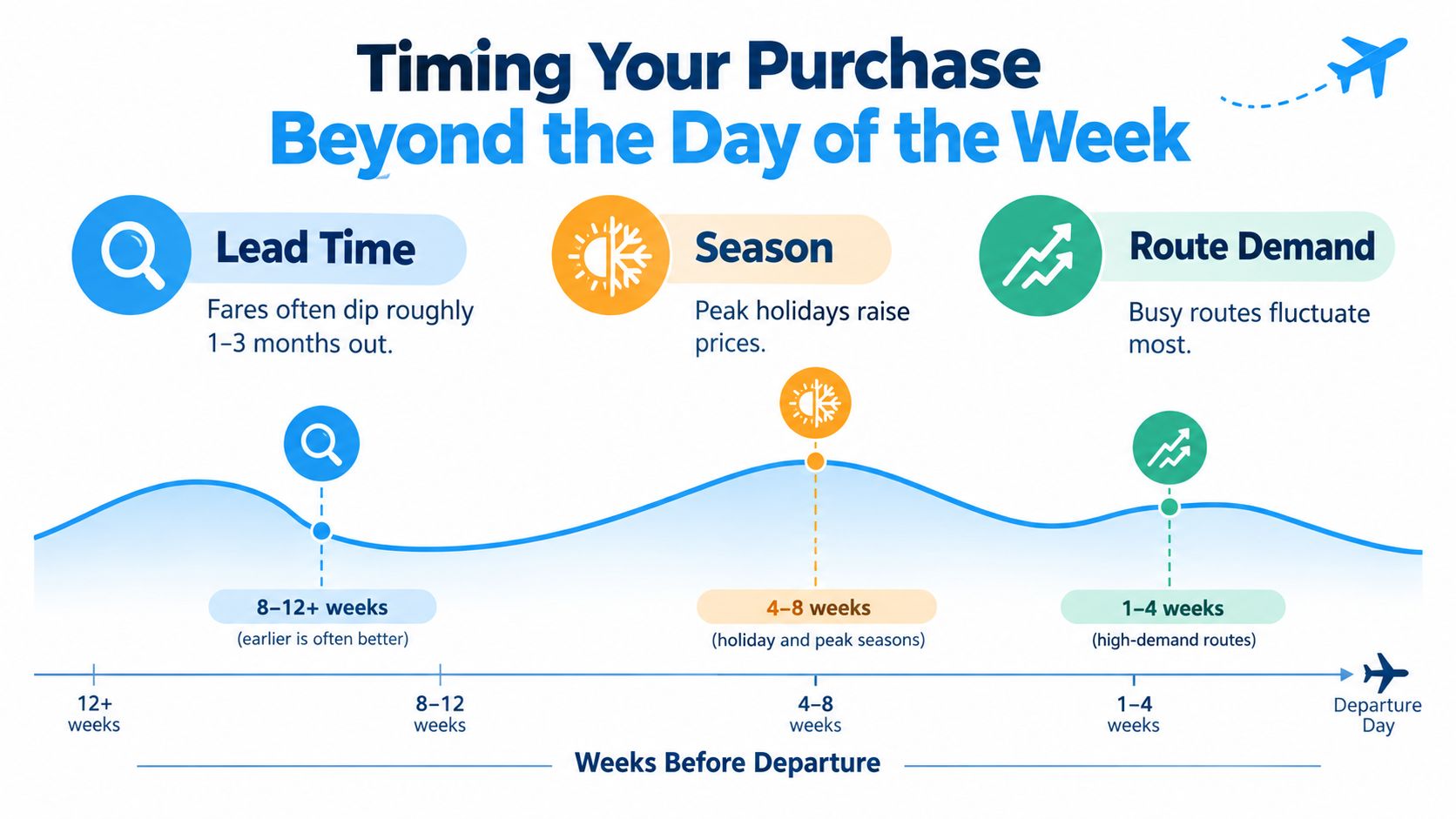
The weekday question can still be useful inside that process. Check Friday because the current Expedia result favors it, but also compare the surrounding departure days and review the fare on more than one occasion. Don't assume a Tuesday afternoon or a late-night search will produce a deal. The evidence provided here does not establish a dependable time-of-day rule.
A personal playbook should therefore look like this:
- Route first: Identify the airports, airlines, stops, and fare conditions you'll accept.
- Dates second: Compare weekday and weekend departures before narrowing the booking day.
- Demand third: Mark periods when many travelers are likely to want the same seats.
- Alerts throughout: Let a tracking tool show whether the fare is moving in a favorable direction.
For travelers handling urgent or flexible plans, these last-minute travel planning ideas can help organize the search without turning a general timing rule into a promise. The right response to a late booking isn't always “wait for Tuesday.” Sometimes the best available itinerary is the one that meets your needs today.
Using Fare Alerts to Capture Real Drops
Fare alerts solve the central weakness of weekday advice: you don't know whether Friday is cheaper until you compare the actual fare. A tracking system watches the route while you get on with your day, then gives you a concrete price to evaluate.
Use three alert types where available:
- Route and date alerts: Track a specific origin, destination, and travel period so you can see changes on the itinerary you're most likely to book.
- Flexible-date alerts: Monitor a wider calendar when you can move the trip. This can reveal a cheaper departure day that a fixed-date search would never show.
- Airline deal alerts: Follow carriers and travel deal newsletters for sales that may affect your route, but verify the final fare and conditions before booking.
A simple setup
Begin with the route, not the weekday. Search your likely airports and dates, compare nearby departure options, and enable price tracking on the result page when the tool offers it. Then add airline newsletters or carrier-app notifications for the airlines that serve the route.
Review the alerts at a regular interval, but don't treat every small movement as a reason to buy. A meaningful drop should be judged against your budget, schedule, luggage requirements, and the chance that the itinerary will become less convenient. If the price already works and the trip is important, waiting for a theoretical low can create more risk than value.

The alert should answer a practical question: “Is this route offering a fare I'm willing to accept?” It doesn't need to prove that you found the absolute bottom. Airline prices can move again after you book, and a lower fare later may come with worse times, fewer seats, or different restrictions.
For a broader checklist covering search habits and trip preparation, use these easy air travel tips. The strongest workflow combines automated monitoring with a human decision rule. Let software identify movement, then decide whether the fare fits the trip.
Putting It All Together on Your Next Trip
The most reliable answer to the best day of week to book flights is a sequence of decisions, not a single weekday. First define the route and acceptable itinerary. Then compare departure days, monitor the fare, and use Friday or another favorable booking-day signal as a tie-breaker when the options are otherwise comparable.
Your pre-trip decision framework
- Set the route and constraints. Choose acceptable airports, airlines, stopovers, baggage, and arrival times. A lower headline fare isn't useful if it creates costs or inconvenience you won't accept.
- Compare departure dates. Test midweek and weekend options before focusing on the day you'll purchase. The available evidence shows that departure-day differences can be larger than booking-day differences.
- Start fare monitoring early enough to observe movement. Watch the route rather than checking only one date. Flexible-date alerts are especially useful when your schedule allows changes.
- Use the current booking-day signal as a final check. Friday is the latest Expedia winner, but earlier studies named Sunday or midweek days. That history makes the day a supporting signal, not a guarantee.
- Book when the complete fare meets your requirements. Include bags, seats, connections, airport transfers, and ticket flexibility in the decision.

For domestic travel, schedule flexibility may give you more advantage than changing the purchase weekday, especially when nearby departures have different demand. For international travel, the reported booking-day spreads can be wider, so keep monitoring active and compare both booking and departure dates. Neither approach replaces checking the actual itinerary.
Keep three guardrails in mind:
- Prioritize departure day: If your schedule allows it, test when you fly before obsessing over when you buy.
- Treat weekday savings as variable: A reported average isn't a guaranteed discount for your route.
- Let alerts do the watching: Route-specific price movement is more actionable than a permanent calendar myth.
Easy Travel Bookings helps you compare flight offers from multiple providers alongside other travel services, giving you a practical place to start monitoring routes and evaluating fares. Visit Easy Travel Bookings to compare options for your next trip and turn general booking-day advice into a route-specific search.
Written with Outrank