

You've found a Boston-to-Venice fare that looks reasonable, but the itinerary hides the true decision. Your trip could begin with a winter departure from Logan, a long Atlantic crossing, and an arrival at Marco Polo that puts you near a water-bus dock. Or the same search could send you to Treviso, followed by a tiring ground transfer before you even reach the lagoon.
That's why I don't treat Boston to Venice as a simple flight search. I compare the complete journey, including the connection, arrival airport, baggage rules, transfer, and the effect of the time difference. The cheapest ticket often isn't the cheapest trip, and the itinerary with the shortest flying time can still waste your first day in Italy. Before you book, review these practical air travel planning tips and then judge every fare by what happens after the aircraft lands.
Table of Contents
- Picture This Boston to Venice Trip Before You Book
- What the Boston to Venice Route Actually Looks Like
- Choosing Between Marco Polo and Treviso on Arrival
- Typical Layover Hubs on Boston to Venice Itineraries
- What Boston to Venice Fares Usually Look Like
- Arrival Tips That Make the First Day in Venice Easier
- Putting Together Your Boston to Venice Booking Plan
Picture This Boston to Venice Trip Before You Book
Your alarm goes off in Boston while the streets are wet with winter slush. You reach Logan early, clear security, and board an overnight flight toward Europe. Several hours later, you're comparing two arrival screens: one itinerary reaches Venice Marco Polo, while another lands at Treviso for less money.
The Marco Polo option may leave you stepping onto a bus or water-transport service with the historic center ahead. The Treviso option may involve a longer road journey before Venice starts to feel like Venice. Both tickets can appear in the same search results, but they don't deliver the same first day.
Booking rule: Compare the trip from your Boston door to your hotel entrance, not just the fare from BOS to Italy.
A higher-priced itinerary can make sense if it avoids a difficult transfer, protects your sleep, or arrives early enough for a useful afternoon. A cheaper itinerary can win if the connection is manageable, you're traveling light, and the transfer from the alternative airport fits your hotel location. There's no universal winner, but there is a clear way to decide.
The price on the screen is only the beginning
Start by identifying whether the itinerary is nonstop, one-stop, or a codeshare combination. Then check the connection city, the length of the layover, the baggage allowance, and the arrival airport. A fare that excludes a checked bag or forces a separate transfer payment may no longer be attractive once you add those costs.
Venice also rewards travelers who plan around the destination's physical layout. A hotel near a vaporetto stop may be convenient from Marco Polo but awkward after arriving late at Treviso. A property close to Piazzale Roma may work well with a land transfer, while a hotel on a narrow water-access street may require a different final connection.
The itinerary changes your first day
Boston travelers often focus on the departure time and ignore the arrival experience. That's a mistake. A late arrival can leave you navigating bridges and luggage routes when services are less convenient, while an early arrival can create a long gap before hotel check-in.
I'd pay more for a simpler arrival when traveling with children, older relatives, heavy bags, or anyone who sleeps badly after an overnight flight. Solo travelers with compact luggage and flexible plans have more room to chase a lower fare. The right choice depends less on airline branding than on how much friction you're willing to absorb after landing.
What the Boston to Venice Route Actually Looks Like
Boston Logan and Venice Marco Polo are separated by approximately 3,958 miles, or about 6,369 to 6,440 kilometers, across the North Atlantic, as shown in published Boston to Venice route data. That distance makes this a long-haul journey, not a quick European hop, and it affects aircraft type, connection planning, luggage handling, and recovery time after arrival.
Fast itineraries generally use one connection rather than a nonstop service. One representative schedule lists about 8 hours and 45 minutes of flying time, excluding the layover, while total journey time can reach approximately 15 hours and 50 minutes depending on the connecting airport, schedule, weather, and air traffic.
Read the itinerary in the right order
Ignore the headline duration at first. Check the route using this sequence:
- Departure airport: Confirm that the flight starts at Boston Logan, not a distant substitute airport that adds a separate journey.
- Connection city: Identify where you'll change planes and whether the itinerary requires a terminal transfer.
- Layover length: A short connection may look efficient but leaves less room for delays or passport processing.
- Arrival airport: Confirm whether you'll land at Marco Polo or Treviso.
- Final transfer: Estimate the time and effort from the airport to your accommodation.
This process exposes the difference between flight time and door-to-door time. A schedule with a longer layover can sometimes be the more sensible choice if it arrives at a useful local hour or reduces the chance of a missed connection.
Plan around the six-hour shift
Venice is six hours ahead of Boston, so your arrival window matters as much as the date. An overnight routing may let you reach Venice during the day, but sleeping on the aircraft isn't guaranteed. A daytime departure with an evening arrival may protect your sleep but consume more of the first calendar day.
Travelers should also expect a substantial adjustment after landing. Don't schedule a demanding excursion immediately after arrival, especially if you'll need to cross the lagoon with luggage. Give yourself a simple first objective: reach the hotel, eat something light, walk a manageable route, and stay awake until a normal local bedtime.
Choosing Between Marco Polo and Treviso on Arrival
Marco Polo is the default choice for most Boston travelers. It's the principal air gateway for Venice and sits approximately 11 miles, or 18 kilometers, from central Venice, with a typical road transfer of about 35 minutes, according to Boston to Venice airport comparison information. The final approach may still require land-and-water transport, but the airport is generally the cleaner starting point for reaching the lagoon.
Treviso can work, but only when the saving is meaningful and the rest of your plan supports it. The airport serves the wider Venice market, yet the onward journey adds time, ground transport, and another luggage transition. For a first visit, that inconvenience is easy to underestimate.
Marco Polo versus Treviso for Boston Arrivals
| Factor | Marco Polo (VCE) | Treviso (TSF) |
|---|---|---|
| Role in the journey | Principal airport for Venice | Alternative airport for the wider Venice area |
| Arrival location | Closer to central Venice | Farther from the lagoon and historic center |
| Onward transport | Bus and water-transport options | Longer ground journey is usually required |
| Best for | First-time visitors, late arrivals, families, heavy luggage | Flexible travelers who find a worthwhile fare difference |
| Main drawback | The fare may be higher | Transfer time and handling can erase the saving |
The critical point is not the airport's label. It's the generalized cost of the complete itinerary. A lower fare from Treviso may lose its advantage after you add the bus, possible train or local connection, luggage handling, and the time spent reaching Venice.
When Treviso makes sense
Choose Treviso when you're traveling light, arriving at a practical hour, and staying somewhere that's easy to reach after a land transfer. It can also be reasonable when the fare difference is large enough to justify the extra effort. Don't choose it automatically because the airline advertises a low price.
Choose Marco Polo when you want the least complicated arrival. I particularly recommend it for families, passengers with mobility concerns, travelers arriving late, and anyone staying deep in the historic center. The airport decision often changes the trip more than the airline decision does.
Typical Layover Hubs on Boston to Venice Itineraries
The best layover hub is the one that balances a reliable connection with a sensible arrival time. Boston to Venice searches commonly surface European gateways such as London Heathrow, Paris Charles de Gaulle, Amsterdam Schiphol, Frankfurt, Munich, Zurich, Madrid, Lisbon, Reykjavik, and Istanbul. Each can work, but they don't create the same transfer experience.
I don't rank hubs by reputation. I rank them by what you'll have to do after leaving the first aircraft.
Large hubs can hide extra walking
London Heathrow and Paris Charles de Gaulle can produce attractive schedules, but terminal changes and passport-control steps may make a short connection uncomfortable. Frankfurt and Munich can be efficient when both flights use compatible terminals, yet the walking distance and airport layout still matter. Amsterdam Schiphol often feels straightforward on one ticket, but a busy connection can leave little slack.
Zurich is usually appealing when the schedule fits because the airport is easier to understand than some larger gateways. Madrid and Lisbon can offer a pleasant southern routing, though the best option depends on the departure and arrival times. Reykjavik may create a useful fare combination, but the weather and schedule pattern deserve close attention. Istanbul can open another routing structure, but it may add more elapsed time than the screen initially suggests.
Use these filters before choosing
- One ticket beats separate tickets: If the airline sells the journey as one booking, the connection is generally easier to manage than two unrelated reservations.
- Avoid heroic connection times: A connection that leaves no margin for delay is a poor bargain, even if the total duration looks excellent.
- Check terminal movement: A terminal transfer can involve buses, trains, security screening, or a long walk.
- Protect your luggage plan: Confirm whether bags transfer automatically or whether you must collect and recheck them.
- Match the hub to your loyalty strategy: A familiar alliance, status benefit, or baggage policy can matter more than a slightly lower fare.
A connection should feel boring. If the itinerary depends on perfect timing, it isn't efficient, it's fragile.
Overnight layovers can reduce the fare, but they're only worthwhile if you've priced the hotel, airport transport, meals, and lost time. For a short Venice visit, I'd usually prefer a clean one-stop itinerary over a cheaper schedule that turns the journey into an airport overnight.
What Boston to Venice Fares Usually Look Like
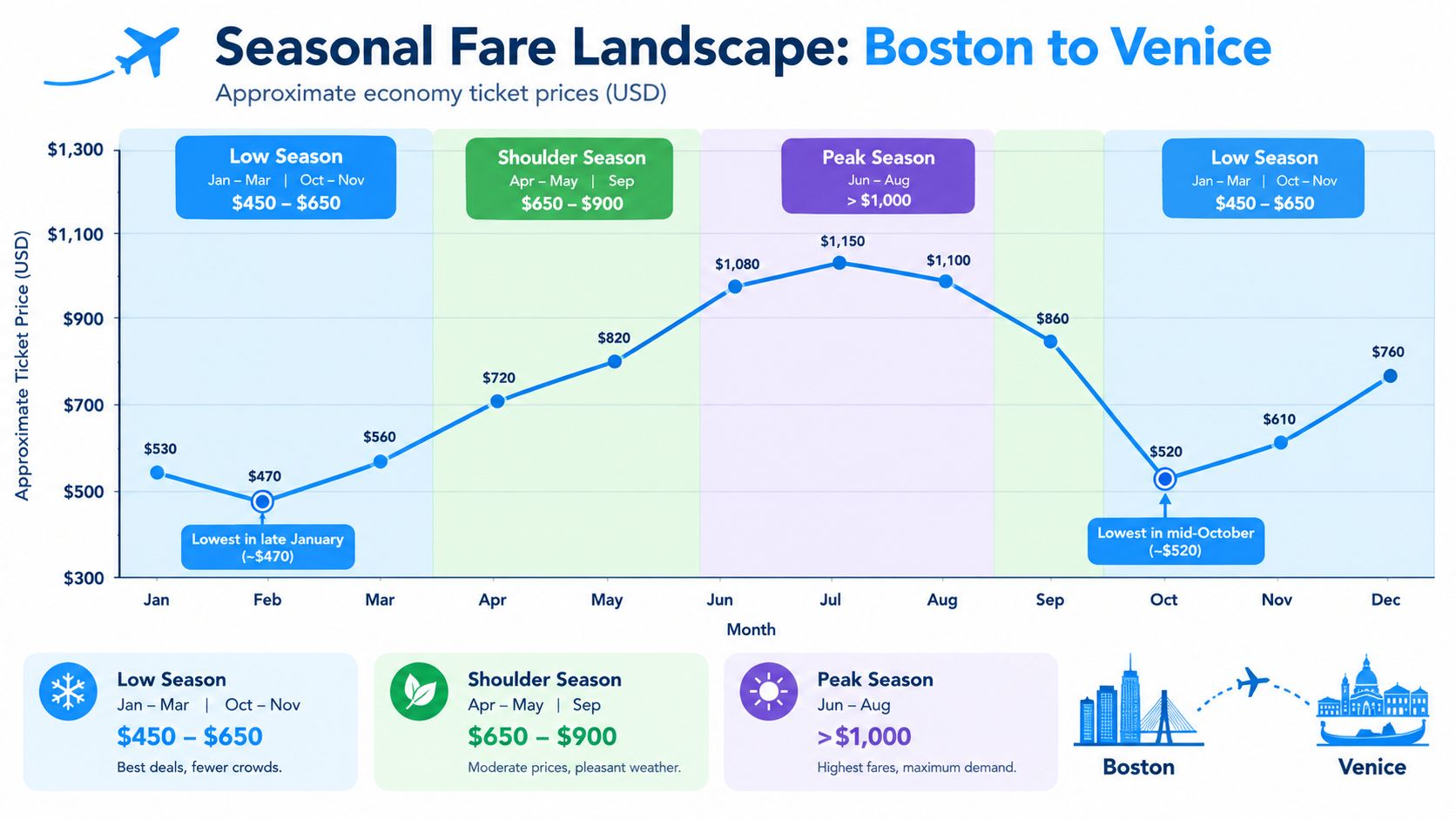
Boston to Venice pricing moves with demand, school calendars, major events, and the amount of flexibility in your dates. You won't find one reliable “normal” fare that applies throughout the year. Instead, think in terms of lower-demand periods, shoulder periods, and peak travel windows.
Late winter and parts of autumn often provide better opportunities for travelers who can move their dates. Spring can be mixed, with pleasant conditions drawing visitors back to Italy. Summer typically attracts the strongest leisure demand, while Christmas, Carnival, trade events, and major cultural dates can distort the usual pattern.
Compare fare families, not just fare totals
Basic economy can look appealing until you check the restrictions. Review seat selection, changes, cancellation terms, carry-on rules, and checked-bag inclusion before comparing it with standard economy. The lowest displayed fare is useful only if its conditions match how you really travel.
Premium economy can be worthwhile for an overnight segment when the seat, baggage allowance, and flexibility solve a real problem. It isn't automatically good value for a daytime connection, particularly if the upgrade leaves you with an awkward arrival or a long layover.
Business class deserves the same scrutiny. A lie-flat seat may be valuable for travelers who need to function on arrival, but the fare shouldn't distract you from the route itself. A better cabin on a badly timed itinerary can still produce an unpleasant first day.
Build a flexible search
Search nearby departure dates, compare different return patterns, and inspect the full calendar rather than judging one result. Use guidance on the best day to book flights as a planning reference, but don't treat a particular weekday as a guarantee of savings.
The strongest fare is the one that survives the complete calculation:
- Ticket conditions: What can you change, cancel, or carry?
- Connection quality: Is the layover comfortable and protected?
- Arrival airport: Does the lower fare send you to Treviso?
- Ground transfer: What will it take to reach your hotel?
- First-day value: Will the arrival time let you use the day?
I'd rather book a slightly higher fare with a clean connection and Marco Polo arrival than chase a bargain that requires several separate decisions after landing.
Arrival Tips That Make the First Day in Venice Easier
You arrive after the six-hour time shift, collect your bags, and discover that your hotel is not beside a road. Venice makes a vague arrival plan expensive in time and energy. Bridges, narrow lanes, water stops, and crowds can turn the final part of the journey into the hardest leg.
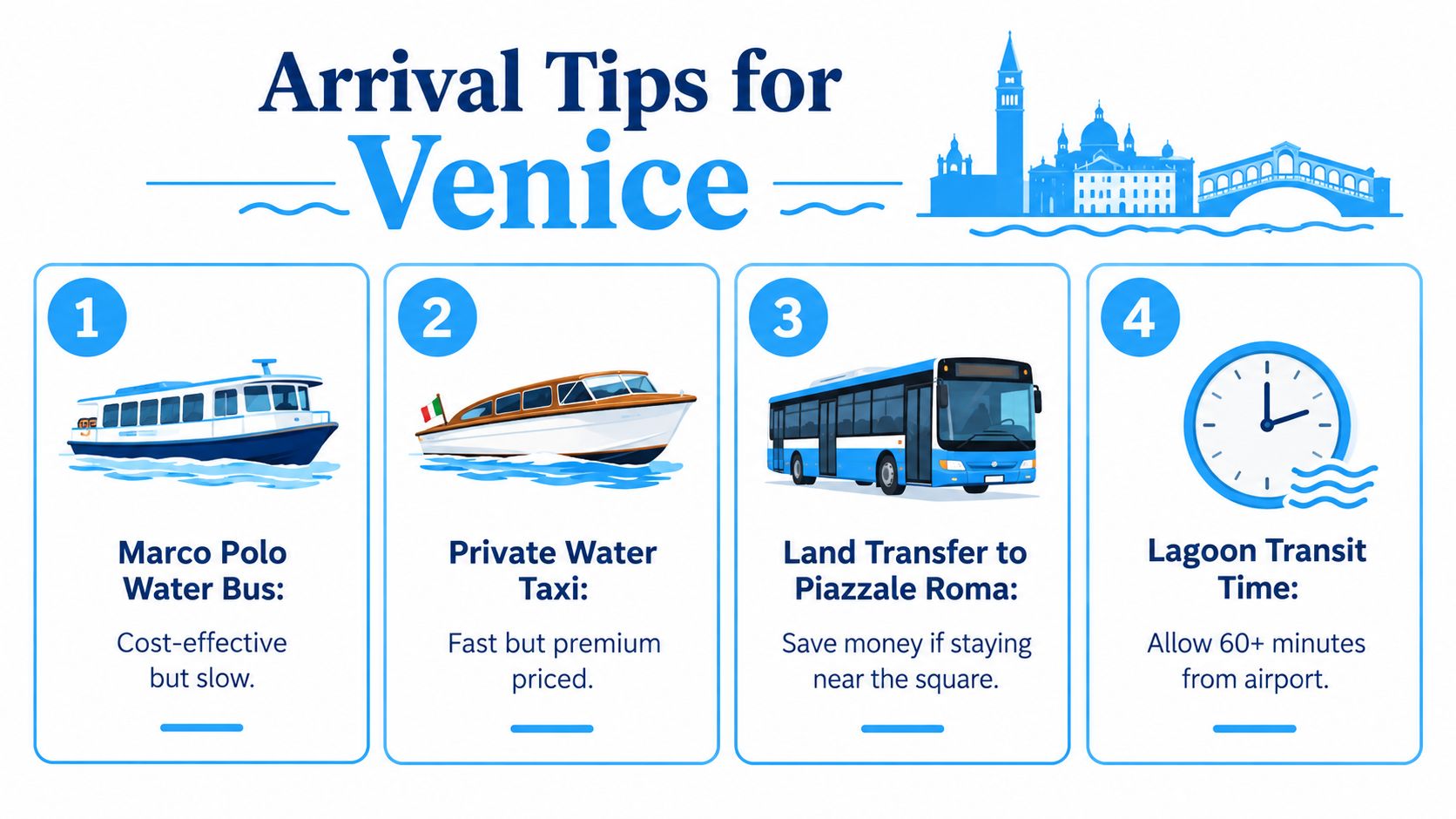
Marco Polo offers bus and water-transport options, while no train runs directly to the airport. Choose the transfer based on your hotel's location, arrival time, luggage, and tolerance for extra steps. A cheaper ticket can lose its value if it leaves you with a difficult city transfer.
Choose the final transfer before departure
A water bus suits travelers who want shared transport and can accept a slower arrival. A private water taxi costs more, but it is faster and easier with heavy luggage. A land transfer to Piazzale Roma makes sense when your accommodation is nearby or a water connection would force backtracking.
Before choosing, review what an airport transfer includes so you can compare the full service, not just the ticket price. Then check your hotel's access instructions. “Near Venice” tells you very little. Confirm whether you will arrive at a vaporetto stop, private dock, Piazzale Roma, or a street requiring a walk across bridges. Save the directions offline, since mobile data may not work immediately after landing.
Respect the luggage and time problem
Allow plenty of time for the airport-to-city journey, especially with shared water transport. Waiting, intermediate stops, boarding, and walking with bags all add friction. The shortest route on a map may be the least practical with suitcases.
Check late-arrival options before booking a hotel reachable only by water. Tide conditions, dock access, or the property's instructions may alter the final approach.
Handle the six-hour shift deliberately
Stay awake until a normal local bedtime if you can. Get outside, keep the first walk gentle, eat at a sensible hour, and avoid turning a short rest into an evening of sleep. Keep the first day light rather than empty. A calm walk, a nearby meal, and an early night will serve you better than an ambitious sightseeing schedule.
Putting Together Your Boston to Venice Booking Plan
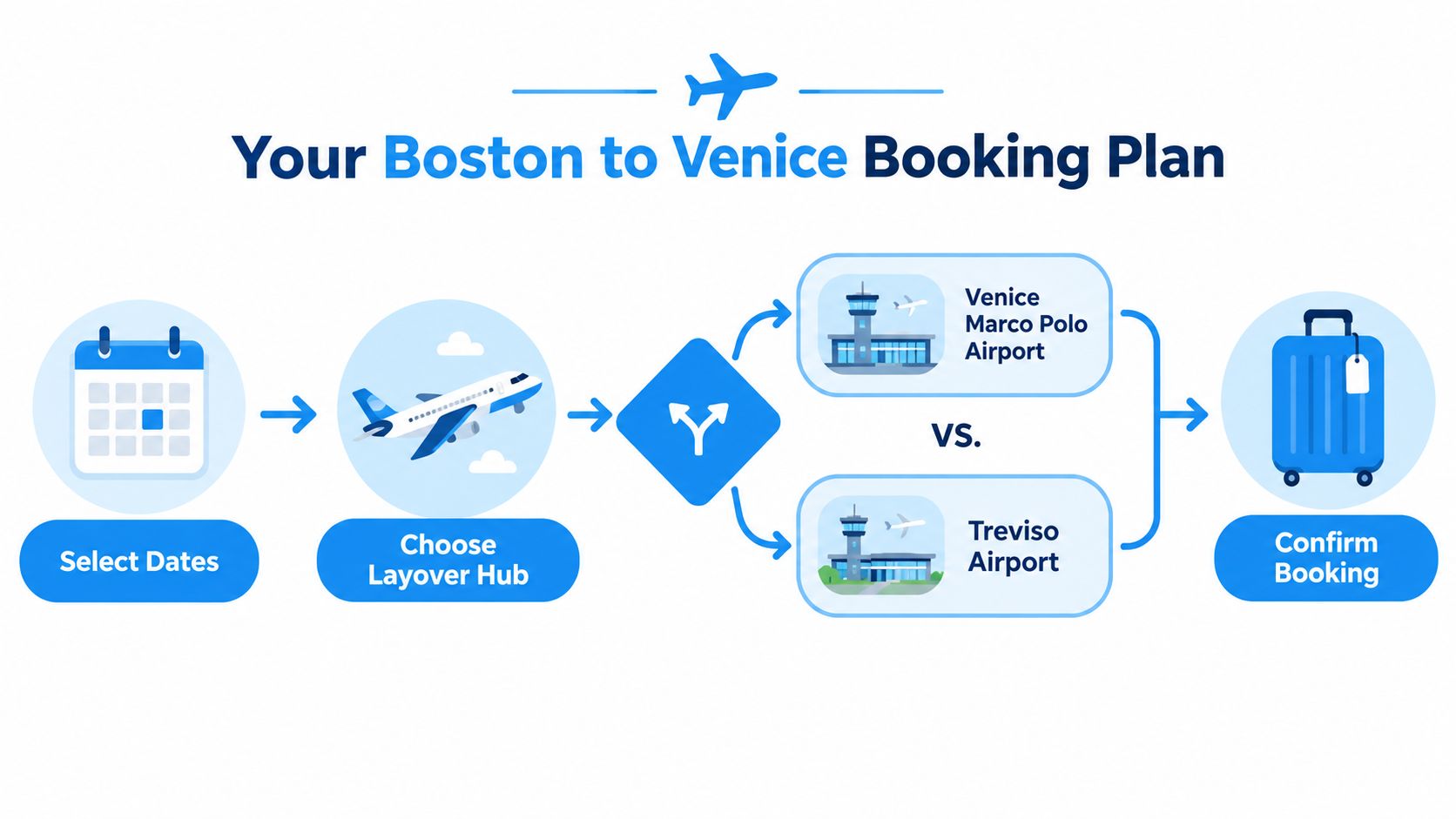
The best booking process is sequential. Don't start with the airline logo or the lowest fare. Start with the conditions that determine whether the journey will feel easy.
Begin with dates and demand
Choose dates that fit your purpose, then check the local calendar for holidays, Carnival, trade events, and other periods that can push demand upward. If your dates are fixed, accept that flexibility may come from the route, fare family, or arrival airport instead.
Once the dates are set, search complete itineraries from Boston Logan to both Venice airports. Don't assume that a search labeled Venice includes the same arrival experience. Confirm the airport code on every result.
Select the connection before the cabin
A one-stop route through a manageable European hub is usually the starting point I'd recommend. Compare the total duration, connection protection, terminal movement, baggage transfer, and arrival time. If one route is slightly longer but gives you a dependable connection and a useful arrival window, it may be the better purchase.
Be careful with separate tickets. They can create a lower headline price, but they also shift missed-connection risk onto you. For most leisure travelers, one protected itinerary is worth prioritizing over a fragile combination.
Decide whether Treviso earns its place
Treviso should pass a simple test. The fare saving must remain meaningful after the onward transport, extra time, luggage effort, and possible late-arrival inconvenience. If it doesn't, book Marco Polo.
Marco Polo is also the stronger choice when the hotel sits in the historic center, your party has heavy luggage, or you expect to arrive tired. Treviso becomes more reasonable for light packers with flexible schedules and accommodation suited to a land transfer.
Audit the fare before paying
Open the fare rules. Check baggage, seat assignment, changes, refunds, and whether the booking is handled by the airline or a third-party agency. Don't assume that a branded economy fare includes the same benefits across airlines.
Use a final comparison that includes:
- The fare and its restrictions.
- The connection and missed-flight risk.
- The arrival airport and city transfer.
- The luggage and seat costs.
- The time you'll have on your first day.
Easy Travel Bookings lets travelers compare flight offers alongside hotels and airport transfer options, which is useful when you're evaluating the full Boston-to-Venice journey rather than airfare alone. Visit Easy Travel Bookings to compare available flights, accommodation, and transfer choices for your dates, then book the itinerary that delivers the easiest arrival, not merely the lowest advertised fare.