
You're standing at a rental counter in a city you barely know, or staring at an app with three bikes that all look close enough. One rate seems cheap, another promises better range, and the staff keeps asking about a deposit you didn't plan for. That's where people usually make the expensive mistake, they treat how to rent a bike like a quick tap-and-go decision instead of a small travel contract with real risk attached.
Rent a bike the wrong way and you don't just overpay, you inherit a fit problem, a damage dispute, or a route that wasn't right for riding in the first place. Rent it the right way and it becomes one of the cleanest ways to move through a city, see more in less time, and keep control of your budget. Easy Travel Bookings also surfaces rent-a-bike options alongside hotels, flights, and transfers in one search, so you can plan the trip as a whole instead of stitching together separate bookings at the last minute.
Table of Contents
- Picture This Before You Pick Up the Wheels
- The Three Main Ways to Rent in 2026
- Documents and Deposits You Should Expect
- What a Bike Rental Really Costs in 2026
- Pre-Ride Safety Check You Should Never Skip
- Where Cheap Rentals Get Expensive
- If Something Goes Wrong Mid-Rental
Picture This Before You Pick Up the Wheels
Amsterdam and Lisbon can hand you a bike decision before you have time to think. The queue makes it feel like a quick convenience choice, but the core question is simpler: which bike protects your time, body, and wallet?
Treat the rental like a travel decision, not a convenience click
Bike rental grew from a rough public experiment into a global mobility service. The early model was basic and hard to control, then technology changed the game in Rennes in 1998. Paris later proved the scale was real, with 20 million trips in the first year of Vélib' and more than 130 million cumulative trips by the end of 2012. By 2013, more than 500 cities in 49 countries were running advanced bike-sharing programs with a combined fleet of more than 500,000 bicycles NACTO history of bikesharing.
Practical rule: rent the bike that fits your route first, then compare price.
That order matters. A cheap bike that is wrong for hills, cobblestones, traffic, or your body can cost more than a better one once you count discomfort, delays, or damage claims. Renters who get this right treat the rental like a small project. They check the route, the terms, the fit, and the return rules before they pay.
The smartest shortcut is not picking the cheapest listing. It is choosing the option that will not create a problem later. That mindset keeps a short ride from turning into a dispute at the desk.
The Three Main Ways to Rent in 2026
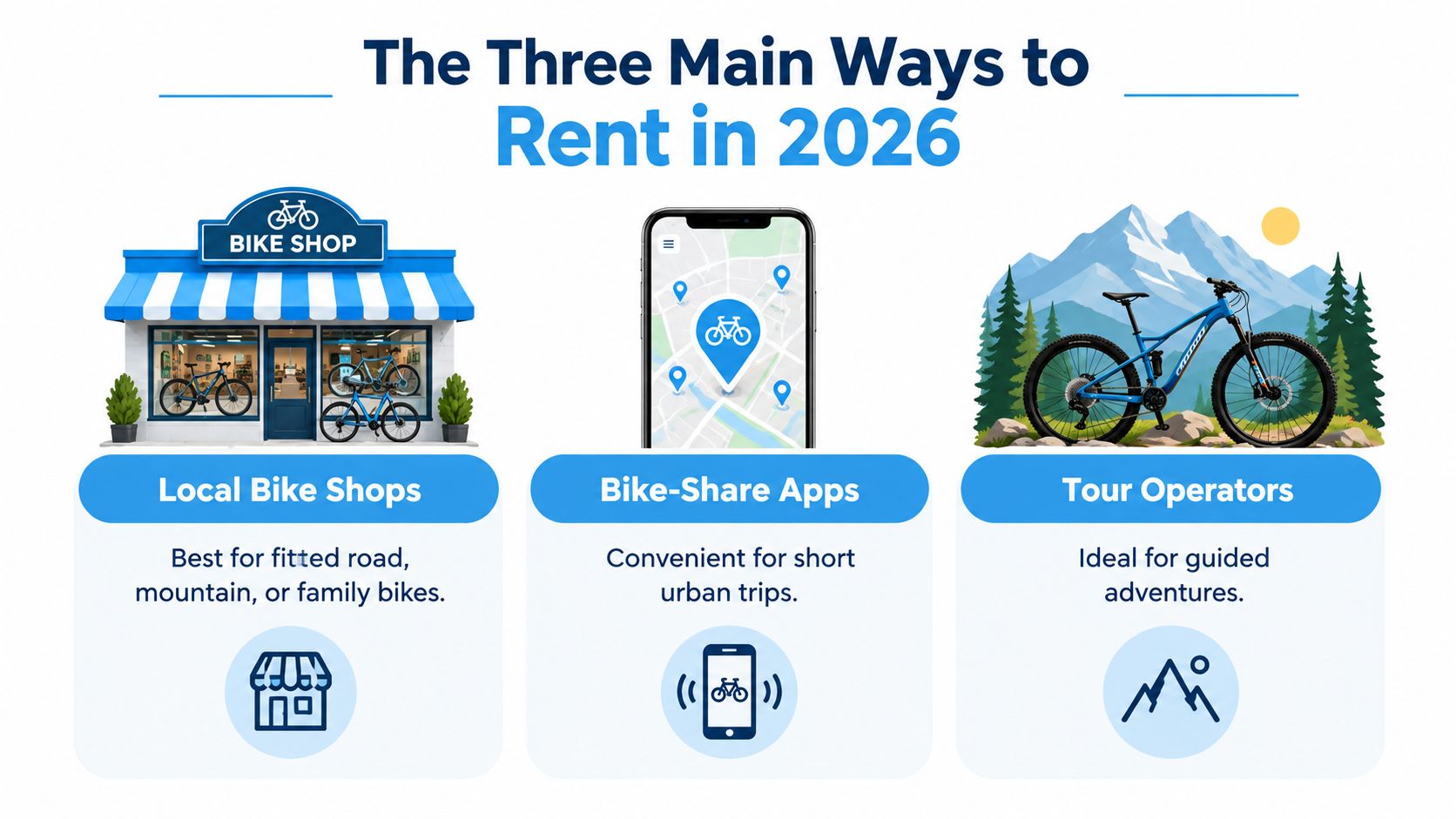
Local bike shops
Use a local shop when fit matters. If you want a road bike for a long paved ride, a mountain bike for trail use, or a family setup with child seats and sized frames, the shop counter is still the most reliable channel. Staff can adjust the saddle, spot a bad match immediately, and tell you whether the route you planned is realistic.
That's the right move for a family in Amsterdam who needs bikes that fit different ages and confidence levels. It's also the better choice for anyone with back, knee, or reach concerns, because you're not guessing from an app thumbnail.
Bike-share apps
Use bike-share for short urban hops, sightseeing bursts, and one-way movement across a city. Registered members and casual users both tend to use these bikes for relatively short trips, and the system is built for convenience, not customization Texas Department of Transportation summary via QUT. That's why bike-share makes sense for a solo traveler in Lisbon who wants to move between neighborhoods without dealing with a full-day rental counter.
Best fit: short, flexible rides in dense cities.
Public systems also work when you don't want to plan ahead. If the dock is near your hotel and the route is flat and direct, it's a practical choice. If you need a specific frame size, child gear, or long-range confidence, don't force it.
Tour operators and agency-style rentals
Choose this route for guided rides, unusual bikes, or longer stays where the operator bundles the gear with advice. It's the sensible option for a hilly coastal town in Italy, where an e-bike or cargo bike may matter more than the lowest quote. It's also where you're more likely to get route guidance, roadside support, or a package that includes extras you'd otherwise scramble to add later.
For travelers comparing these channels in one place, e-bike rental listings can help narrow the options before you commit.
Documents and Deposits You Should Expect
The fastest way to waste time is to arrive without the right ID or payment method. Most providers want a government-issued photo ID, a credit card for the hold, and a signed waiver if they use one. International travelers may also face passport checks or extra verification, so don't assume your mobile confirmation is enough.
Bring the right paperwork the first time
Make your prep list simple:
- Photo ID: Carry the passport or government ID the provider will accept.
- Credit card: Use the card the shop wants for the deposit hold, not a debit card that may get rejected.
- Rental details: Keep the reservation name, pickup time, and return deadline on hand.
- Battery or accessory notes: If you booked an e-bike, child seat, or add-on equipment, bring the confirmation that shows it.
- Liability waiver: Read it before you sign, especially if the rental includes local traffic or off-road conditions.
A refundable security deposit is not the same thing as a non-refundable insurance excess. The deposit comes back if nothing gets disputed. The excess is the part you may still owe if there's damage or theft under the policy terms. That difference is where a lot of travelers get burned, because the sticker price looks low while the exposure underneath is not.
If you're comparing booking flows that ask for different payment behavior, the mechanics are similar to the way hotel bookings without a credit card can still involve verification and conditions. Travel providers vary. Bike rentals vary too. Read the rules before you stand in line.
Do this before you leave home: check whether the provider wants a passport copy, a return-ticket reference, or a local phone number. You don't want to discover those requirements at the counter.
What a Bike Rental Really Costs in 2026
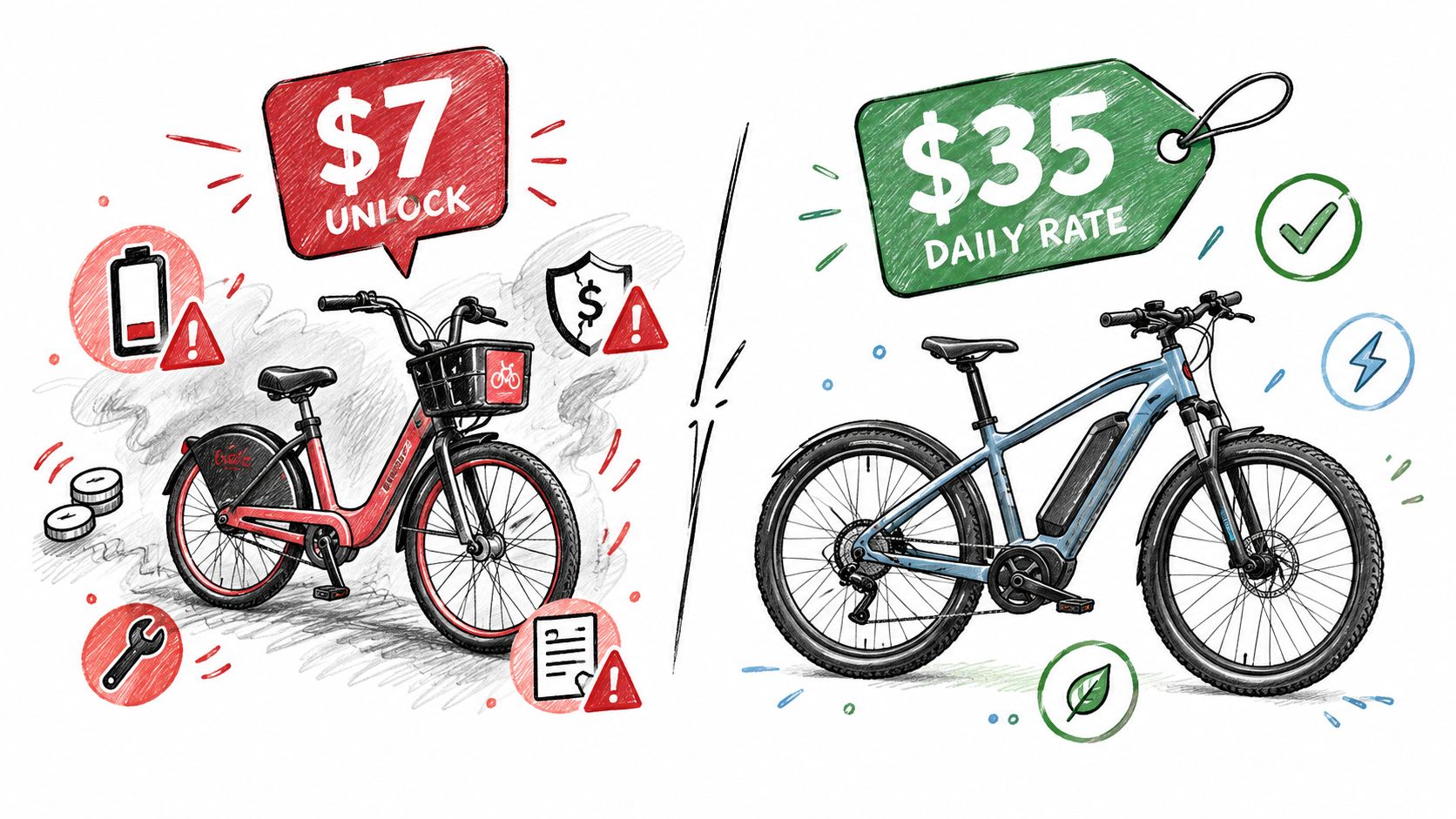
The daily rate is only the headline. The true cost shows up in the add-ons, the hold amount, and the damage exposure if something goes wrong. That's why a cheap-looking rental can end up being the most expensive choice on the receipt.
Read the price as a stack, not a single number
A basic quote usually hides a few layers. First is the rent itself. Then come the extras, helmet, lock, child seat, insurance, late return penalties, or battery-related terms for e-bikes. Then there's the hold or excess, which is the part people forget until a card is blocked or a claim gets filed.
| Bike Type | Average Daily Price | Common Add-ons | Typical Excess/Damage Hold |
|---|---|---|---|
| Budget city bike | Varies by destination | Lock, helmet, late return fee | Varies by provider |
| Hybrid or road bike | Varies by destination | Pedals, helmet, route map | Varies by provider |
| Premium e-bike | Varies by destination | Battery terms, charger, helmet | Varies by provider |
| Cargo or kids' bike | Varies by destination | Child seat, trailer, special waiver | Varies by provider |
That table is the honest answer when a site won't show you a clean total. If the provider won't spell out the deposit, excess, theft protection, roadside assistance, or liability coverage, you don't have a full price. You have a teaser.
Compare the total, not the sticker
A lower daily rate can still lose to a slightly higher one if the cheaper option carries worse terms. That's especially true for e-bikes, where battery liability can change the risk profile fast. If you want to compare offers in one search, how much it costs to rent a bike is the right place to start inside Easy Travel Bookings, because the key question is always the full trip cost, not the headline rate.
A sensible budget should leave room for the likely extras, not just the base fare. If the provider won't tell you what happens when you're late, park badly, or return a bike with a scratch they say was there already, walk away.
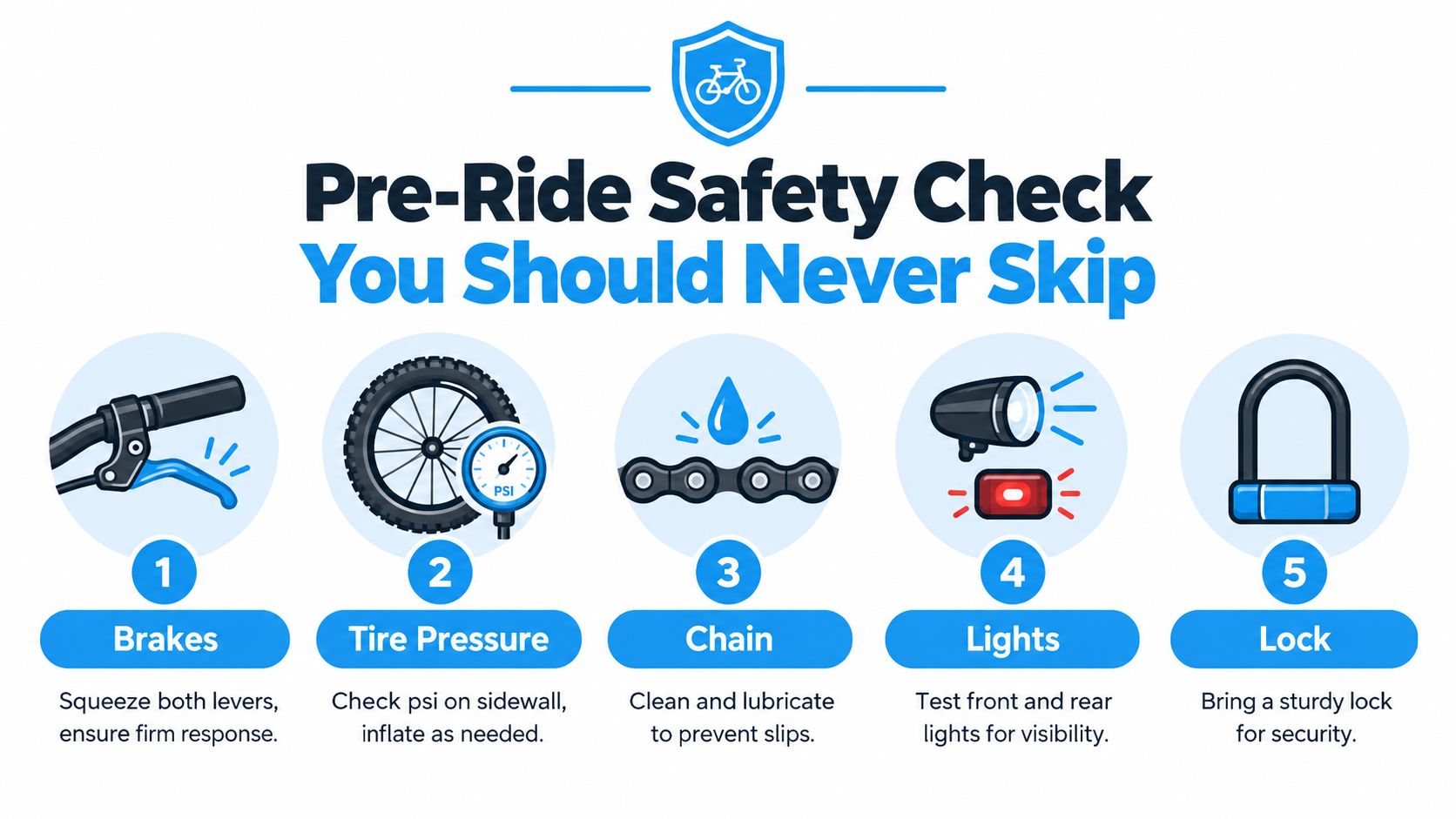
Pre-Ride Safety Check You Should Never Skip
A five-minute inspection at the counter, dock, or pickup point costs less than the damage dispute you can prevent before rolling away.
Check the fit before you move
Stand over the frame first. You want clearance, not contact. Then sit and set the saddle so your extended leg keeps roughly 25 to 30 degrees of knee flexion at the bottom of the pedal stroke, with the ball of your foot over the pedal axle. Keep the handlebar about 1 to 2 inches below the saddle and the reach natural, then confirm it with technical fitting guidance.
If your knee, hips, or shoulders already feel awkward before you start riding, the bike is wrong for you.
Run the mechanical check
Test both brake levers. Spin each wheel and listen for rubbing. Check tire pressure and sidewalls, then make sure the quick releases or thru-axles are secure. Shift through a few gears, test the bell and lights, and take a short slow ride before you commit to a longer route.
A well-fitted bike should feel calm. If the bars pull to one side, the brake cable drags, or the saddle keeps forcing you forward, fix it before you leave. Shared-bike research also shows that saddle height matters, and low settings can increase knee load, so do not accept a poor fit just because the bike is shared bicycle-sharing fitting study.
Do this part well and you cut the chance of a mechanical complaint turning into a bill later.
Where Cheap Rentals Get Expensive
The cheapest listing is often the one with the nastiest surprise. A bargain city bike can look harmless until the provider points to a damage clause, a battery rule, or a theft condition that was buried in the rental terms. That's how travelers end up paying more than they expected without ever taking a “luxury” option.
Four questions that matter more than the daily rate
- What's covered if the bike is stolen? Theft protection varies, and some policies fall apart if you didn't use the provider's lock.
- What's the damage exposure? A low rent can hide a large excess, and that can swallow the savings instantly.
- What happens with the battery on an e-bike? Battery damage or mismatch can be expensive if the provider says you used the bike outside the rules.
- What support exists if the ride ends badly? Roadside help, accident reporting, and liability coverage matter more than a flashy quote.
Cheap rentals also get expensive when riders ignore the route. After-dark riding, riding under the influence, or crossing into areas outside the permitted zone can void protection. That's not a theoretical problem, it's exactly how renters lose ground when the bill lands.
The bike-share boom made it easier to rent, but it didn't make every rental a safe bet for every ride. U.S. docked bikeshare trips rose 4.2% from July 2024 to July 2025, and September 2024 to September 2025 trips across eight large systems rose 5.7%, with San Francisco up 38.6% and Chicago down 13.0% U.S. DOT bikeshare data. That uneven pattern says what travelers already know on the ground, availability and usefulness depend on the city, the route, and the day.
If Something Goes Wrong Mid-Rental
Stop, photograph everything, and contact the provider before you try to “just ride it back.” If there's a flat, a crash, theft, or battery failure, your first job is evidence, not improvisation. Save the rental agreement, the access or checkout confirmation, timestamped photos, and any incident number from local authorities.
Keep the paper trail: if the provider later disputes pre-existing damage, your photos and receipt are the only things that matter.
If you're injured, get help first. If the bike is stolen, report it quickly and follow the local process the provider asks for. Then keep every message, because deposit disputes and insurance claims usually turn on timing and documentation, not on who sounded more convincing at the counter.
A clean exit from a bad rental starts with proof. A messy one starts with assumptions.
Easy Travel Bookings lets you compare bike rental options alongside hotels, flights, transfers, and other trip essentials in one search, so you can check the rental terms before you commit. If you want to avoid the usual surprises, use Easy Travel Bookings to look at the ride, the route, and the total trip cost in the same place.