
Standard city bikes usually land around $25–$40 per day, while e-bikes run $40–$80 per day. If you only need a short ride, hourly pricing often starts around $8–$15 for standard bikes, and that's where travelers get tricked into thinking they've found a bargain.
The core question isn't the headline rate. It's how fast the bill grows once you add the rental model, the bike class, the destination, and the extras shops tuck into the checkout flow.
Table of Contents
- What It Really Costs to Rent a Bike in 2026
- Rental Models That Change the Price
- Price Differences by Bike Type
- How Destination Affects the Final Bill
- Hidden Costs Most Travelers Miss
- Smart Ways to Save on Bike Rentals
- Where to Book for the Best Deal
- Putting It All Together Before You Ride
What It Really Costs to Rent a Bike in 2026
Four pricing levers determine the final bill: rental model, bike class, destination, and add-ons. The daily rate remains a useful starting point for how much does it cost to rent a bike, but it is not a complete budget. The ranges shown in the infographic and outlined by The Biking Traveler give you a baseline, not a guaranteed checkout total.
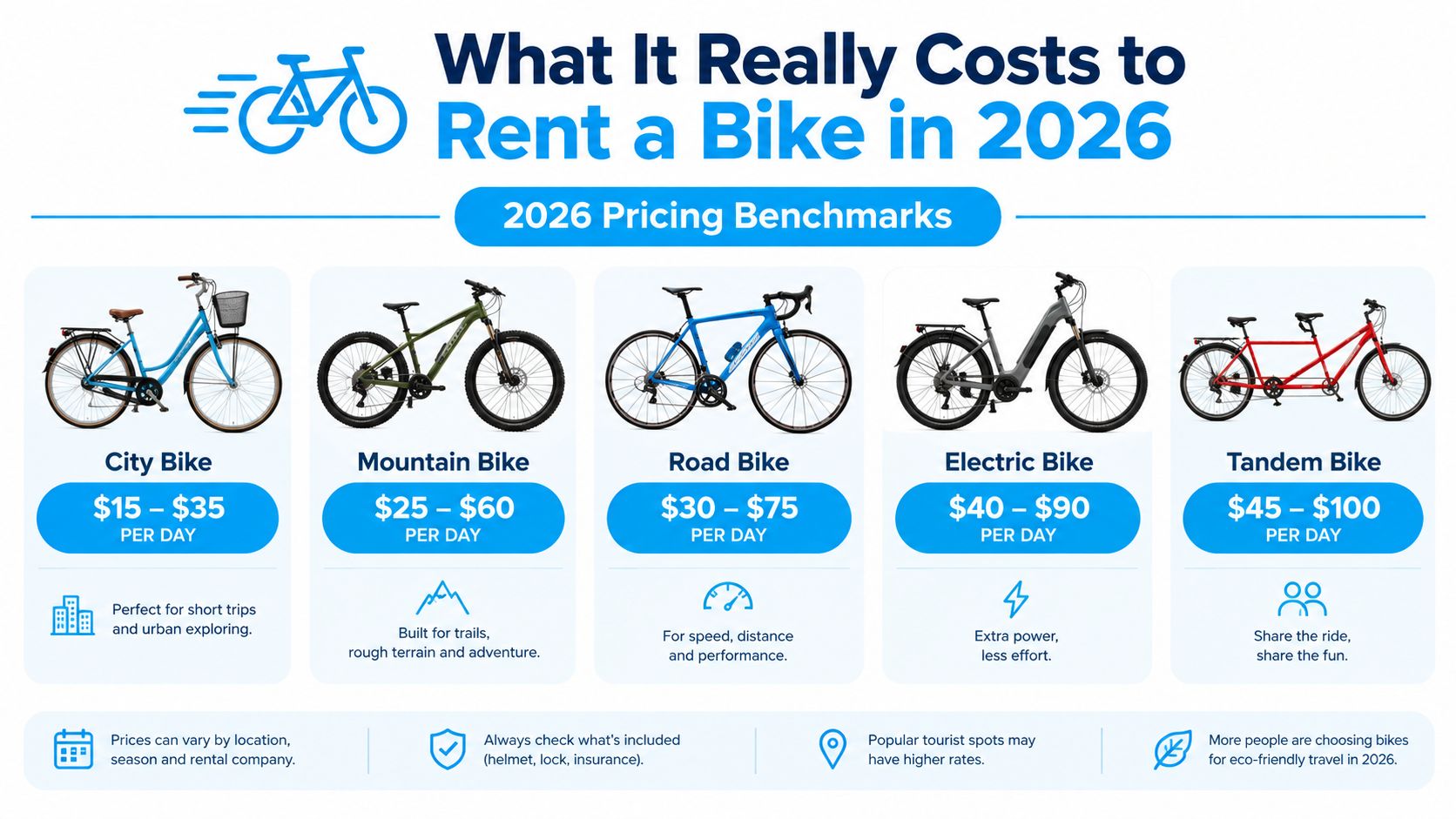
A quick city spin, half-day sightseeing loop, full-day touring ride, and week-long holiday use different pricing structures. Compare the way you plan to ride before comparing advertised rates.
The four levers that move the price
The first lever is the rental model. Hourly bike-share can become expensive when ride time, idle time, access fees, or an inconvenient return station enter the calculation. Fixed half-day and full-day rentals usually make the bill easier to predict. LendControl also separates rental costs by duration and bike type, which makes a useful comparison point.
The second lever is the bike class. An e-bike costs more than a basic hybrid or cruiser because it requires a battery, charging, maintenance, and more expensive replacement parts.
The third is destination demand. Coastal resort towns, dense capitals, and mountain gateways price differently because fleet availability and turnover vary. Booked-out markets give shops more room to charge.
The fourth is the add-on layer, including helmets, locks, bags, insurance, deposits, taxes, and delivery. A deposit may not be a fee, but it still affects the cash you need available.
Practical rule: budget from the quoted rate plus gear, taxes, the deposit hold, and the return policy. A low base rate matters only when those conditions are clear.
Rental Models That Change the Price
The rental model often matters more than the advertised bike rate. Bike-share works for short point-to-point trips, but the meter keeps running while you stop for photos, lunch, or a museum visit. Add a start fee, access charge, or awkward return station, and a cheap-looking ride can cost more than a shop rental. LendControl offers a useful comparison of rental costs by duration and bike type.
Match the model to your riding time
Use bike-share for brief city hops when you can return the bike promptly. Check whether the system charges by the minute, by ride, or through a day pass. A day pass may still impose time limits or extra charges when a single ride runs too long.
Half-day rentals suit sightseeing loops and errands. They give you a fixed cost without forcing you to pay for a full day. Full-day rentals usually win once your route occupies most of the daylight, especially when a lock and helmet are included.
Here is the practical break-even test: a three-hour sightseeing loop at $12 per hour costs $36, while a $35 full-day rental is cheaper before any lock or helmet fees. The day rate wins once you pass 2.5 hours, provided the shop's extras do not erase the difference.
Weekly rentals suit travelers who are staying in one place and riding repeatedly. Ask for the weekly total, then check whether maintenance, replacement, insurance, and late-return terms are included. The lowest hourly cost is useful only if you will ride often.
| Rental Model | Price Structure | Best For | Main Risk |
|---|---|---|---|
| Hourly bike-share | Usage-based, sometimes with access fees | Short city hops | Idle time and extended rides |
| Half-day rental | Fixed price for a shorter block | Loops and relaxed exploring | Paying for unused hours |
| Full-day rental | Fixed daily rate | Day trips and touring | Add-on fees at checkout |
| Weekly rental | Discounted total for repeated use | Multi-day holidays | Paying for days you do not ride |
Before booking, estimate your actual saddle time, stops, and return plan. Compare the complete bill, not the first-hour rate or release fee.
Price Differences by Bike Type
Bike type changes the bill because it changes the shop's maintenance, replacement, and theft risk. Standard city bikes and hybrids usually offer the best value for ordinary sightseeing. They are simple to maintain, widely available, and suited to paved streets. E-bikes cost more because motors, batteries, charging, and specialized servicing add expense, while theft risk can raise the deposit or insurance requirement (LendControl).
Match the bike to the route
Choose the city bike for a flat route under 15 km. Reserve the e-bike for hills, strong headwinds, or days above 30 km, when battery assistance saves time and energy. Paying for electric assistance on an easy, short ride wastes money. Confirm the battery range and charging policy before accepting the bike.
Mountain bikes justify a higher rate on rough trails because suspension, stronger frames, gearing, and heavier component wear cost more to maintain. Road bikes often sit above city bikes because their lighter frames and specialized parts have greater replacement value. Pick them for speed and longer paved rides, not casual trips through busy streets.
Children's bikes, tandems, cargo bikes, and fat-tire bikes occupy a separate price tier. Their narrower demand means fewer units and more specialized hardware. Rent one only when the route or group requires it.
| Bike Type | Typical Position | Weekly Pricing | What Drives the Price |
|---|---|---|---|
| Standard city or hybrid | Lowest tier | Often the best value | Broad availability and low maintenance |
| Mountain bike | Above standard | Varies by market | Suspension, gearing, and tougher frames |
| Road bike | Often above mountain | Varies by market | Lightweight parts and replacement value |
| E-bike | Premium tier | Higher total cost | Battery, motor service, charging, and theft risk |
| Children's, tandem, cargo, or fat-tire | Separate specialty tier | Varies by market | Niche inventory and specialized hardware |
Book the least expensive bike that safely fits the terrain. Features you will not use only inflate the final cost.
How Destination Affects the Final Bill
Location changes the price more than most travelers expect. A cheap cruiser in one city can cost as much as a mid-range e-bike somewhere else, and the reason is usually not quality. It's demand, seasonality, and how tightly a local operator can keep bikes in circulation.
Tourist cities don't price the same way
Coastal resort markets often push standard bikes toward the lower end because there's steady casual demand and plenty of competition. By contrast, dense tourist capitals usually price standard bikes higher because the same fleet can be turned over all day and riders are willing to pay for convenience. Mountain and wine-country destinations often charge more again because the bikes are more specialized and the inventory is smaller.
That's why a traveler can see a simple cruiser near the beach and a heavily spec'd e-bike in the city with very different price tags. One is built for casual traffic. The other is tied to insurance, theft exposure, and more specialized gear. For a broader trip-planning comparison, the same logic you use for car rentals applies here too. Compare the total trip value, not just the headline rate.
| Destination Type | Standard Bike per Day | E-Bike per Day |
|---|---|---|
| Coastal resort towns | Lower end of the market | Higher, but still competitive |
| European capitals | Mid to upper range | Premium pricing is common |
| North American tourist hubs | Often pricier than casual markets | Highest end of many city listings |
| Mountain or wine-country destinations | Above urban basics for specialty bikes | Strong premium for off-road or electric models |
Local supply matters just as much as demand. If a destination has a dense bike network, the fleet rotates quickly. If the city depends on tourists, the rate usually reflects that.
Hidden Costs Most Travelers Miss
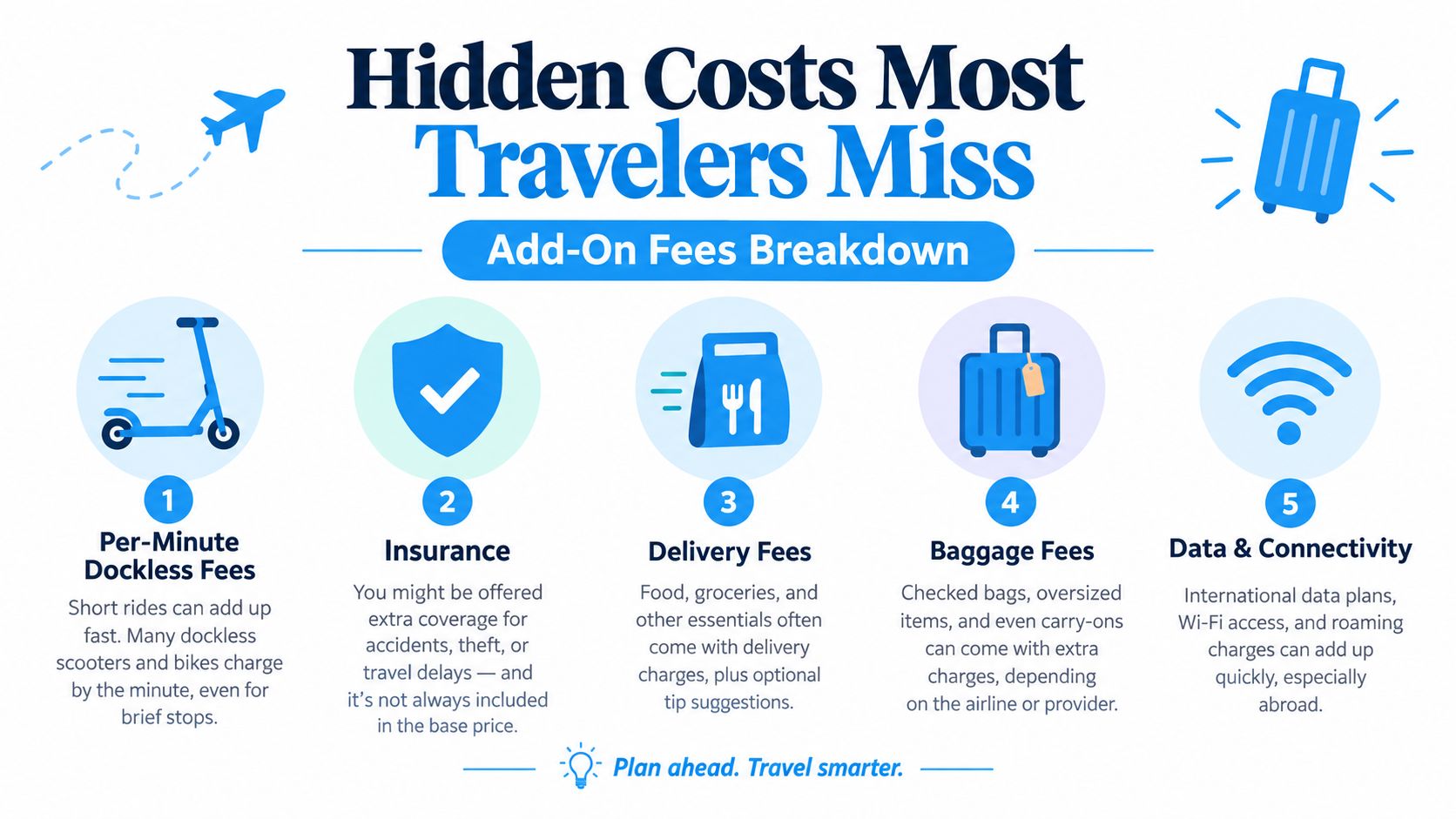
The base rate is only part of the bill. The hidden charges are where travelers get irritated, because they make a reasonable quote turn into a surprisingly expensive rental. Bike-share systems are especially good at hiding this pain, since short rides can look harmless until the clock runs longer than planned. New York's Citi Bike system charges around $4.99 for a traditional bike and $10.69 for an e-bike for a single 15-minute ride, while San Francisco's Bay Wheels is cheaper at $3.99 and $8.49 (IBO NYC).
The fees that quietly add up
Add-ons are the next trap. Shops may charge for helmets, locks, and baskets, or roll them into the rate without making it obvious. Insurance waivers are another common upsell, and they're not the same thing as full protection against theft or damage.
Deposits matter even more than many travelers realize. Neutral industry guidance says security deposits of about $50–$200 per bike are standard, while some bike and motorcycle rental listings require refundable holds from $100 up to $2,000 (LendControl). That money may come back later, but it still ties up your budget in the meantime.
My rule: if the rental desk can't explain every fee before you sign, walk away.
Pay for the lock if you're parking in a busy city. Decline insurance that duplicates coverage you already have. Be cautious with one-way drop-offs and after-hours returns, because those are classic sources of surprise charges.
Smart Ways to Save on Bike Rentals
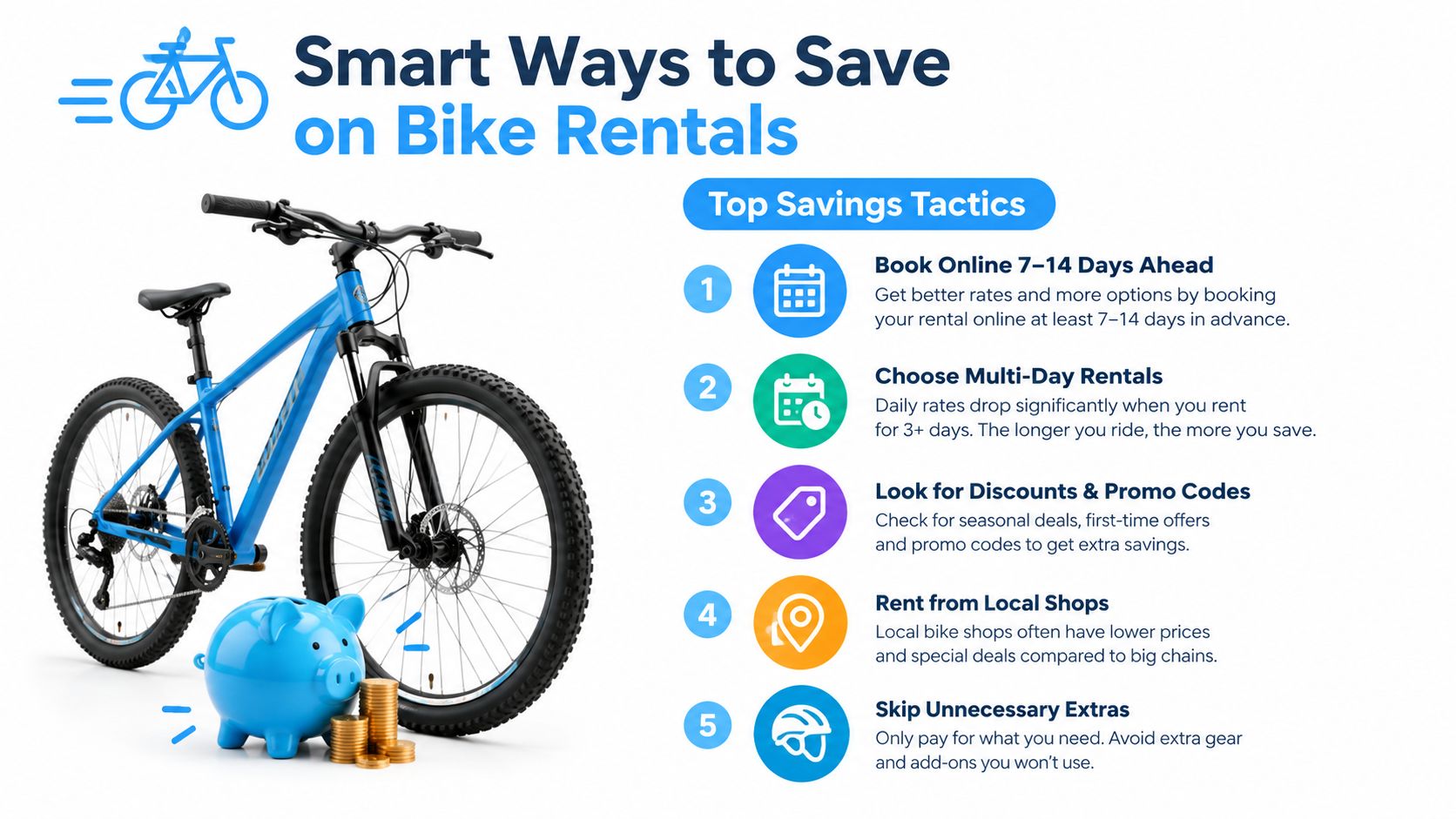
Book early if you want the better rates. Shops commonly soften the price on multi-day rentals when you reserve online in advance, and that matters more than haggling at the counter. If your trip is happening in a shoulder season or on a weekday, the discount pressure usually works in your favor.
Spend less without cheaping out
The easiest savings comes from choosing the right model for the ride. Don't use an e-bike for a flat city loop just because it sounds convenient. A standard city bike is usually the better buy when you're covering easy terrain and don't need extra power.
Skip dockless apps for anything longer than a short hop. Once the meter starts to push past a casual sightseeing budget, the daily rental is usually the smarter move. If you're comparing departure timing and travel habits more broadly, the same planning mindset applies as it does when you check the best day of week to book flights.
- Book online ahead of time: You'll usually get a cleaner rate than a walk-up rental.
- Choose shoulder seasons and weekdays: Less demand gives shops room to discount.
- Use a standard bike on flat routes: Don't pay e-bike prices for easy terrain.
- Compare bundled insurance carefully: Don't buy duplicate coverage.
- Ask about partner codes: Hotels and local partners often have them, and they can trim the quote.
The smartest savings move is boring but effective. Total the fees before you confirm, then decide whether the convenience is worth the price.
Where to Book for the Best Deal
Local rental shops usually give the best value for full-day and multi-day hires. They tend to have the widest selection, the clearest bike-specific advice, and fewer surprises at pickup. If you care about the exact frame, fit, or model, start there.
Hotel desks are convenient but often pricier. That markup can be worth it if you're short on time or want everything arranged in one stop, but it rarely wins on price. Bike-share apps are the opposite, they're built for quick movement, not for a full day of sightseeing.
Aggregators are the best middle ground when you want to compare operators side by side. That's the smartest way to spot differences in bike type, included gear, and pickup rules before you hand over a card. If you're comparison shopping, start with rent-a-bike listings and compare the total, not just the base price.
| Channel | Best For | Typical Price Range | Trade-Off |
|---|---|---|---|
| Local rental shop | Full-day and multi-day rentals | Usually strongest for value | Requires an in-person stop |
| Hotel or resort desk | Convenience and bundled planning | Often higher than shop pricing | Markup for simplicity |
| Aggregator | Side-by-side comparison | Depends on operator | Best for research, not instant pickup |
| Bike-share app | Short urban hops | Cheap at first, costly over time | Poor value for long rides |
Best channel by trip length: use apps for very short hops, aggregators for comparison, and local shops for anything longer.
The rule is simple. Book where the trip length and bike type match the channel, not where the glossy interface looks easiest.
Putting It All Together Before You Ride
Start with time, not with price. Count the hours you'll ride, then match the rental model to that window. A short city hop belongs in a bike-share app, a half-day sightseeing loop belongs in a half-day rental, and a full day on the road should be priced as a full-day rental.
Then match the bike to the terrain. Flat streets call for a standard city bike, mixed surfaces may justify a hybrid, and rough routes need more specialized gear. Don't pay for an e-bike because it feels premium. Pay for it because the route or your energy level genuinely calls for it.
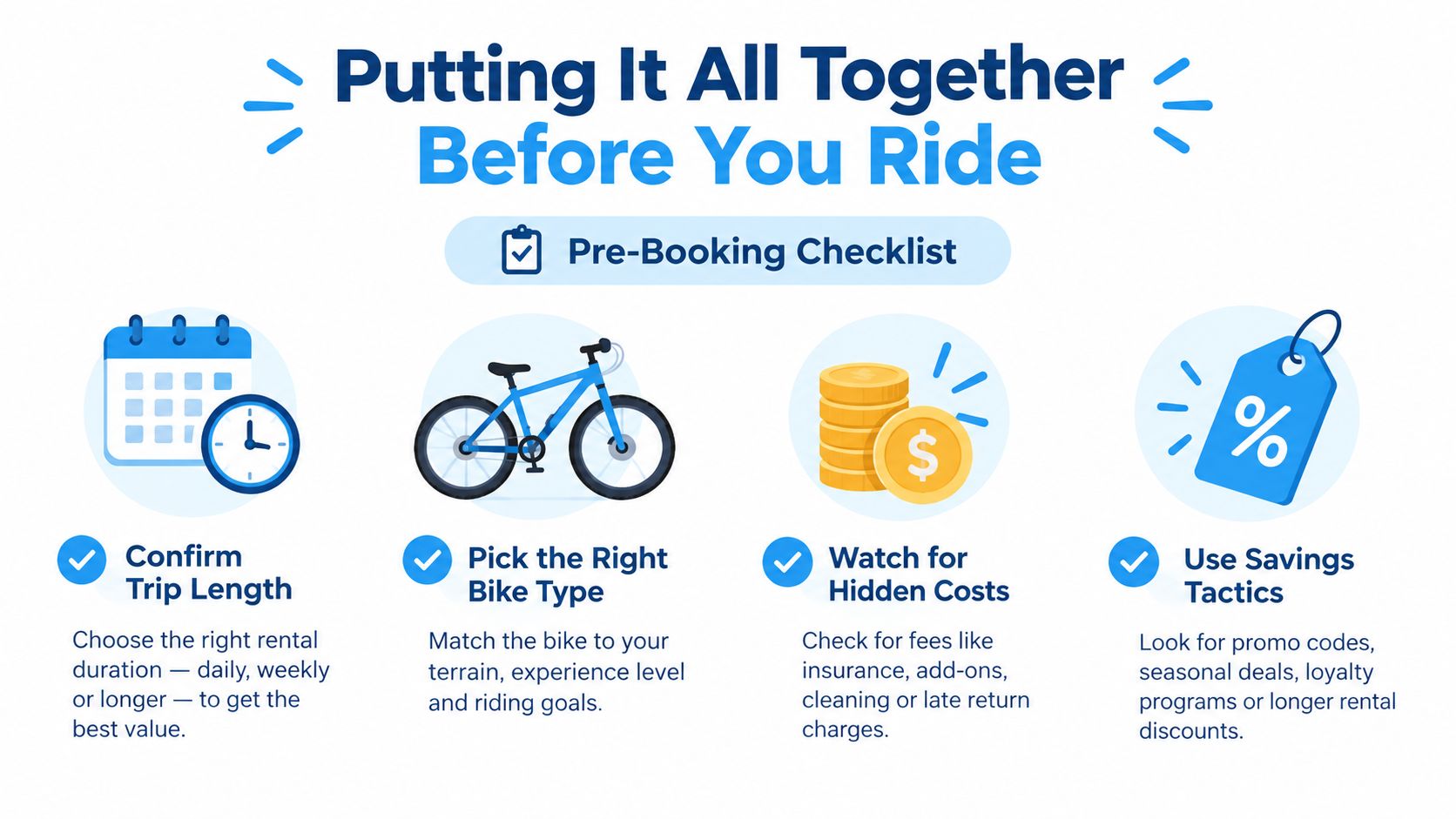
Pre-booking checklist
- Confirm the trip length: Decide whether you need minutes, hours, a day, or a week.
- Choose the right bike class: Match the bike to the surface, not to the upsell.
- Read the fee policy line by line: Check deposits, insurance, late returns, and gear charges.
- Compare at least two booking channels: Use the quotes against each other before you pay.
Finally, carry a lock, your ID, and any gear you know you'll need. If the shop can't clearly explain the return time and the hold on your card, don't book it.
Easy Travel Bookings gives you a fast way to compare bike rental options alongside other trip essentials, so you can spot the full total before you confirm. If you want a cleaner way to price a rental, compare options, and avoid the usual add-on traps, visit Easy Travel Bookings and start with the listings that fit your destination and ride length.
Refined using Outrank tool