

You're trying to book a hotel room for a parent, a kid, a colleague, or a friend, and the reservation form keeps making it look simpler than it is. It isn't simple. Paying for the room is the easy part, the problem is making sure the hotel knows who is sleeping there and who is only funding the stay.
That's why third-party hotel booking keeps going wrong at the front desk. People assume a card number is enough. It isn't. Hotels care about identity, authorization, and check-in matching, and if those three things don't line up, the guest can get stuck while the desk sorts it out.
Table of Contents
- The Quick Answer for Booking on Someone's Behalf
- Why the Law and the Hotel Care Who Is Sleeping in the Room
- Building the Reservation So the Right Person Owns It
- Choosing How to Pay Without Tripping the Property
- What the Guest Will Actually Face at Check-In
- Digital Identity, Mobile Wallets, and the New Third-Party Reality
- Your Handoff Checklist and the One Rule That Prevents Most Failures
The Quick Answer for Booking on Someone's Behalf
If you need the short version, here it is. Book the room under the actual traveler's legal name, not yours. Then separate the roles clearly, the guest is the person arriving, and the payer is the person funding or guaranteeing the stay.
That one distinction solves most of the mess. The hotel needs the arriving guest's name, contact details, and, in many cases, their own ID at check-in. Your card or authorization only handles the money side. It doesn't magically transfer check-in rights.
Practical rule: the reservation should identify the person who will physically check in, and the hotel should know upfront that someone else is paying.
Before you pay, confirm the property accepts third-party bookings and ask what they want, a prepaid reservation, an authorization form, a virtual card, or a separate incidental card from the guest. If you skip that step, you're guessing, and hotels don't reward guessing.
| Role | What they do | What the hotel needs from them | Typical failure point |
|---|---|---|---|
| Guest | Checks in, stays in the room, shows ID | Full legal name, contact details, photo ID, sometimes a personal card | Booking is made under the wrong name |
| Payer | Pays for the room or authorizes charges | Billing details, written authorization if required, payment method | Card is sent without approval or in an unsecured way |
A good starting point is to compare properties before you commit, especially if you want a hotel that's flexible on third-party reservations. If you're still choosing where to book, this hotel price comparison guide can help you narrow options before you deal with the paperwork.
Why the Law and the Hotel Care Who Is Sleeping in the Room
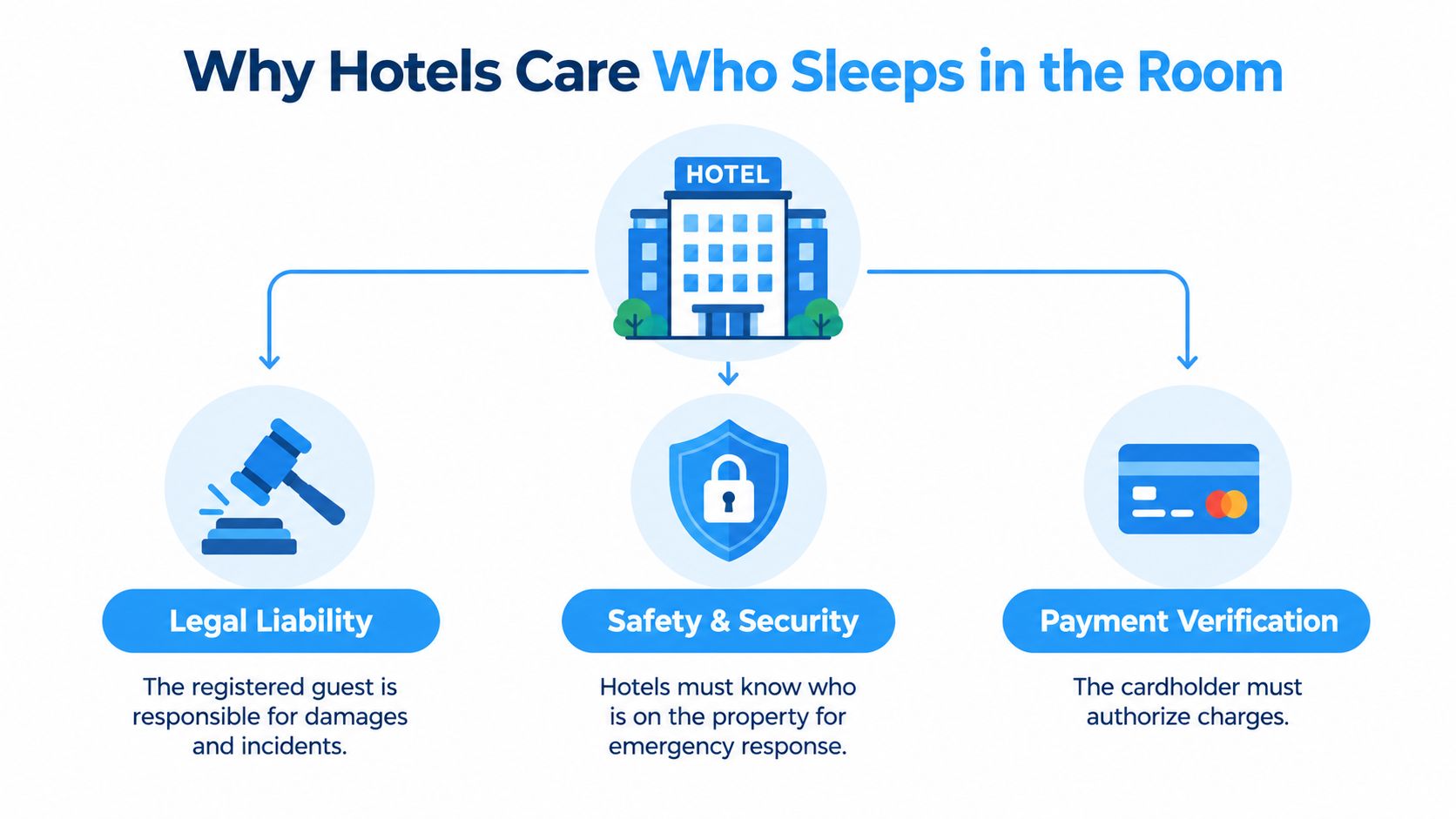
Hotels don't ask for the guest's identity because they're being difficult. They do it because registration rules, safety procedures, and payment controls all depend on knowing who occupies the room. In Minnesota, lodging statutes enacted in 1937 required hotels to collect each guest's name and home address, the names and addresses of accompanying travelers, and vehicle details where applicable, and the information had to be kept accurately for one year; accommodation could be withheld until registration was completed (Minnesota Supreme Court record).
Los Angeles hotel-record rules have existed continuously since 1899, and the modern framework required records like the guest's name and address, party size, vehicle information, arrival time, scheduled departure, room number, rate, amount collected, and payment method, with some guests also required to show photographic identification and records generally kept for 90 days (Supreme Court record). That's the point most travelers miss. The hotel isn't just selling a bed, it's creating a traceable record of who stayed, who paid, and what happened during the stay.
What that means in practice
If the reservation is under your name but your relative shows up with their ID, the front desk has to untangle the mismatch before they hand over keys. Some hotels will fix it quickly. Others won't. A prepaid card doesn't override a registration rule, and a reservation number doesn't prove the absent cardholder is authorized to check in.
The cleanest setup is blunt and boring. Put the actual guest on the reservation, disclose that someone else is paying, and make sure the hotel has enough information to match the person at the desk with the person in the booking record. If the guest's ID doesn't line up with the reservation, you've already invited friction.
The more the hotel has to infer, the more likely the check-in stalls.
That's why the reservation name should match the guest's government ID exactly. If the payer is different, treat that as a separate field, not a hidden workaround.
Building the Reservation So the Right Person Owns It
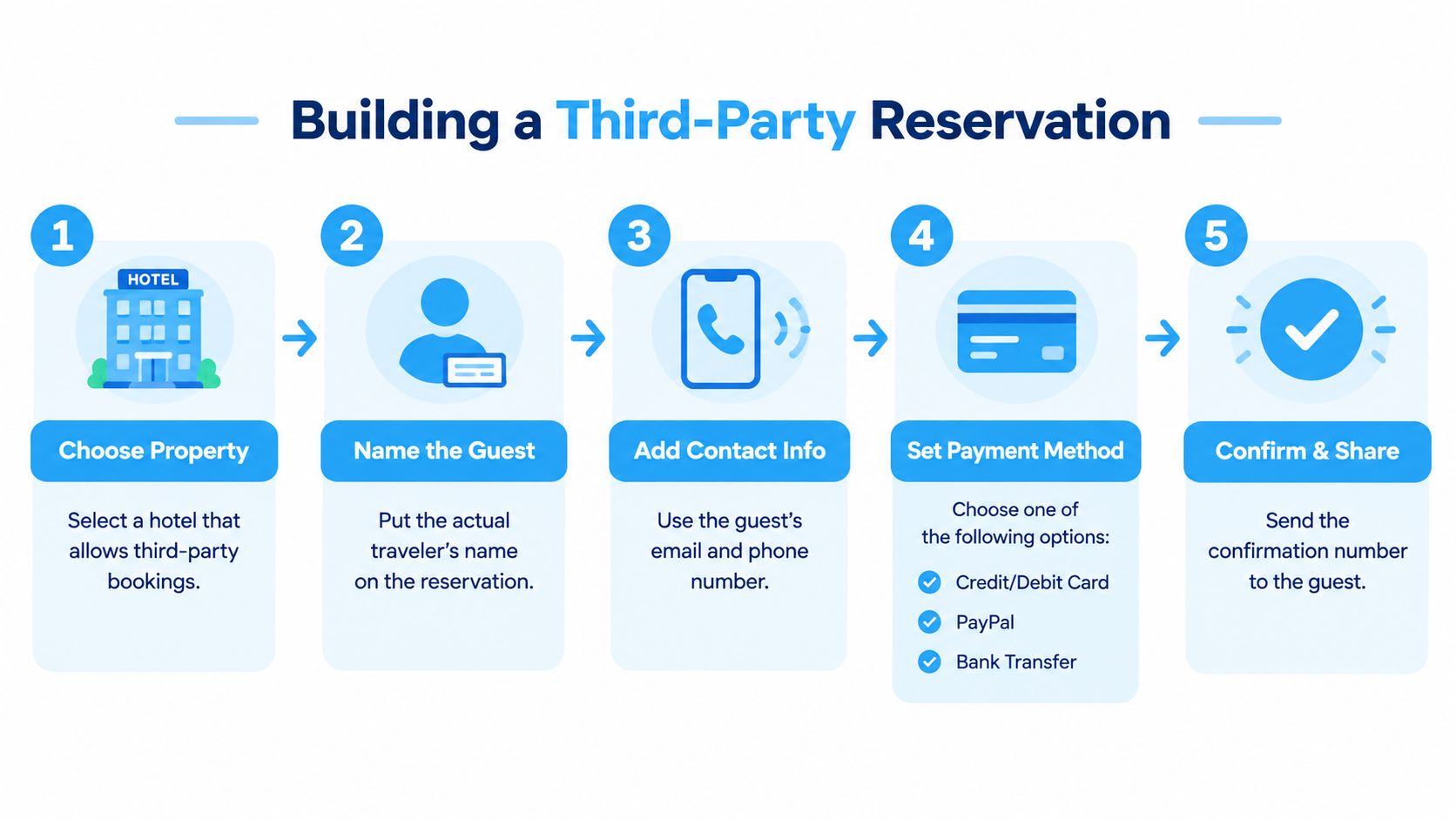
Start with the property itself. Pick a hotel whose cancellation policy and third-party rules are workable before you enter any card details. If the hotel's booking flow is rigid, don't try to outsmart it. Move on.
Then put the traveler's full legal name in the primary guest field exactly as it appears on government ID. Not a nickname. Not a family shorthand. Not the payer's name. If the booking engine lets you add phone and email for the guest, use the guest's contact details, because the property may send arrival instructions or verification requests there.
Keep the payer separate, on purpose
If you're funding the stay, disclose that clearly. Don't hide the payer behind the guest's name, and don't assume the booking engine's payment field is enough to tell the hotel what's happening. Call or message the property directly and ask whether third-party payment is accepted. Get the answer in writing, and keep the confirmation number.
A useful workflow is simple:
- Choose the property carefully: favor a hotel that clearly accepts third-party reservations and spells out its check-in rules.
- Enter the guest correctly: use the traveler's legal name, not yours, and match their ID.
- Add the guest's own contact details: use the information the property will rely on.
- Flag the payer separately: make it obvious that someone else is covering the stay.
- Get written confirmation: save the authorization note, form, or email from the hotel.
A reservation number alone is not proof of authorization. That's especially true if the front desk needs to verify the cardholder or ask whether the stay was prepaid. If you want a direct booking walkthrough, this hotel booking guide is a useful companion.
For a cleaner handoff, send the guest a short note with the hotel name, booking reference, and the exact name that appears on the reservation. If the front desk questions the setup, the guest should not improvise. They should point to the hotel's own confirmation and ask for the manager on duty if the desk can't reconcile the record.
Choosing How to Pay Without Tripping the Property
Payment is where third-party reservations usually break. The room can be booked correctly and still fail at the desk if the hotel does not know who pays, who stays, and what it may charge.
Prepay, authorize, or issue a virtual card
Prepaying room and tax works best when you want the room charge settled before arrival. It lowers the odds that the guest is asked for the payer's card at check-in, but it does not remove the hotel's need to verify the person sleeping in the room. The guest may still need a card or deposit for incidentals, and hotels often place holds for minibar, parking, meals, or damages. A widely cited bank travel guide puts that hold at roughly $50 to $200 per night, though the actual amount depends on the property and market (Citi travel guide).
A credit-card authorization form is the right move when the hotel accepts it and you need the property to charge a card that will not be present. Make the approval narrow. List exactly what the hotel may charge, room and tax only, room plus incidentals, or all charges. A maximum approved amount is cleaner than open-ended permission.
A virtual card is often the cleanest setup if your bank or payment provider supports it. It reduces exposure and keeps card data out of email threads. But do not assume every hotel can process it. Some properties still insist on a traditional card or signed authorization at check-in.
If you cannot or do not want to put a card on the reservation at all, this guide on how to book a hotel without a credit card covers the alternatives.
Choose the method by property type
Chain hotels are usually more predictable. Boutique hotels and smaller properties are often stricter and more manual. Resorts with heavy incidental spending are the most likely to want a guest-side card even when the room is prepaid. That is the hotel protecting itself against charges that happen after arrival.
Emailing card photos is careless. Posting card numbers in chat is worse. A booking platform's payment guarantee does not prove the hotel will accept the setup. If the property has a secure authorization form, use it. If it does not, ask for its process and follow that instead.
My advice: if the hotel has not confirmed the payment method in writing, treat the arrangement as unapproved.
What the Guest Will Actually Face at Check-In
The desk is where theory meets reality. Your guest may arrive tired, with a suitcase, and find out the reservation name doesn't quite match the ID, or the front desk wants a card that isn't in their wallet. That's not unusual, it's the normal failure pattern when the booking wasn't built carefully.
The usual friction points
If the name on the reservation doesn't match the government ID, the desk will pause. If the room was prepaid but the hotel still wants an incidental hold, the guest will need their own card unless you arranged otherwise. If the hotel wants the payer to call directly, that usually means the desk still doesn't have enough authorization on file.
The guest should have three things ready at arrival, the ID, the confirmation number, and the payment card or backup method the hotel said it would accept. If the hotel requires extra verification, the guest should stay calm and ask the desk to check the notes on the reservation instead of starting from zero.
What to fix before the guest leaves home
Tell the guest exactly what is prepaid and what is not. Tell them the hotel's address and phone number. Tell them whether they need a personal card for incidentals, because that's the detail people forget most often.
| Check-in issue | What the guest should have ready | What the booker should have done |
|---|---|---|
| ID mismatch | Government-issued photo ID | Put the traveler's legal name on the booking |
| Card request | Personal card or authorized payment method | Confirm the hotel's payment rule in advance |
| Deposit hold | Sufficient available funds on a card | Clarify incidentals before arrival |
| Missing record | Confirmation number and hotel contact | Obtain written authorization and share it |
Privacy matters too. The guest should share only what the hotel needs for verification, not their entire personal or financial history. Requirements vary by country, state, and property, so the smart move is not to guess. It's to confirm the hotel's process before the trip starts.
Digital Identity, Mobile Wallets, and the New Third-Party Reality
A third-party booking that once failed because of a card mismatch now fails because the hotel cannot trust the identity chain. That is the shift. Hotels care less about who paid and more about who can stand at the desk, prove they belong there, and satisfy the property's check-in rules without creating a privacy mess.
Industry reporting from ITB Berlin 2025 points to identity verification and the European Digital Identity Wallet as growing priorities for secure, low-friction check-in and GDPR compliance (ITB Berlin 2025 insights on hotel payments). Oracle's 2025 hospitality research reports that 49.1% of travelers wanted contactless payments retained in hotel experiences (Oracle hospitality research). The message is clear. Guests want faster handoffs, and hotels want tighter control over who checks in.
That changes how third-party reservations should be built. A virtual card helps with payment, but it does not solve identity. The cleaner model is a verified guest identity paired with a secure remote payment tool, so the hotel gets the right payer and the right arriving guest without passing sensitive details back and forth.
Digital ID wallets, mobile wallets, and contactless check-in are pushing the industry in that direction. They reduce friction only if the hotel supports them and the guest can use them.
Use digital first, fallback second
The failure point is obvious. Plenty of guests still do not have a compatible phone, a digital wallet, or the right document ready for scanning. So the smart approach is to use the digital route when the property supports it, then keep a simple fallback ready.
That fallback is straightforward: direct hotel confirmation, a signed authorization if the hotel asks for one, physical ID at arrival, and a separate card for incidentals unless the property says otherwise. If you are booking for an older traveler, an international guest, or anyone without the right device, do not rely on contactless check-in alone.
Digital tools make the handoff easier. They do not replace the hotel's need to know exactly who is standing at the desk.
Your Handoff Checklist and the One Rule That Prevents Most Failures
Send the guest a short handoff message the day before arrival. Include the confirmation number, hotel name, address, phone number, exact name on the reservation, cancellation deadline, what's prepaid, what still needs a card, and the maximum incidental hold the property said to expect. Add one line that tells them to mention the written authorization if the front desk questions the booking.
The one rule that saves most third-party reservations is this, match the reservation to the arriving guest's legal identity, and authorize everything else in writing. If you do that, most of the common failures never get a chance to happen.
Easy Travel Bookings helps travelers compare hotel options and book through trusted providers without the usual search clutter. If you're arranging a stay for someone else, use Easy Travel Bookings to compare options first, then apply the identity-and-authorization rules here before you finalize anything.