

You've found two hotel rooms in the same neighborhood, with similar photos and the same attractive nightly rate. One looks like the obvious bargain, so you click through quickly. Then the checkout page adds taxes, mandatory charges, parking, or a deposit, and the “cheap” room no longer looks cheap at all.
The safest way to book a hotel room is to stop treating the advertised nightly rate as the price. Compare the total stay cost, then judge that offer by its payment timing, cancellation rules, room details, and provider identity. A lower number is useful only when you know exactly what it includes.
Table of Contents
- The Moment You Realize the Headline Price Isn't the Real Price
- Walking Through the Booking Flow Step by Step
- Payment Timing Options and Which One Protects You
- Cancellation Policies That Quietly Cost You Money
- Scams, Lookalike Sites, and How to Verify Your Reservation
- Your Pre-Booking and Pre-Arrival Checklist
The Moment You Realize the Headline Price Isn't the Real Price
A traveler comparing Miami Beach hotels sees two near-identical listings at $159 per night. She selects the cheaper-looking option, enters her details, and reaches the confirmation page. The amount has changed dramatically because resort fees, destination charges, parking, and other mandatory items appear later in the process.
That shock isn't limited to one destination. BBB complaints describe hotel reservations where additional resort and accommodation fees totalled $519.80, with charges disclosed late in the purchase process. The lesson is simple: the advertised rate is a starting point, not a reliable measure of value. Read the BBB guidance on avoiding hotel booking scams before trusting an unfamiliar reservation provider.

What creates the gap
The difference between the displayed rate and the true price usually comes from line items that appear after the initial search:
- Taxes and service charges: These may be included in the first price or added later.
- Mandatory resort or destination fees: A room can look inexpensive until fixed property charges are added.
- Parking and breakfast: These may be compulsory, optional, or priced separately.
- Payment conditions: A prepaid rate may charge immediately, while another rate only guarantees the room with a card.
- Room restrictions: The lowest rate may apply to a smaller room, a different bed arrangement, or a nonrefundable category.
A hotel booking study of 382 independent tourists visiting Hong Kong found that only 16.5% reserved accommodation through a direct channel such as the hotel's own website or direct contact. The result is geographically specific, but it illustrates a practical reality: travelers often compare several channels before completing a reservation. The academic study supports the case for comparing both booking platforms and search-driven hotel discovery.
Practical rule: Never compare two hotel offers until the room type, total stay cost, payment timing, cancellation deadline, and provider are visible.
Use a comparison service such as Easy Travel Bookings' hotel search to reduce the time spent checking multiple channels, but still inspect the final provider page before paying. A low displayed rate is only a good deal when the final amount and booking responsibility are clear.
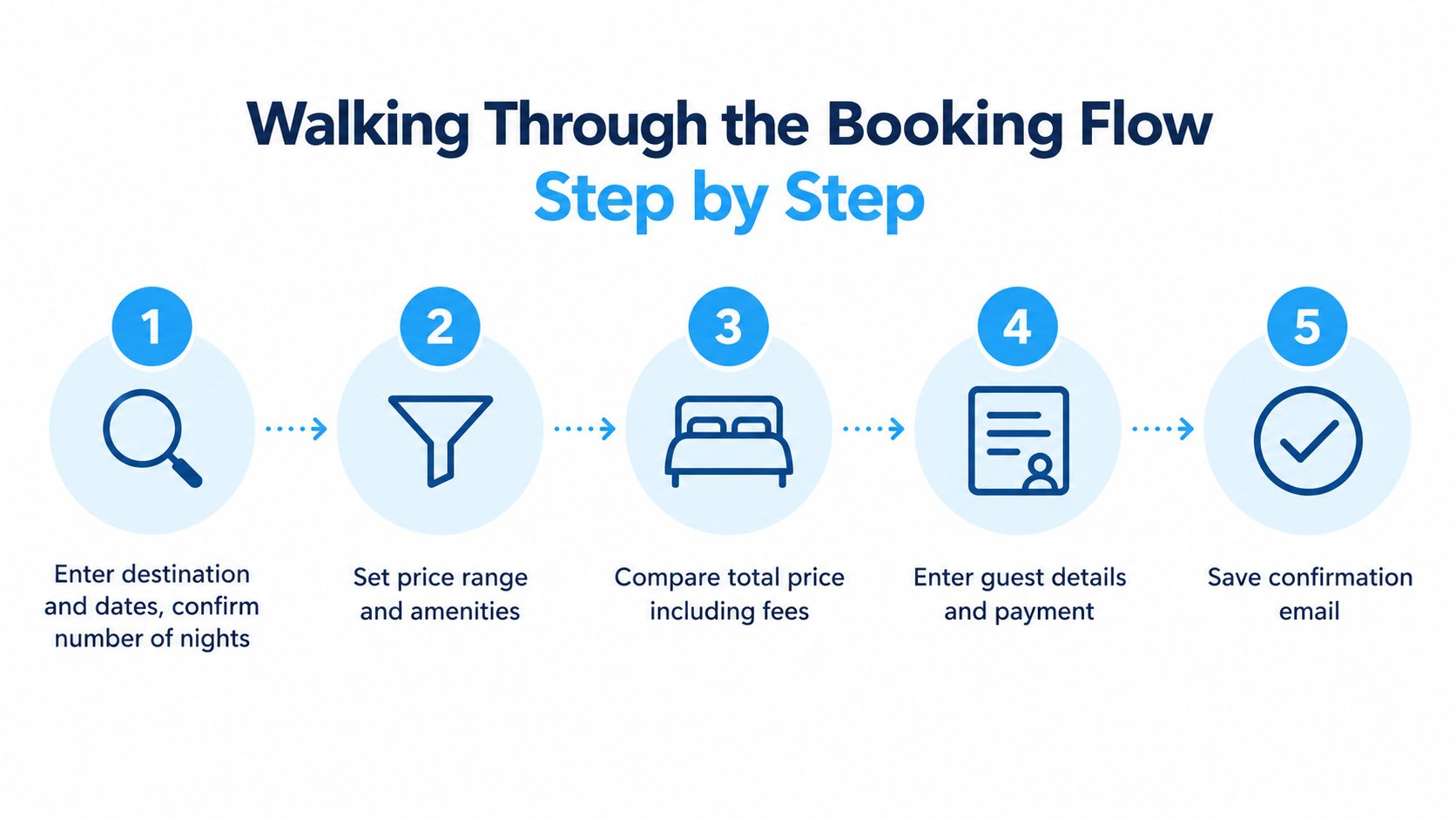
Walking Through the Booking Flow Step by Step
Booking a hotel room becomes much easier when you follow the same order every time. Don't begin with the cheapest result. Begin by making the search accurate.
Start with the trip details
Enter the destination and exact dates. Confirm the check-in and check-out dates, then check the number of nights. A small date error can change availability, pricing, and cancellation conditions.
Set occupancy correctly. Enter every adult and child, including children's ages where requested. Hotels may apply different rules to family occupancy, beds, breakfast, and child charges.
Filter for what you need. Choose the neighborhood first, then filter for essential amenities such as air conditioning, elevator access, parking, or a front desk that handles late arrival. A cheaper hotel that fails a basic requirement isn't cheaper if you need to replace it.
You can use hotel listings on Easy Travel Bookings to compare properties, but treat the results as a shortlist rather than a final decision.
Compare the room, not just the photograph
Two rooms can look alike in a thumbnail and differ in bed configuration, size, view, or occupancy. Open the room details and check whether the listed bed arrangement works for your party. Pay attention to terms such as “assigned at check-in,” “subject to availability,” or “city view,” which may not guarantee the feature you expected.
Next, compare the same room category across providers. Normalize each offer by the entire stay total, included taxes, mandatory fees, breakfast, payment timing, and cancellation terms. A room with breakfast included may beat a lower room-only rate once you calculate what you'd otherwise spend.
Finish with a receipt-level check
Before entering payment details, read the rate details block. Confirm the hotel name and address, room category, occupancy, check-in time, cancellation deadline, and whether payment occurs now or later.
Enter the guest name exactly as it appears on the traveler's identification. Use an email address and phone number you can reach during the trip. On the final screen, stop and verify the full amount again. After payment, save the confirmation email, supplier reference, and hotel contact details offline.
The reservation is trustworthy only when the confirmation identifies who took the payment, which hotel accepted the booking, what room was reserved, and what rules apply.
Payment Timing Options and Which One Protects You
The payment button tells you more than when money leaves your account. It also signals how much flexibility you have if plans change, how much control the hotel has over the reservation, and what you may need to dispute later.
| Payment Option | Typical Discount | Cancellation Flexibility | Best For | Main Risk |
|---|---|---|---|---|
| Pay now | Often presented as a lower rate, but compare the full total | Usually limited, depending on the rate | Fixed plans and scarce inventory | A change can make the discount expensive |
| Pay later | Varies by property and supplier | Often allows cancellation until a stated deadline | Trips where plans may shift | Missing the deadline can trigger a charge |
| Pay at property | Varies by property and currency | Depends on the hotel's written policy | Longer stays and trusted properties | Currency conversion, holds, or front-desk payment surprises |
Pay now
Prepaid offers can make sense when your dates are fixed and the hotel has limited inventory. They're a poor choice when flights, visas, health, family arrangements, or work schedules remain uncertain. Don't accept a cheaper headline rate until you've read whether the entire amount is refundable, partly refundable, or not refundable at all.
Pay later
A card guarantee can reserve the room without charging the full amount immediately. This is usually the most sensible option for an ordinary trip with some uncertainty, provided the cancellation deadline is written clearly and you can monitor it.
Pay at property
Paying at check-in or check-out gives you control over when the hotel bills you, but it doesn't remove risk. The final amount may depend on the hotel's currency conversion, incidental hold, or property-level charges. Use this option with hotels you trust and only after confirming what the property will authorize on arrival.
Save or screenshot the rate rules page before checkout. Your confirmation email should show the payment date, cancellation deadline, penalty, taxes, and supplier contact. If it doesn't, don't assume the flexible option is flexible.
Cancellation Policies That Quietly Cost You Money
Cancellation is a price feature, not small print. A room with a higher total can be the rational purchase if it protects you from a costly change, while a nonrefundable rate can be sensible when your plans are fixed.
Decode the policy structure
Fully refundable usually means you can cancel without a room penalty before a stated deadline. Check whether taxes and service charges follow the same rule.
Free cancellation with a penalty tier may allow a no-cost cancellation until one deadline, then charge one night or another defined amount after that point.
Nonrefundable means the rate may be lost even if you cancel soon after booking. Some properties allow changes without a refund, while others provide no useful remedy.
Partial-stay penalties can charge for the first night, several nights, or the full reservation. A no-show clause may apply a separate penalty if you fail to arrive or notify the property.
A hotel-policy study reported that common cancellation deadlines require notice at least 24 hours before arrival, sometimes by 6:00 p.m., or the guest may be charged the first night plus taxes. The same source reported an average no-show rate of about 5.4% among surveyed hotels, while cited historical ranges reached 5% to 15%. The hotel-policy research explains why properties commonly require a card guarantee.
Calculate the value of flexibility
Use this formula before booking:
Expected cancellation cost = probability of changing plans × cancellation penalty
Then add that expected cost to the advertised rate. You don't need false precision. If your plans are uncertain and the penalty is large, the flexible rate deserves serious consideration even when its headline price is higher.
For example, compare a flexible rate with a lower nonrefundable rate by asking three questions:
- What would I lose if I cancel?
- How likely is a change before the deadline?
- Is the price difference smaller than the financial risk I'm accepting?
Don't copy the common mistake of comparing a flexible nightly rate with a nonrefundable nightly rate as if they were identical products. They're not. One includes an option to change course.
| Policy Type | Deadline Rule | Typical Penalty | Best For |
|---|---|---|---|
| Fully refundable | Cancel by the stated local deadline | No room penalty before the deadline | Uncertain itineraries |
| Refundable with tiers | Penalty increases after each deadline | One night, several nights, or another stated amount | Travelers monitoring plans |
| Nonrefundable | No ordinary free-cancellation window | Often the amount paid or a defined portion | Fixed trips |
| Partial-stay penalty | Cancellation or no-show triggers a stay-based charge | One night or more, according to the policy | Reservations with clear arrival plans |
Record the deadline with its time zone, not just the date. Reconfirm 24 to 72 hours before arrival, especially if you'll arrive late, and contact the property if your arrival falls outside the stated check-in window.
Scams, Lookalike Sites, and How to Verify Your Reservation
“Book direct” isn't a complete safety strategy. A search advertisement or lookalike website can imitate a hotel brand, collect payment, and leave you with a reference number the property never received. The cheapest result isn't automatically legitimate either.
Identify the actual provider
Read the domain carefully before entering payment details. Look for subtle spelling changes, unexpected words such as “reservation desk,” or a business name that doesn't match the hotel. A familiar logo proves nothing. Confirm that the hotel's official website links to the booking page you're using, and check who appears as the payment recipient.
Be cautious when a listing uses identical stock photography, copied room descriptions, or urgent countdown messages. Wire transfers, off-platform payment links, and requests to pay through an unusual method are reasons to stop.
The BBB complaint record for Agoda also illustrates why travelers should examine added charges and reservation handling rather than relying on the first price displayed.
Confirm the reservation with the hotel
A supplier confirmation number and a hotel confirmation number may not be the same thing. After booking, call the hotel using the phone number on its official website, not a number supplied only by an unfamiliar seller. Give the reservation name, dates, room type, and the relevant reference number, while avoiding disclosure of a full card number.
Ask the property to confirm that the reservation exists in its system, that the room category is correct, and that the payment or guarantee is recorded. Do this promptly, especially when the booking is for a high-demand period or the rate was unusually low.
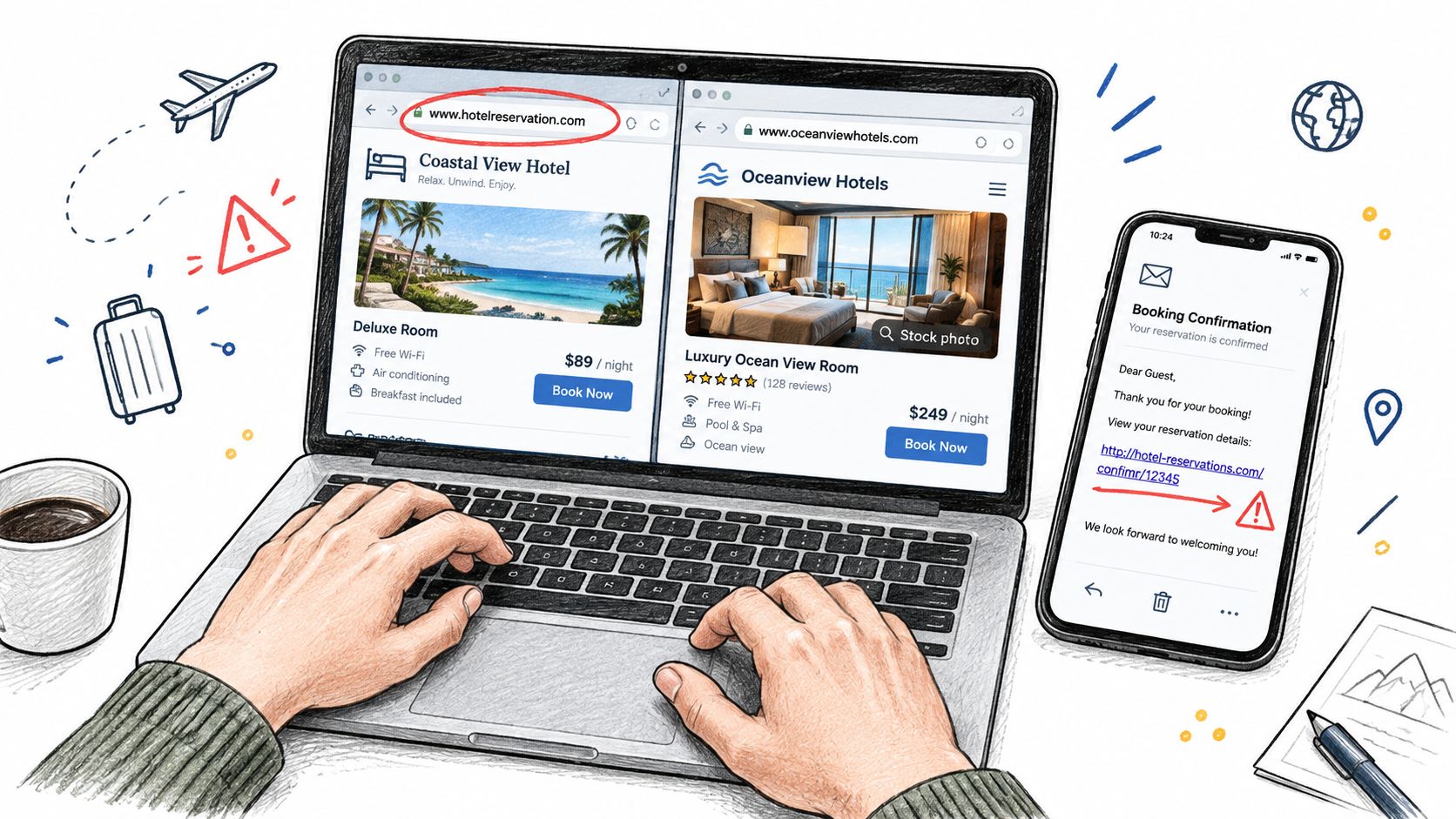
Keep the confirmation email, cancellation terms, supplier contact, hotel phone number, and payment receipt in one place. Use a credit card where possible, because it gives you a clearer dispute path than an irreversible transfer. Verification is not an optional extra. It is the step that turns a paid reservation into a stay the hotel can easily find.
Your Pre-Booking and Pre-Arrival Checklist
A dependable booking routine has two checkpoints. The first protects your budget before payment. The second protects the reservation after payment and before you reach the front desk.
Before you book
- Set the total budget: Include taxes, mandatory resort or destination fees, parking, breakfast, deposits, and possible incidental holds.
- Shortlist several properties: Compare options across different price points, but keep the room category and occupancy consistent.
- Check flexibility: Record the payment timing, cancellation deadline, penalty, and refund conditions for each offer.
- Price the risk: Compare the cost of a flexible rate with the possible loss from cancelling a cheaper nonrefundable rate.
- Read relevant reviews: Look for recent comments from travelers with a similar party, room need, and arrival pattern. Pay attention to noise, accessibility, cleanliness, and unexpected charges.
- Verify the provider: Match the seller's identity with the hotel's official domain and confirm who will handle changes or refunds.
The historical development of reservation technology explains why offers can now move across interconnected distribution systems. Early reservations relied on telephone, mail, or telegram, while central reservation systems later connected inventory and rates across channels. By 1995, early online hotel-booking engines had helped move consumers toward self-service reservations. This reservation-system history is useful context, but it doesn't remove the need to verify the final seller.
Before you arrive
- Save the confirmation: Keep the number and full terms in an offline file or screenshot.
- Reconfirm the booking: Check with the supplier and, where practical, the hotel before arrival.
- Record direct contact details: Save the property's official phone number and address.
- Review arrival requirements: Note check-in hours, identification rules, payment requirements, and late-arrival instructions.
- Prepare for payment holds: Make sure your payment method can cover the room and any property-level authorization.
- Plan the route: If you need transport from the airport, compare options such as an airport transfer service before departure.
- Notify the hotel of late arrival: Contact the property if you'll arrive after the stated check-in window.
- Keep proof after checkout: Save the final folio until all pending charges and holds have cleared.
Print the checklist or keep it in your phone's offline notes. A dead battery, poor connection, or missing email shouldn't leave you searching for the address or cancellation rules at the front desk.
Easy Travel Bookings lets you compare hotel offers from major booking platforms and local systems, then continue to a provider to complete the reservation. Use Easy Travel Bookings to compare the total offer, check its terms, and choose the booking that gives you the clearest balance of price, flexibility, and verified responsibility.