

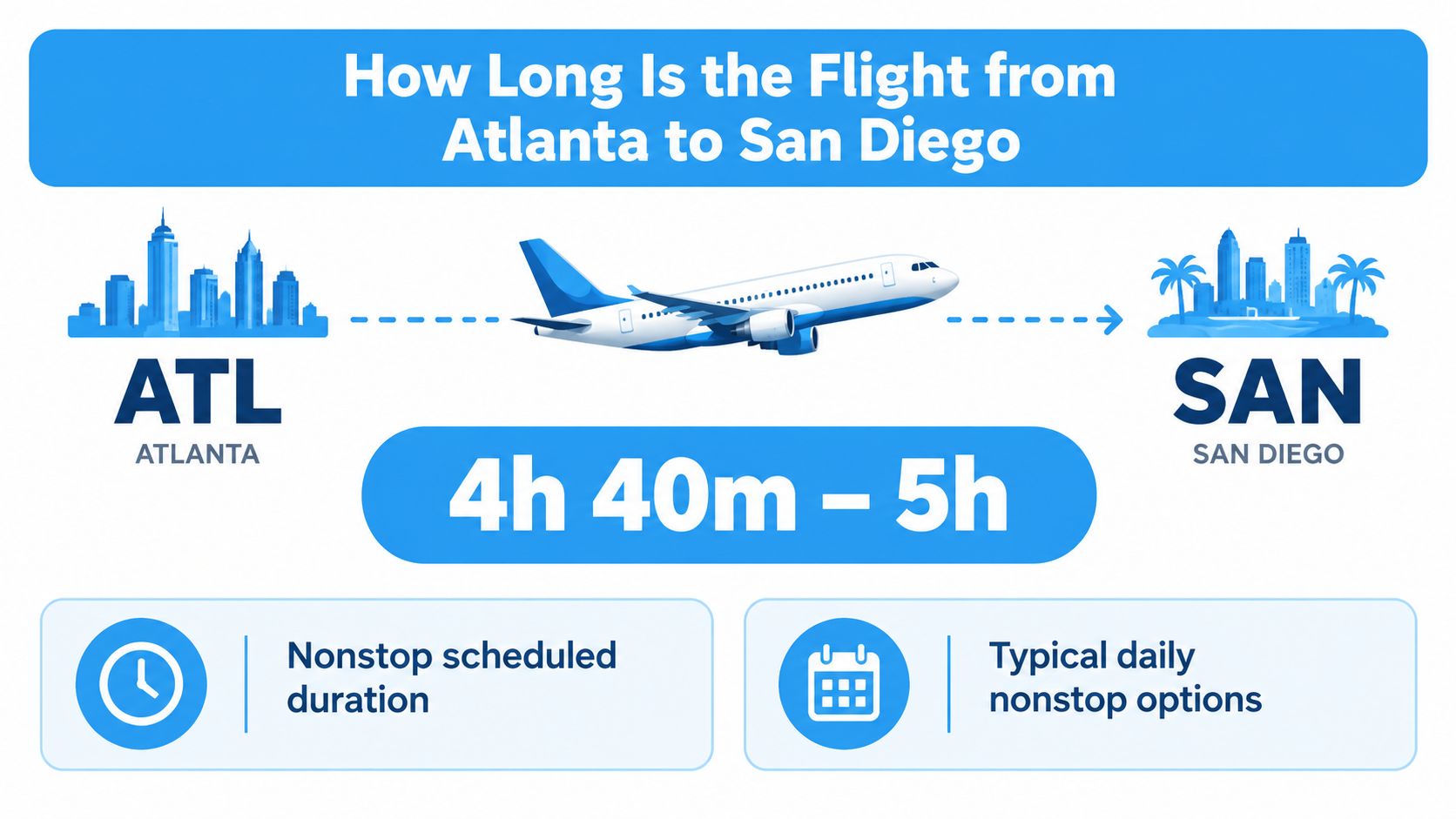
A nonstop flight from Atlanta to San Diego is typically scheduled at about 4 hours 40 minutes to 5 hours gate-to-gate, with the three-hour time-zone shift making a 9 a.m. Eastern departure appear to arrive around 10:44 a.m. Pacific. That early-looking arrival can leave you with a useful day in California, but only if you don't confuse reaching the gate with reaching your hotel.
My recommendation is straightforward: choose a morning nonstop when your arrival day matters. Compare the local arrival time, the full itinerary duration, and the time you'll need after landing before you commit to activities.
Table of Contents
- How Long Is the Flight from Atlanta to San Diego
- Nonstop Flight Duration in Detail
- Connecting Flight Times and Common Layover Hubs
- Time Zone Difference Between Atlanta and San Diego
- Arrival Scenarios by Departure Window
- What Actually Changes Flight Time in Practice
- Airport-to-Hotel and Door-to-Door Time
- Comparing Nonstop Versus Connecting Fares by Total Time
- Planning Checklist Before You Book
- Quick Reference Card for Atlanta to San Diego
How Long Is the Flight from Atlanta to San Diego
The useful answer to Atlanta to San Diego flight time is the airline's scheduled airport-to-airport duration, not the time the aircraft spends airborne. For ATL to SAN, the great-circle distance is approximately 1,886 to 1,900 miles, and published schedules put a typical nonstop near 4 hours 44 minutes, within a practical scheduled range of 4 hours 40 minutes to 5 hours, according to KAYAK's Atlanta to San Diego route information.
That range is your booking anchor. It isn't a promise that you'll leave your Atlanta home and reach a San Diego hotel within the same interval.
Know which clock you're reading
Travelers often mix together distinct measurements that answer different questions:
- Scheduled block time is the gate-to-gate interval on your itinerary. It includes the aircraft's movement on the ground as well as the flight itself.
- Airborne time runs from takeoff to landing. An onboard display may show this rather than the complete scheduled interval.
- Door-to-door time includes your trip to ATL, airport formalities, the flight, arrival processing, and transportation to your destination.
Use block time to compare flights and door-to-door time to plan your day. Neither should be replaced by a rough estimate based on distance.
Practical rule: Treat the scheduled arrival as the time your airport exit process begins, not the time your vacation activity begins.
When you open an itinerary, check whether the displayed duration describes a nonstop segment or the complete journey with a connection. Then check the destination's local arrival time separately. That small distinction prevents a cheap connecting option from looking deceptively similar to a nonstop and keeps an early-looking arrival from becoming an overpacked afternoon.
Nonstop Flight Duration in Detail
Don't expect the return flight to take exactly as long as the outbound. Atlanta to San Diego is predominantly westbound, and prevailing winds can make that direction slower.
One published benchmark compares 4 hours 38 minutes outbound with 4 hours 22 minutes inbound, a 16-minute difference; the same route information says the actual flown track is typically 2 to 5% longer than the great-circle distance because aircraft follow operational routings rather than a perfect geographic line (Priceline's ATL to SAN route benchmarks).
ATL to SAN nonstop duration snapshot
The table summarizes that published comparison, not a guaranteed schedule for your departure date.
| Direction | Scheduled block time | Typical difference | Main cause |
|---|---|---|---|
| Atlanta to San Diego | Longer westbound benchmark described above | Longer than the return in this comparison | Prevailing winds |
| San Diego to Atlanta | Shorter eastbound benchmark described above | Shorter than the outbound in this comparison | More favorable directional winds |
The practical lesson isn't to search for a universally correct duration down to the minute. Compare the actual flight you're considering, because published route summaries can use different schedules and measurement periods.
Your onboard countdown can also disagree with the itinerary without anything being wrong. The aircraft might spend less time airborne than the booking duration suggests, while ground movement accounts for the remainder.
Don't interpret every difference as a delay, either. A schedule is a planning estimate for the complete airport-to-airport movement. What matters for your plans is whether the flight reaches its arrival gate near the ticketed time, not whether the airborne portion matches a route guide.
Connecting Flight Times and Common Layover Hubs
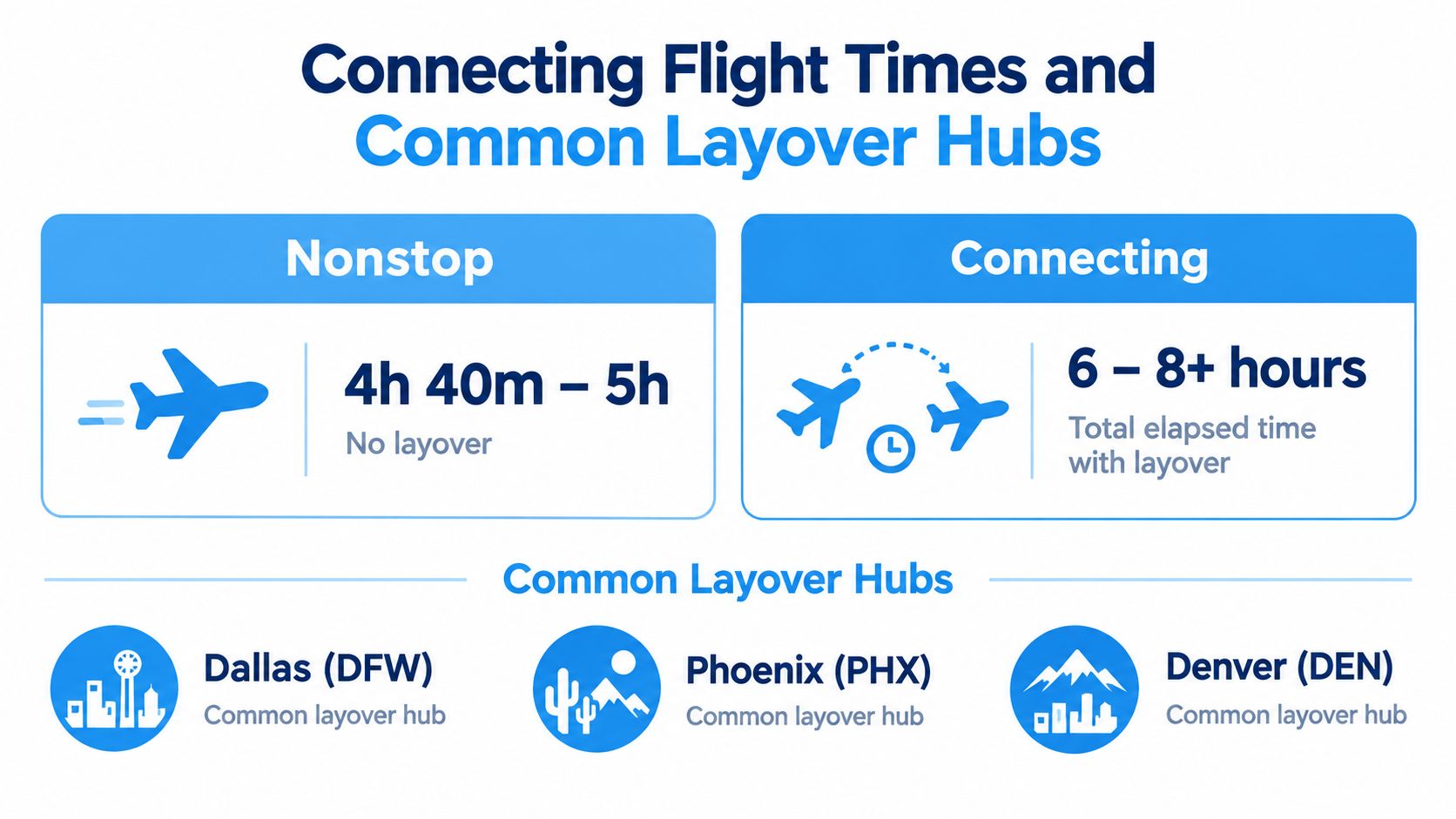
A connection changes the decision from flight length to total elapsed itinerary time. Connecting journeys commonly take 6 to 8 hours or more, compared with about 4.5 to 5 hours nonstop, depending on the connection airport and layover length (Atlanta.com's overview of flights from Atlanta to San Diego).
Don't add only the flying segments and call that your travel time. The wait between them belongs in the comparison, along with the practical inconvenience of leaving one aircraft and boarding another.
Choose the itinerary, not the hub's reputation
If your search offers connections through Dallas-Fort Worth, Denver, Phoenix, Las Vegas, Houston, or Minneapolis, compare the actual arrival and connection details. Don't assume a particular hub will always produce the shortest trip, or that the shortest layover will be the most comfortable choice.
Use these questions to separate sensible alternatives from false economies:
- Arrival suitability: Does the connection still get you to San Diego before the plans you care about?
- Transfer practicality: Would you feel comfortable making the connection with your luggage, mobility needs, and travel companions?
- Routing simplicity: Is the extra stop serving a real budget or scheduling purpose, or merely making the ticket look cheaper?
- Fare conditions: Are you comparing equivalent baggage allowances and change restrictions?
I'd reject an itinerary with additional stops unless the savings or departure time clearly justify it. A modest discount isn't compelling when you lose the afternoon you intended to enjoy.
The same comparison discipline applies to longer journeys such as Boston to Venice travel planning: evaluate the journey from first departure to final arrival, not the attractiveness of an individual segment. On ATL to SAN, the nonstop should be your baseline, and every connection should have to earn its place.
Time Zone Difference Between Atlanta and San Diego
San Diego is behind Atlanta on the clock, so your westbound arrival looks earlier than the elapsed journey might suggest. Both cities follow their respective daylight-saving changes, preserving the usual Eastern-to-Pacific relationship described in the route information above.
Use the following illustration to keep the departure clock and destination clock separate.

Read the arrival time before doing your own conversion
The morning example in the opening uses a typical published duration. It doesn't mean every departure in that window arrives at the same minute, and it doesn't mean the journey feels as short as the difference between the displayed local times.
For booking decisions, use this sequence:
- Read departure locally: Your ATL departure is shown on Atlanta's clock.
- Read arrival locally: Your SAN arrival is shown on San Diego's clock.
- Use elapsed duration separately: That's the measure of how much time you spend traveling between airports.
Don't subtract the time-zone difference from the itinerary's duration. The airline has already accounted for local time in its displayed departure and arrival.
This video accompanies the time-zone planning discussion.
The useful benefit is scheduling flexibility, not reduced travel fatigue. You may reach California early enough for lunch and an afternoon outing while still having started your day much earlier in Atlanta.
Keep your arrival day ambitious enough to enjoy, but flexible enough to absorb the journey. A walk, an unhurried meal, and a cancellable reservation make more sense than a tightly timed chain of commitments.
Arrival Scenarios by Departure Window
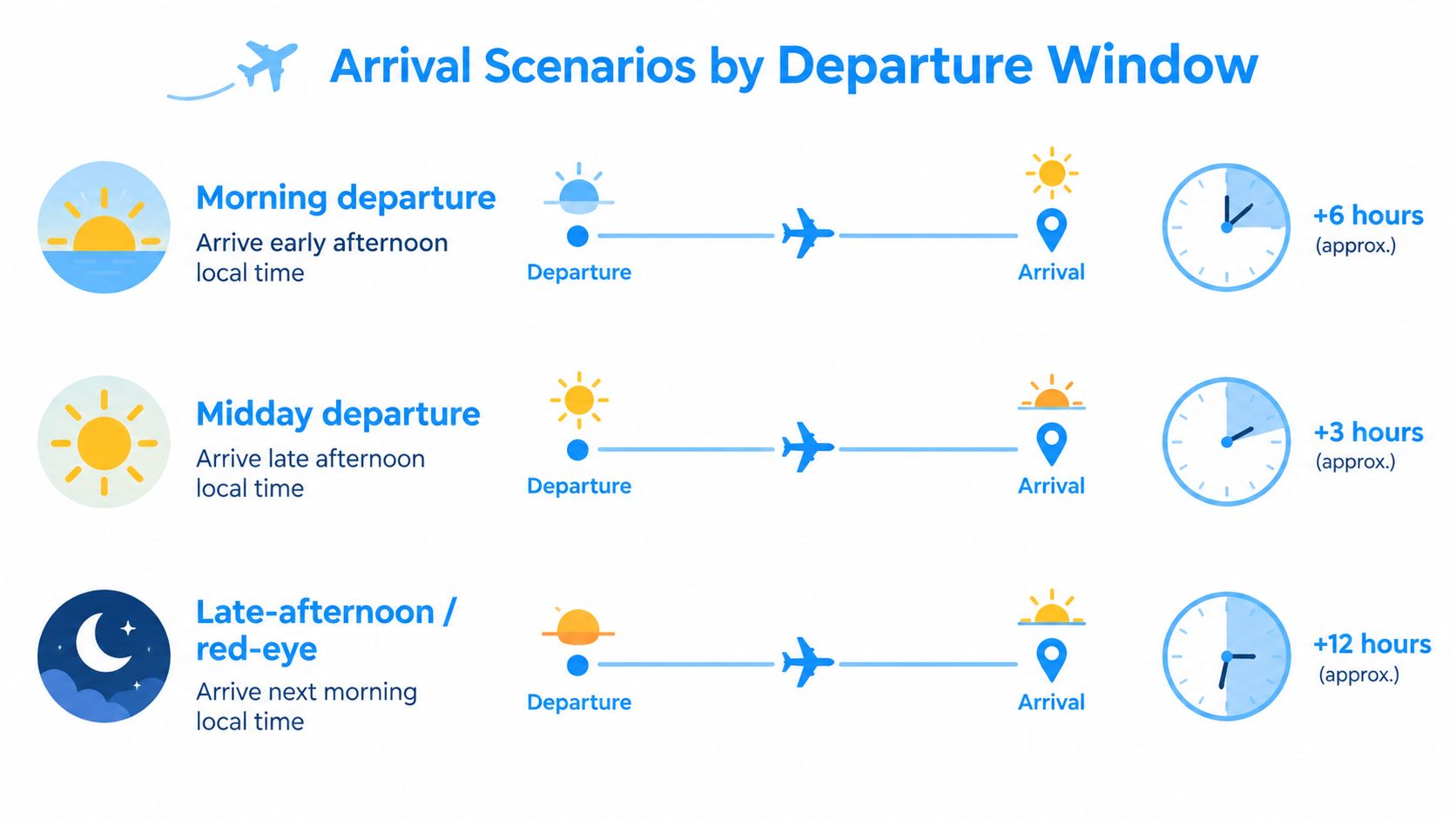
Morning departures are my first choice when the arrival day has value. They leave more of the destination's day available after the flight, while a midday or evening departure shifts your usable time later.
The reported route-level performance for the 12 months through July 2026 was 78.2% on time, with 20.4% arriving at least 15 minutes late; July's on-time figure was 74.5%, according to Atlanta.com's ATL to SAN flight-time analysis. My recommendation is to leave 90 minutes to two hours before ordinary time-sensitive plans, and to treat that as a planning allowance rather than protection against every disruption.
Use your ticket's local arrival time for the scenarios below.
Match the departure window to the commitment
| Departure window | Sensible arrival-day plan | What I'd avoid |
|---|---|---|
| Morning | Flexible sightseeing, lunch after the airport, an evening reservation | Treating the scheduled arrival as your activity start |
| Midday | Hotel arrival followed by a relaxed evening | A prepaid afternoon activity with no flexibility |
| Late afternoon or evening | Transportation, hotel check-in, a meal if convenient | A tightly timed event immediately after landing |
Don't infer an overnight arrival merely from an evening departure. Check the arrival date printed on the itinerary, particularly when connections are involved; the ticket takes precedence over a generic timeline.
An on-time aircraft can still leave you late for dinner if you haven't allowed for getting off the plane, collecting bags, and reaching the restaurant.
For a cruise or another departure you can't afford to miss, I'd choose an earlier arrival date rather than rely on a same-day buffer. The consequence of missing the commitment matters more than the average flight duration.
What Actually Changes Flight Time in Practice
A published schedule can't describe every operating condition your flight will encounter. The directional wind effect discussed earlier is only part of the explanation for why the trip can feel different from one journey to another.
Routing, weather, air-traffic restrictions, taxiing, and seasonal winds all affect actual travel time, as described in the route information cited earlier. The important distinction is whether the aircraft takes longer to fly the route or spends longer waiting and moving on the ground.
Separate flight variation from airport delay
- Weather along the route: An operationally preferred route can differ from the shortest geographic path.
- Air-traffic restrictions: Controllers may require a different route or delay aircraft movement.
- Taxiing: Time between gate departure and takeoff, or landing and gate arrival, belongs to the airport-to-airport journey.
- Seasonal conditions: Don't assume an experience on a previous trip predicts the next departure.
For your own plans, the cause matters less than the effect on arrival. A flight that departs late may not arrive equally late, and an aircraft that lands near schedule hasn't necessarily reached its gate.
Booking judgment: Favor an itinerary that leaves room for disruption over one that works only if every stage goes perfectly.
Check the airline's current flight status before leaving for ATL, and keep monitoring it rather than relying on the original booking confirmation. Don't shorten your airport arrival allowance because an initial status message shows a delay. Follow the airline's instructions and boarding information.
Airport-to-Hotel and Door-to-Door Time
The flight duration isn't your complete travel commitment. Build your own door-to-door estimate, because your starting location, baggage choices, airport needs, and final address can change the result substantially.
I wouldn't assign every traveler a universal total. Someone staying near the airport with carry-on luggage has a different arrival process from a family collecting checked bags and continuing to a more distant accommodation.
Build the trip in separate blocks
| Journey stage | What to include |
|---|---|
| Home to ATL | Your actual starting address, transport choice, and road conditions |
| Before departure | Airline-recommended arrival allowance, bag drop, security, and reaching the gate |
| Airport to airport | The scheduled block time on the ticket |
| SAN arrival | Deplaning, baggage collection if needed, and finding transportation |
| Airport to accommodation | The route to your exact hotel or rental address |
Don't double-count taxiing. If you're using scheduled gate-to-gate time, the aircraft's normal ground movement already belongs inside that block. Add the processes before boarding and after arrival separately.
Arrange your arrival transportation around the service's pickup rules, not just the flight's scheduled arrival minute. If you're unfamiliar with the options, this explanation of what an airport transfer includes can help you decide what to book and what details to confirm.
Send the operator your flight information when requested, check the meeting location, and understand what happens if the flight is delayed. For a hotel reservation, confirm the property's check-in arrangements rather than assuming an early airport arrival guarantees an immediately available room.
Comparing Nonstop Versus Connecting Fares by Total Time
The cheapest ticket isn't automatically the best-value itinerary. A connection can be a reasonable budget choice, but only when you accept the full travel-day cost before paying.
Start by deciding what you're protecting. If it's an arrival-day activity, prioritize local arrival time and simplicity. If it's the budget and your plans are flexible, a longer itinerary may be acceptable.
Compare equivalent offers
- Total elapsed time: Use the complete departure-to-arrival interval, including layovers.
- Scheduled segment duration: Check whether the search result is showing an individual flight or the entire itinerary.
- Stops: Look past the fare headline and read every transfer.
- Final price and conditions: Compare baggage, restrictions, and the services you need.
My preference is to price the nonstop first, then ask whether the connecting fare saves enough to justify the inconvenience. Don't work backward from the cheapest result and talk yourself into a trip you'd otherwise reject.
Timing advice can support the search, but it shouldn't replace itinerary comparison. Use a guide to the best day of the week to book flights as a planning resource, not a reason to accept an inconvenient arrival.
Buy the cheaper connection when the savings matter more than the lost flexibility. Buy the nonstop when your time in San Diego is the point of the trip.
Before checkout, reopen the itinerary details. Confirm that the option you selected still matches the departure window, stop count, and arrival date you intended to buy.
Planning Checklist Before You Book
Use this checklist while the flight details are still open. It's easier to change an unsuitable itinerary before paying than to reorganize your arrival day afterward.
- Confirm the airports: Your intended pairing is ATL to SAN.
- Start with nonstop: Use it as the baseline when time matters.
- Read local arrival: Keep the destination clock separate from elapsed travel time.
- Protect important plans: Apply the arrival allowance discussed earlier, and choose an earlier arrival date for commitments you can't miss.
- Check the final address: Plan transportation to your actual accommodation, not into San Diego.
- Read pickup conditions: Understand meeting instructions and delay handling before reserving a transfer.
- Match the departure window: Choose morning for a more usable arrival day, or a later flight when hotel arrival is your only goal.
Scheduled duration is a planning anchor, not an arrival guarantee. Leave yourself options where the trip matters most.
Quick Reference Card for Atlanta to San Diego
Keep these distinctions handy when comparing results:
| Item | What to remember |
|---|---|
| Nonstop duration | Use the published gate-to-gate range established above |
| Route distance | Great-circle distance isn't the exact flown track |
| Connecting itinerary | Compare complete elapsed time, including the layover |
| Time zones | Read ATL departure and SAN arrival on their respective local clocks |
| Reliability | Historical on-time performance isn't a promise for your flight |
| Arrival plans | Leave a buffer and account for the airport exit and transfer |
Best overall choice: a morning nonstop with flexible arrival-day activities.
Easy Travel Bookings brings flight and hotel comparisons together with airport transfer options, so you can plan beyond the aircraft's arrival time. Visit Easy Travel Bookings to compare ATL to SAN offers, choose an arrival window that suits your plans, and arrange the rest of your journey.