

You've found the right hotel, the dates work, and the price looks manageable. Then the booking page asks for a credit card, even though you planned to pay with cash, a debit card, or a digital wallet. The reservation stops before it starts.
The solution is to separate two things hotels often bundle together: guaranteeing the reservation and paying for the room. A hotel may accept your payment method for the room but still require a separate guarantee, incidental deposit, or arrival-time authorization. Once you understand those two stages, you can book without a credit card while avoiding the most common check-in failures.
Table of Contents
- Why Credit Card Requirements Exist
- Three Reliable Ways to Book Without a Credit Card
- The Debit Card Trap Most Travelers Miss
- Prepaid Rates vs Pay at Property, What's Better
- The Five Questions You Must Ask Before Booking
- Late Arrivals and No-Show Risks Without a Card
Why Credit Card Requirements Exist
Hotels ask for payment details because an empty room can become a direct loss. If a guest doesn't arrive, cancels too late, damages the room, or charges items to the room and leaves without settling the bill, the property needs a practical way to recover the money. The card is often a guarantee, not necessarily the method you'll use to pay the final bill.
That distinction mattered long before online booking. A 1991 New York Times report on guaranteed hotel reservations documented that resorts and other properties worried about no-shows could require a one-night credit-card deposit and impose strict cancellation rules. One cited policy required cancellation as much as five days before arrival for a refund, while another used a same-day 6 p.m. deadline, as documented in the TravelBoom report on flexible hotel payments.
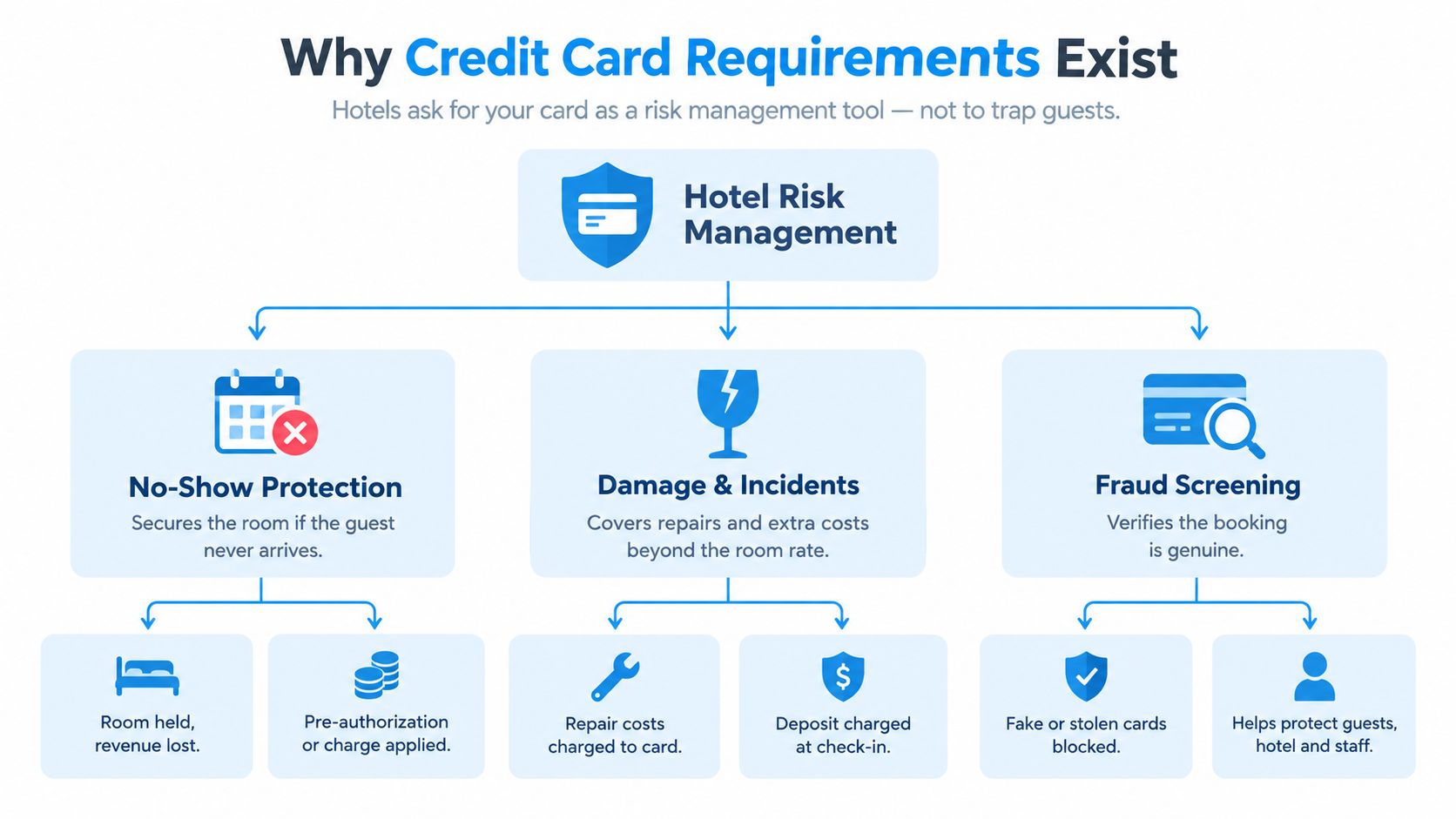
The two-stage booking problem
Suppose you reserve a room with a debit card or pay a prepaid rate through a booking platform. That may settle the accommodation charge, but the hotel can still ask for security at check-in. The front desk may need protection against minibar use, room damage, unpaid room service, or other incidental charges.
Think of the process as two separate questions:
- Will the hotel hold the room for you? This is the reservation guarantee.
- How will the hotel protect itself during your stay? This is the arrival deposit, card authorization, or other security arrangement.
A property can answer yes to the first question and no to your preferred solution for the second. That's why a booking page saying “no credit card required” isn't enough on its own. For more background on the reservation process, review this guide to booking a hotel room.
Cash-only reservations are especially limited for advance bookings because the hotel has no simple protection if you don't arrive. Debit cards, prepaid cards, digital wallets, bank transfers, and prepaid rates can solve the reservation problem, but they don't automatically eliminate check-in requirements.
Three Reliable Ways to Book Without a Credit Card
The most dependable approach is to choose the payment method first, then verify the hotel's guarantee and arrival rules. Don't assume that a booking engine's payment screen tells you everything the front desk will require.
Contact the hotel directly
Call the property or send an email before booking. Ask whether it can accept a debit card, prepaid card, bank transfer, cash deposit, or digital wallet for both the room and the reservation guarantee. Direct contact matters because a local property may offer an arrangement that its automated booking page doesn't display.
Ask the employee to confirm the details in writing. Save the email, the name of the person who helped you, and any booking reference. If the reservation is nonrefundable, written confirmation from the property is more valuable than a generic label on a third-party site.
Select a pay-at-property rate
Search booking platforms for “pay at property,” “pay at hotel,” or “no card required.” Read the rate rules before entering your details. Some rates let you reserve without an immediate charge, but still require a debit card or cash deposit when you arrive.
Check whether the reservation is guaranteed, how long the room will be held, and whether the listed card must belong to the guest. A pay-at-property option is useful for flexible plans, but it can be released if you arrive late without a confirmed guarantee.
Use a supported digital payment or installment option
Digital wallets and buy-now-pay-later services can work when the hotel and booking channel support them. In a 2024 TravelBoom survey, 58% of consumers were likely to choose a hotel offering flexible payment options. Traditional credit cards remained the most influential method at 74%, while buy-now-pay-later services reached 45%, digital payment services 42%, debit cards 42%, and mobile wallets 34%, according to the TravelBoom flexible payment survey.
Those figures describe consumer preferences, not universal hotel acceptance. Debit cards and digital wallets are generally more practical starting points than cash or bank transfers, while installment services depend on the property, platform, country, and your eligibility.
Practical rule: If the hotel won't confirm your payment and deposit arrangements in writing, keep searching. A cheaper reservation isn't a bargain if the front desk rejects your payment method.
The Debit Card Trap Most Travelers Miss
A debit card can help you reserve and check in, but it exposes your everyday bank balance to hotel holds. That's the danger many travelers discover only after arriving.
Hotels commonly use a pre-authorization, which temporarily blocks funds rather than settling a final charge. The blocked amount can include the room balance, taxes, and an incidental allowance. If you planned to use the same account for meals, transport, or emergencies, the hold can leave you with far less available money than expected.
Payment, deposit, and pre-authorization aren't the same
A payment transfers funds to the hotel and settles the charge. A deposit is money collected as security and returned after the stay if there are no deductions. A pre-authorization temporarily reserves funds, and the hotel finalizes a charge only if it needs to collect money.
That distinction affects how you plan your trip:
| Arrangement | What happens to your money |
|---|---|
| Room payment | The accommodation charge is settled |
| Cash deposit | Funds are collected and returned according to hotel procedure |
| Debit pre-authorization | Funds are blocked and reduce your spendable balance |
Industry guidance reports typical incidental holds of roughly $25 to $200 per night, with luxury and resort properties often higher. Debit-card holds may remain unavailable for about 5 to 10 business days, sometimes longer, as explained in this guide to hotel deposits and incidental holds.
Budget for three separate exposures
Before arrival, keep enough available money for:
- Room balance: The amount still due under your rate.
- Taxes and mandatory fees: Charges that may not be included in the headline price.
- Incidental security: The hold or deposit covering potential extras.
Ask the hotel for the exact authorization amount and the expected release process. Also ask whether the hotel can accept cash instead. Cash may avoid a prolonged bank hold, but the property can require the full stay amount plus additional security, and some hotels may still insist on a card on file.
Don't confuse “debit accepted” with “debit is harmless.” A debit card can solve the credit-card requirement while creating a temporary cash-flow problem.
Prepaid Rates vs Pay at Property, What's Better
Prepaid and pay-at-property rates solve different problems. One prioritizes certainty and often locks in the charge immediately. The other preserves flexibility but may leave you exposed to guarantee and check-in requirements.
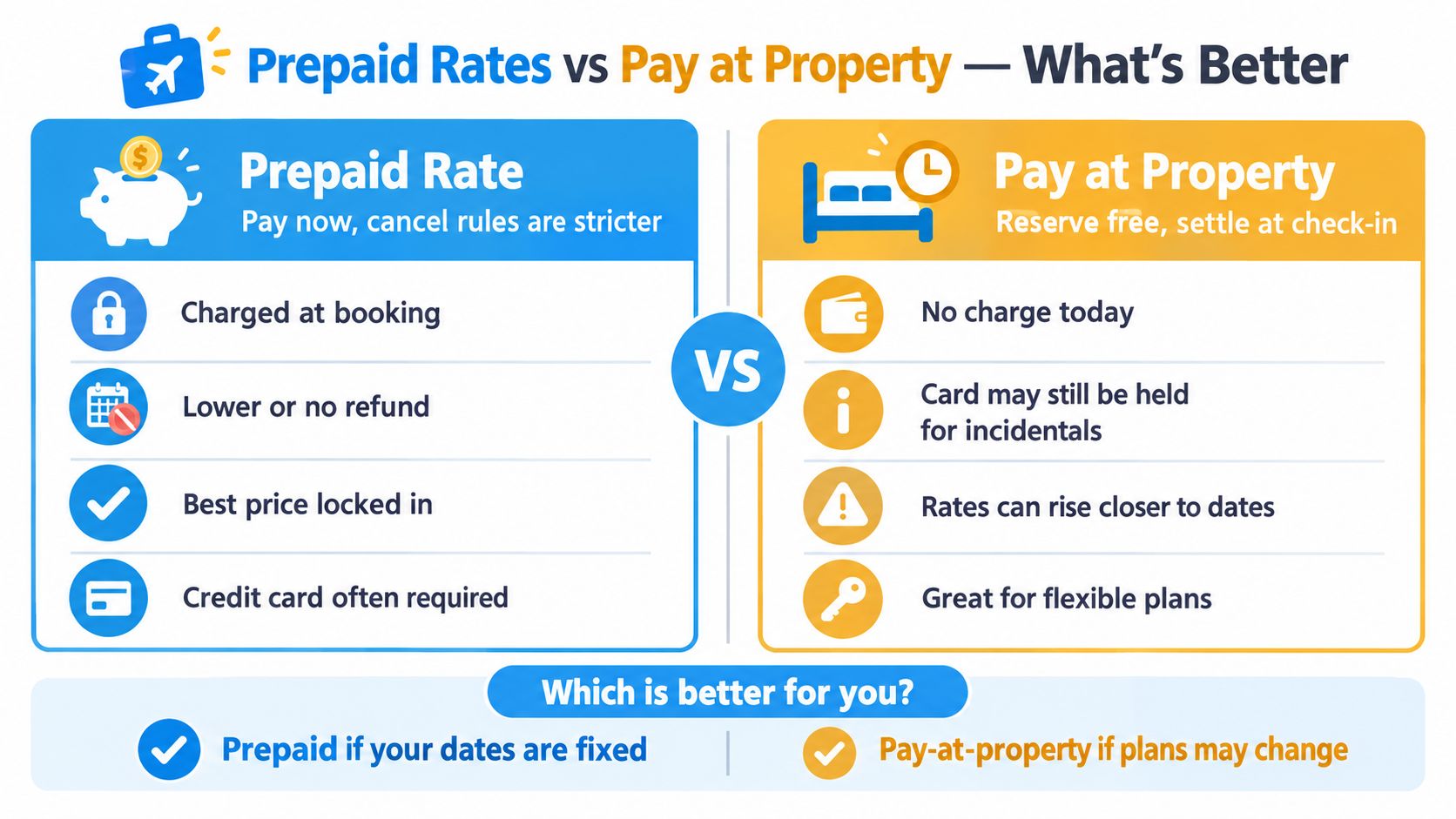
Prepaid rates suit fixed plans
A prepaid rate can be the cleaner choice when your dates are settled and you have an accepted debit card, wallet, or other payment method. The room charge is handled at booking, so the property has less reason to worry about a no-show. You still need to confirm the hotel's arrival deposit and incidental policy.
The trade-off is limited flexibility. Many prepaid rates are nonrefundable or carry strict change rules. Read the cancellation language carefully before paying, especially if your transport arrangements could change.
Pay at property suits uncertain plans
Pay-at-property rates preserve cash until arrival and can be useful when your itinerary is still moving. They may also offer a clearer path to paying at the front desk with cash or debit, but only if the hotel accepts that method for the guarantee and deposit.
The phrase doesn't guarantee a credit-card-free check-in. Some properties still require a card, a cash deposit, or a debit authorization. Confirm whether the reservation will be held after the stated arrival time.
Direct bookings deserve a closer look
A hospitality analysis reports cancellation rates of approximately 31% to 42% for OTA bookings, compared with 11.1% to 18% for direct bookings, though those figures are directional rather than universal. The comparison appears in this analysis of hotel payment and cancellation practices.
That doesn't mean you should always book direct. It means you should compare the rate rules, guarantee terms, and support available from each channel. A direct call may uncover a payment arrangement that a third-party checkout cannot handle, while an OTA may display a useful prepaid or alternative-payment option.
Use this hotel deal guide to compare offers, then inspect the cancellation, payment, and deposit conditions before choosing the lowest displayed price.
The Five Questions You Must Ask Before Booking
A successful online reservation can still end in a failed check-in. The booking site may accept your debit card or payment wallet, while the hotel requires a different instrument at arrival. Get answers from the property before you commit.
Ask about the arrival requirement
1. Does the hotel require a credit card at check-in? Ask this even if the reservation has already been paid. You need a direct answer about the front desk, not just the booking channel.
2. What is the exact incidental deposit or hold? Ask whether the hotel accepts cash, debit, or another option instead. Request the amount in the hotel's currency and ask whether it applies per stay or per night.
3. Will you place a debit-card pre-authorization? If yes, ask how much it will be and when unused funds should become available. The Rixos terms and policy information highlights why travelers should verify the card requirement, deposit amount, payment methods, authorization process, and release timing directly with the property.
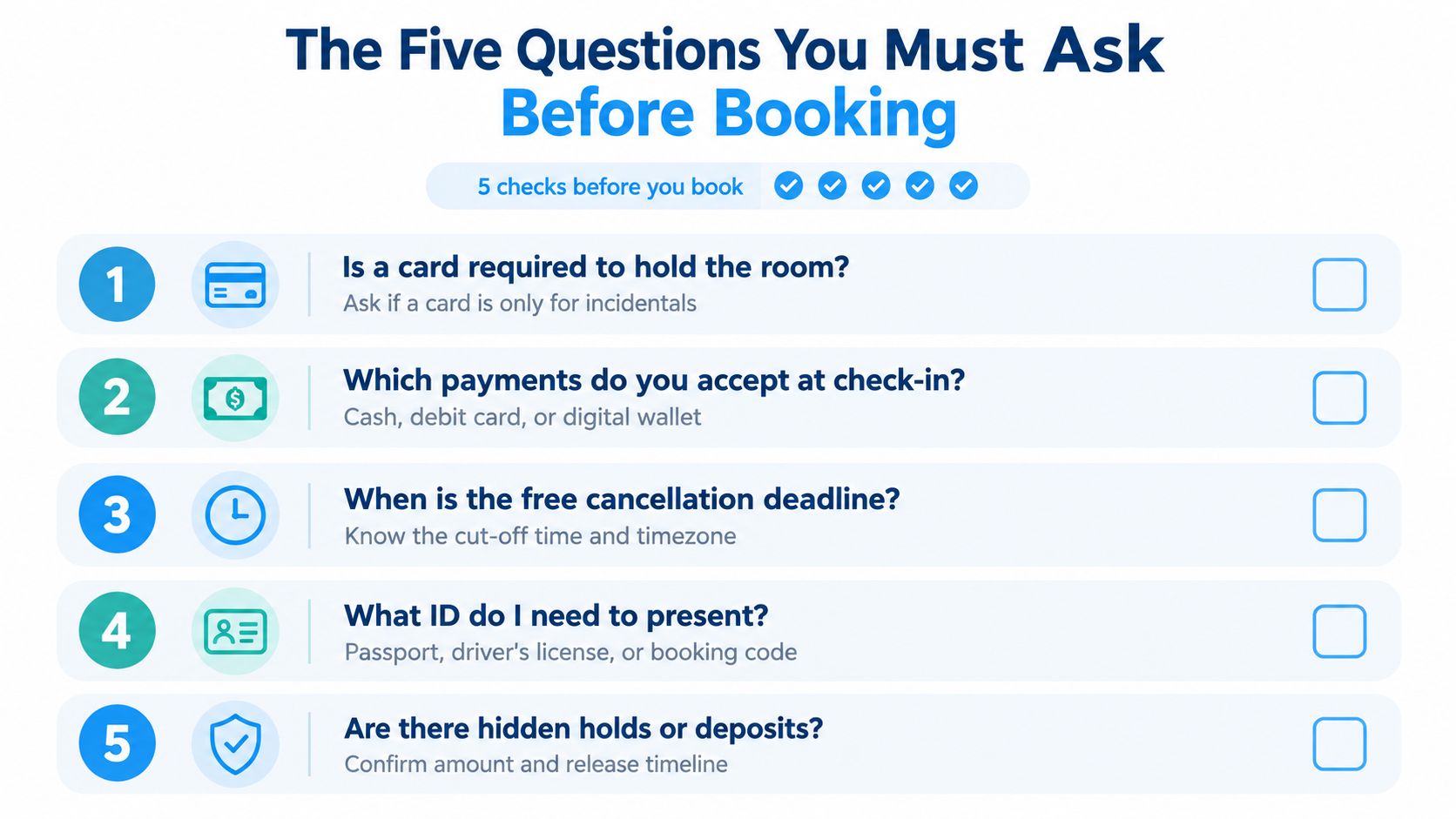
Confirm the booking rules
4. Can you use a digital wallet or installment service for both the reservation and deposit? A method accepted by the booking platform may not be accepted by the hotel terminal. Ask specifically about Apple Pay, Google Pay, PayPal, or any supported installment option rather than saying only “digital payment.”
5. What cancellation and no-show rules apply to this rate? Ask for the deadline, time zone, late-arrival procedure, and any charge if you don't appear. “Free cancellation” doesn't necessarily mean “no guarantee required.”
Get the response by email or through the property's written messaging system. Save the confirmation, payment instructions, hotel correspondence, and any deposit receipt. Bring matching government ID, the booking reference, and enough available funds for the room balance and security arrangement.
The booking-page label is a lead, not a promise. The property's written check-in policy is what protects you.
These checks matter most at resorts, internationally branded hotels, and properties with strict cancellation windows. If the employee gives a vague answer, ask for a supervisor or choose another property.
Late Arrivals and No-Show Risks Without a Card
A non-guaranteed room may be held only until a stated time. If you arrive after that deadline, the hotel may release it, even if the booking confirmation exists. A guaranteed reservation generally offers stronger protection for late arrival, but it can also expose you to a no-show charge.
That risk is easy to underestimate when you're booking with cash, debit, bank transfer, or pay-at-property terms. A delayed flight, border crossing, or reception closure can turn a low-cost reservation into an empty room.
Use this decision rule:
- Your arrival is late or uncertain: Choose a prepaid or explicitly guaranteed rate.
- Your arrival is during normal reception hours: A confirmed pay-at-property arrangement may work.
- You're relying on cash: Obtain written confirmation that the room will be held and that cash is accepted at check-in.
- Your transport is delayed: Contact the property immediately and record the name of the employee who confirms the room will remain available.
One cited property policy allows a full-reservation charge for a no-show when the booking is credit-card-guaranteed, while a non-guaranteed booking may be released after its holding deadline, as discussed in this guide to confirmed hotel reservations and cancellation risks.
The safest option isn't always the cheapest rate. If you land late, prioritize guaranteed room availability over a payment label that merely avoids a credit card. Travelers arranging complicated itineraries can also review these last-minute travel planning options, then verify the hotel's own late-arrival rules before paying.
Easy Travel Bookings helps you compare hotel offers from major booking platforms and local providers, including rates that may support pay-at-property or alternative payment arrangements. Search Easy Travel Bookings, compare the full cancellation and payment terms, and confirm the property's check-in requirements before you finalize the reservation.