

You've found it: a downtown hotel at a price that looks almost suspiciously good. The room appears to cost $89 a night, cancellation is free, and you're already congratulating yourself. Then the checkout page loads. A resort fee, destination tax, and service charge have pushed the total to $127, and the bargain has shifted into something else.
That experience isn't a booking glitch. Hotel pricing often puts the most attractive number at the front of the process and the conditions later, where fewer shoppers will abandon the reservation. Learning how to get a hotel deal means looking past the first price, timing your search intelligently, and treating cancellation terms and mandatory fees as part of the rate.
Table of Contents
- The Booking Room Trap
- Timing Your Booking for Maximum Savings
- The Two-Stage Booking Method
- Refundable vs Non-Refundable and the Real Cost of Flexibility
- Reading the Fine Print on Mandatory Fees
- Your Action Plan for the Next Booking
The Booking Room Trap
The first number you see is often an invitation to continue, not the final price. A hotel can advertise a low nightly rate, then add mandatory charges during the booking flow. The traveler who compares only the initial figure may choose an offer that costs more than a competitor's less dramatic headline rate.

The displayed rate is only the opening move
Suppose two hotels show similar nightly prices. One adds a destination charge, facility fee, taxes, and service charge at checkout. The other displays a higher room rate but includes more of those costs earlier. The second hotel may be cheaper once you compare the amount charged to your card.
This is why a discount percentage can mislead. A large reduction from the advertised rate has little value if mandatory charges erase it. The only useful comparison is the all-in total for the same stay, not the largest discount badge.
Consumer Reports' 2025 survey of 2,121 U.S. adults found that hotel websites and booking services may initially show room rates without mandatory fees, which can appear only after users move through additional pages. Consumer Reports' hotel-fee transparency materials support a simple habit: keep clicking until you can see the complete payable amount.
Build a suspicious-browser routine
Before entering payment details, check these items:
- Total stay price: Include taxes, resort or destination fees, service charges, and required facility fees.
- Room identity: Confirm the bed configuration, occupancy limit, view, size, and included facilities.
- Included extras: Breakfast, parking, Wi-Fi, and other amenities may differ between rates.
- Payment timing: “Pay later” doesn't automatically mean “free cancellation.”
- Cancellation deadline: Record the local date and time, not just the broad cancellation label.
Save the final price and terms before payment. Screenshots or confirmation emails give you something concrete to compare if the displayed offer changes later.
Practical rule: Never call a hotel rate a deal until you know the total amount leaving your bank account.
A comparison site can help you spot differences across providers, but it doesn't remove the need to inspect the final booking page. The provider's checkout terms control the reservation. A cautious shopper checks the room, inclusions, fees, payment timing, and cancellation rights in one pass.
Timing Your Booking for Maximum Savings
Booking early feels responsible, but it isn't automatically cheap. Waiting feels clever, but it can become expensive when demand is concentrated around a conference, festival, school holiday, Christmas period, or major sporting event. The right booking window depends on how flexible your trip is and how difficult the room will be to replace.
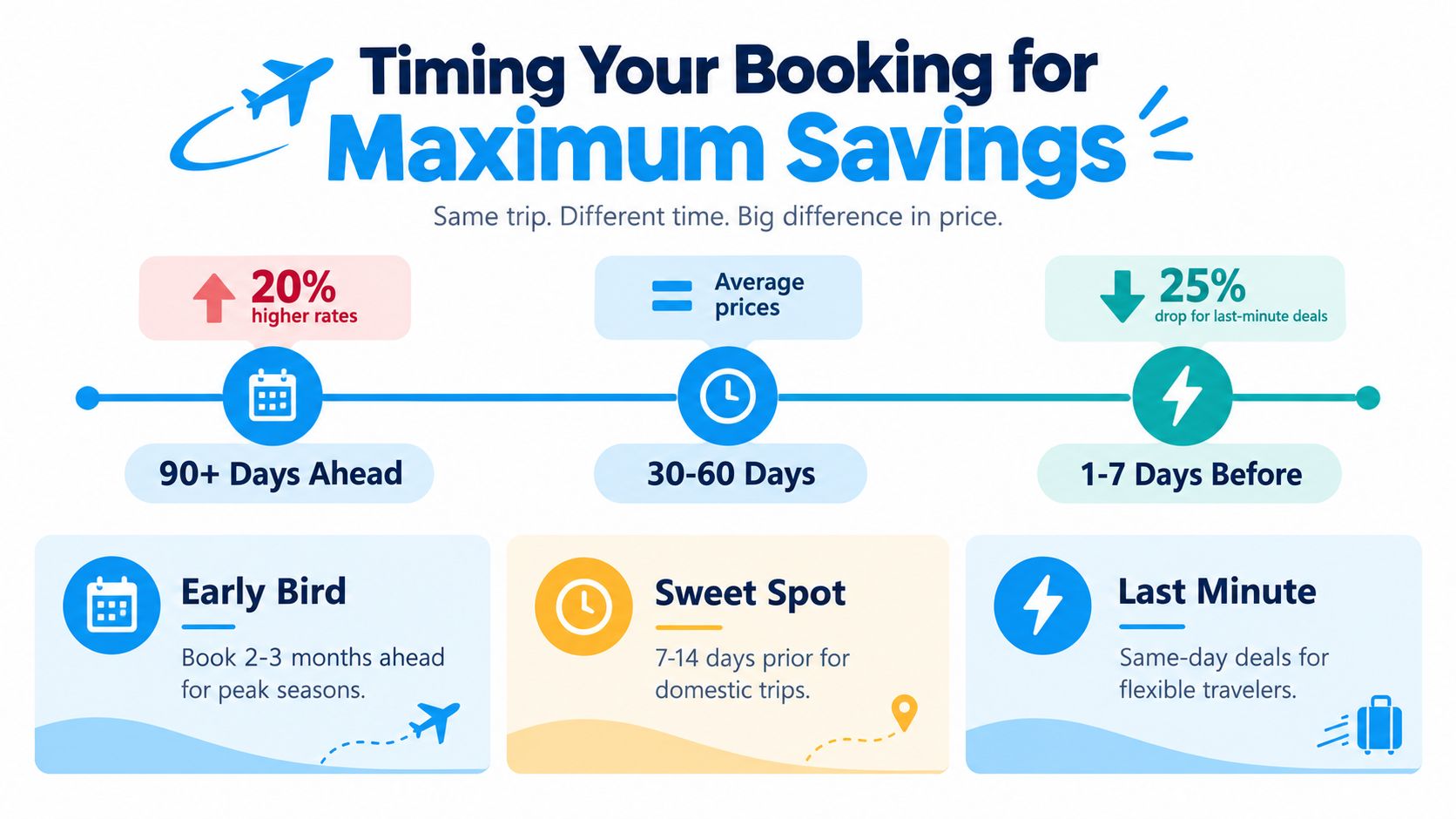
A 2022 NerdWallet analysis reviewed more than 2,500 hotel room prices recorded from 2019 through early 2021 across multiple countries, brands, locations, and quality tiers. It compared reservations made 15 days before arrival with reservations made four months in advance. The shorter-lead bookings were cheaper 66% of the time, with an average price approximately 13% lower. Travel + Leisure's summary of the analysis also reports that the pattern varied by year, with average savings of 6.5% in 2019, 26.3% in 2020, and 13.9% in 2021.
What the timing data actually suggests
The same analysis found that, in 2021, last-minute reservations were cheaper 73% of the time. Average savings were similar across geography, at 12.7% for North American hotels and 13.5% for hotels in other countries. Hotel category made a larger difference: lower-priced properties showed an average difference of 5.5%, while higher-tier hotels produced average savings of about 22% when booked 15 days ahead rather than four months ahead.
Those figures are historical averages, not a promise for your destination. The period included the COVID-19 disruption, which created unusual demand conditions. A flexible traveler can use the findings as a reason to recheck prices, but not as permission to cancel a secure room blindly.
A separate Hotels.com analysis reported that travelers booking only days before departure saved an average of 23% compared with travelers booking more than four months ahead. Its strongest results appeared roughly 8 to 14 days before arrival. In the United States, Sunday check-ins were identified as the cheapest starting day, with average rates about 15% below Friday check-ins. Time Out's reporting on the Hotels.com analysis supports testing arrival-day flexibility rather than searching only one fixed weekend pattern.
Choose safety or flexibility deliberately
Use an earlier booking window when the room supply is constrained or your dates cannot move. Waiting may expose you to sellouts, higher rates, or a poor choice of room category. A refundable reservation changes the calculation because you can protect availability while retaining the option to reprice.
Waiting is more defensible when you can shift dates, accept nearby neighborhoods, consider different hotel tiers, and tolerate a less desirable room. It's especially useful for ordinary low-demand stays, where hotels have more reason to release unsold inventory.
For a broader look at the practical trade-offs, see this guide to making last-minute travel easier. The useful principle is simple: flexibility creates opportunities, while fixed dates require protection.
The Two-Stage Booking Method
The safest way to benefit from later price drops is to separate protection from optimization. First secure a refundable room. Then search again close to arrival and replace the reservation only if the new offer is genuinely better.
Stage one secures the trip
Book the refundable option once your destination and dates are settled, particularly when the stay falls during a busy period. Before paying, confirm the cancellation deadline, payment timing, room type, occupancy, and included amenities. A cheap room that disappears while you wait isn't a saving.
Record the reservation details in a note or spreadsheet. Include the total payable amount, the provider, the cancellation deadline in the hotel's local time, the penalty after that deadline, and the refund method. This turns a vague promise of flexibility into something you can manage.
Stage two tests the market
At approximately 15 days before arrival, search for the identical property and conditions. The comparison needs to match all of the following:
- Same dates and occupancy. A different number of guests can change the room and rate.
- Same room category. Don't compare a standard room with a superior room just because the headline price is lower.
- Same meal and facility inclusions. Breakfast, parking, and access charges can alter the true value.
- Same cancellation rights. A non-refundable replacement isn't equivalent to a refundable original.
- Same taxes and mandatory fees. Use the all-in total.
A large worldwide rate comparison found that rooms booked 15 days before arrival averaged $203, compared with $233 for rooms booked four months ahead in North America, a 12.7% difference. The reported segment differences were approximately 21.6% for luxury hotels, 9.4% for mid-range hotels, and 5.5% for budget hotels. CNBC's coverage of the comparison makes clear that these are averages, not forecasts for a particular weekend.
The replacement test: A new rate is better only when it preserves the room, inclusions, cancellation protection, and total cost you actually need.
If the new reservation passes that test, book it first and wait for written confirmation. Only then cancel the original reservation, and only while its free-cancellation window remains open. If the destination is event-driven or inventory is scarce, keeping the original refundable booking may be the better decision even when a lower number appears.
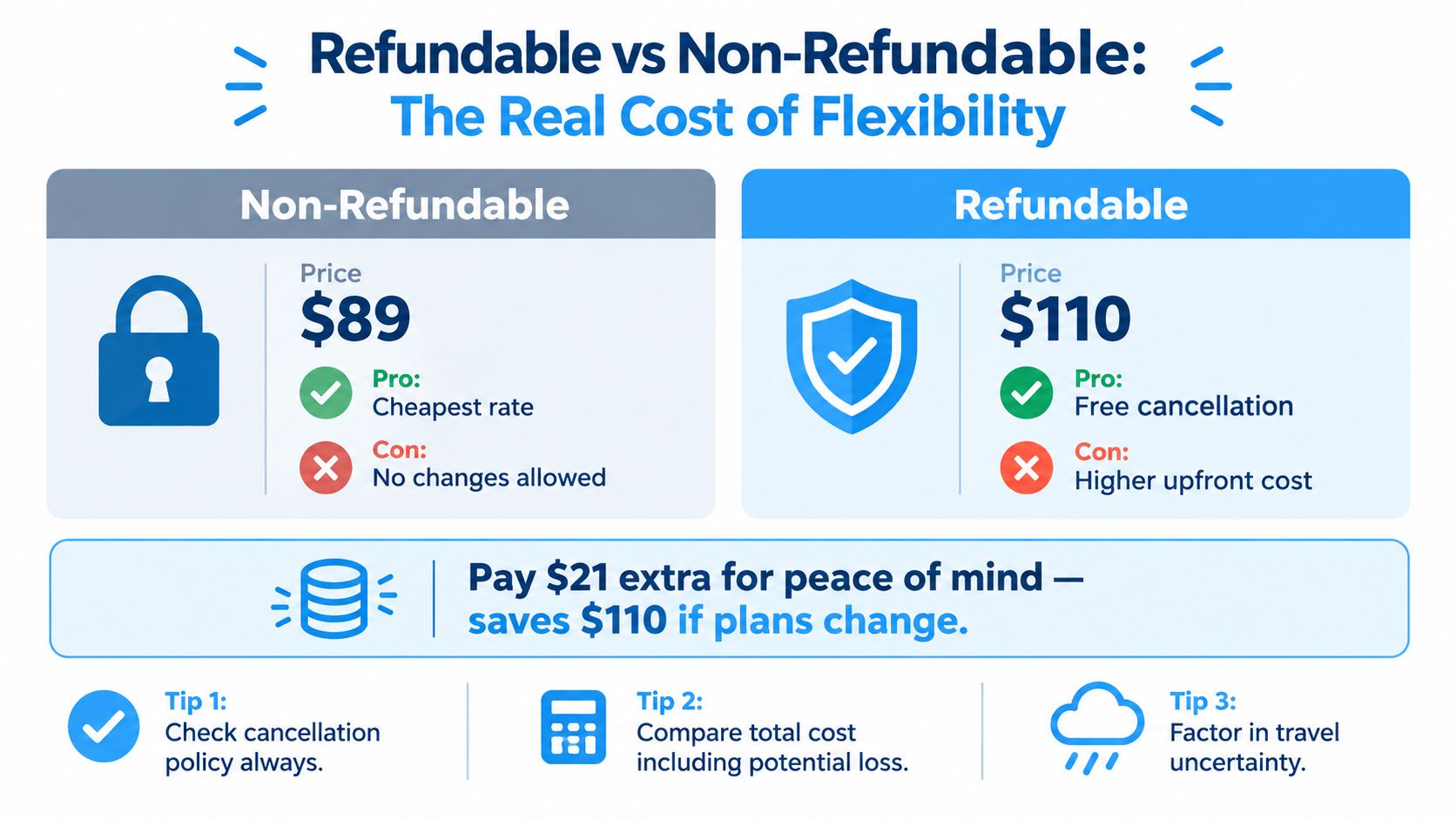
Refundable rooms commonly carried a 10% to 15% premium over non-refundable rooms across roughly 25 million hotel postings in four countries, and that premium persisted close to check-in. That premium is the price of an exit route. Don't treat it as waste until you've considered what changing plans could cost.
Refundable vs Non-Refundable and the Real Cost of Flexibility
A non-refundable rate can be the right choice when your dates are fixed and the financial risk is acceptable. It can also be a false economy when a small discount removes your ability to respond to a delayed flight, illness, work change, or family problem.
Compare the two offers as competing financial products, not merely as cheap and expensive rooms.
| Question | Non-refundable rate | Refundable rate |
|---|---|---|
| Upfront price | Usually lower | Usually higher |
| Changes | Often restricted or unavailable | May allow cancellation or changes before a deadline |
| Risk if plans change | Potential loss of the prepaid amount | Lower financial exposure, subject to the policy |
| Best fit | Fixed plans and high confidence | Uncertain plans or scarce availability |
Research on hotel pricing found that every $50 increase in booking price was associated with a 16% increase in cancellation hazard, after controlling for room type, channel, seasonality, and booking lead time. The modeled revenue impact could reach 11% for some room types and seasons. The hotel cancellation research doesn't tell you whether your booking will be canceled. It does show why price and cancellation behavior deserve to be considered together.
Calculate the value of an exit route
Write down the refundable price, the non-refundable price, and the amount you'd lose if you canceled the cheaper option. Then ask how likely it is that your plans will change and whether you could absorb that loss without damaging the trip budget.
A flexible rate that costs only modestly more can function as inexpensive insurance. When the premium approaches the documented 10% to 15% range, calculate the break-even point more carefully. If the possible loss is substantial and your itinerary is uncertain, the nominal discount may not be worth taking.
Check these details before you choose:
- Deadline: Confirm the exact local time and date.
- Penalty: Find out whether you lose one night, the full booking, or another amount.
- Refund method: Check whether the money returns to your card or becomes credit.
- Change rights: Cancellation and modification are different permissions.
- Payment terms: “Pay later” doesn't guarantee a free exit.
For a practical guide to the reservation process, use this hotel room booking guide. Whatever channel you use, never cancel the original reservation until the replacement has been confirmed in writing.
Reading the Fine Print on Mandatory Fees
The cheapest advertised rate and the cheapest hotel stay are two different things. A low nightly figure can conceal mandatory charges that apply to every guest, whether or not the guest uses the associated facility. The hotel may still call the room discounted, but your bank account sees the final total.
Compare the complete checkout amount
Look for every charge that appears before payment:
- Resort or destination fees: Often presented separately from the room rate.
- Taxes: These may be added after the initial search result.
- Service charges: Check whether they're mandatory or optional.
- Facility fees: Required charges can cover amenities you don't plan to use.
- Property-specific costs: Parking, extra guests, or other required charges may change the total.
A provider that shows only a nightly rate makes comparison harder. Consumer Reports' survey found that initial rates can omit mandatory fees until users click through additional pages. That's why the correct question isn't “Which result has the lowest room price?” It's “Which offer has the lowest all-in total for equivalent conditions?”
Use a consistent comparison sheet
Record the final total for the full stay rather than multiplying a displayed nightly rate yourself. Also note whether taxes and fees are included, whether the rate includes breakfast, and whether the cancellation terms match the competing offer.
If one provider shows a lower headline figure but a higher final total, reject the headline. If two offers have similar totals, choose based on cancellation flexibility, room suitability, payment timing, and provider reliability.
A metasearch service can save time by placing offers from major booking platforms and smaller local systems in one search. Easy Travel Bookings is one option that aggregates hotel prices and passes travelers to partner providers, so it can be used as a comparison starting point. The final provider page still deserves scrutiny because that's where the booking conditions are presented.
The number in the search result is a lead. The number in the final checkout is the decision.
Save the checkout screen or confirmation showing the total and cancellation terms. Prices and conditions can change between comparison and payment, and memory is a poor substitute for documentation. A deal is only real when you can identify what you'll pay and what you'll receive.
Your Action Plan for the Next Booking
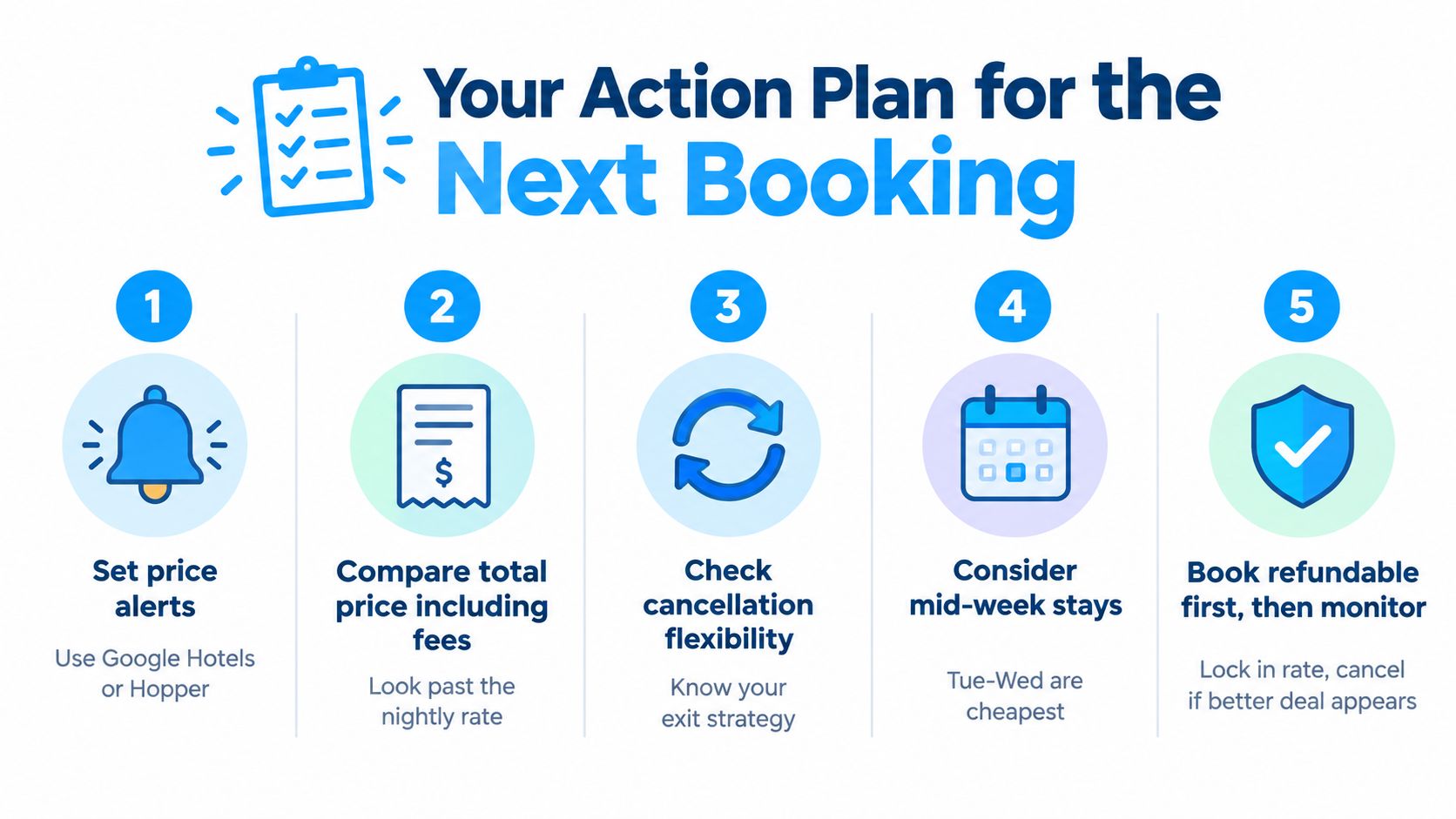
The next time you search, don't begin by hunting for the smallest number. Begin by defining the stay you're willing to accept, the total price you can afford, and the amount of uncertainty you can tolerate.
Follow the booking checklist
Set a target all-in price. Decide what the complete stay should cost, including mandatory fees and taxes. Use that figure to judge offers rather than chasing an advertised discount.
Search flexible dates. Test Sunday, midweek, and alternative arrival dates when your itinerary allows. A small date shift can matter more than a loyalty badge or promotional code.
Secure a refundable option when risk is high. For peak periods, scarce destinations, and fixed itineraries, protecting the room may matter more than gambling on a lower future rate.
Recheck at roughly two weeks out. Search the same property, room, occupancy, inclusions, total fees, and cancellation conditions. Replace the original only after the new booking is confirmed.
Choose non-refundable only with clear eyes. The lower rate is suitable when your plans are firm and the potential loss is acceptable. Otherwise, flexibility is part of the value you're buying.
Know when to stop waiting
Deal hunting becomes counterproductive when you keep delaying a secure, suitable reservation without a clear target. Set a price you'd accept, reserve a cancellable option if available, and monitor only until the cancellation deadline. During a major event or holiday, stop waiting once the room and terms meet your needs, because a last-minute discount is never guaranteed.
For broader trip savings, compare hotel offers alongside flights and other travel components through a discount travel package search. The useful habit is not endless searching. It's a repeatable process that compares the final price, protects your options, and gives you a defined point at which to commit.
Easy Travel Bookings compares hotel offers from major booking platforms and smaller local systems, helping you examine prices across providers before handing off to a booking partner. Start your next search with Easy Travel Bookings, then verify the all-in total and cancellation terms before you pay.