

The worst hotel-booking advice is still the most popular one. People chase the lowest number on the screen, then act surprised when taxes, fees, refund rules, and payment terms turn that “deal” into the most expensive stay in the cart.
If you want to compare hotel prices online the right way, stop thinking about the room rate as the whole story. Treat it as two separate questions, what is the true total cost, and how much control do you keep if plans change. That's the standard that actually protects your wallet.
Table of Contents
- Why the Cheapest Room Rate Is Rarely the Cheapest Stay
- The Three Layers of Price Sources You Should Be Checking
- An Apples-to-Apples Workflow That Actually Compares Offers
- Reading Past the Headline Rate
- OTA Versus Direct Booking and How to Choose
- Your Pre-Booking Playbook
Why the Cheapest Room Rate Is Rarely the Cheapest Stay
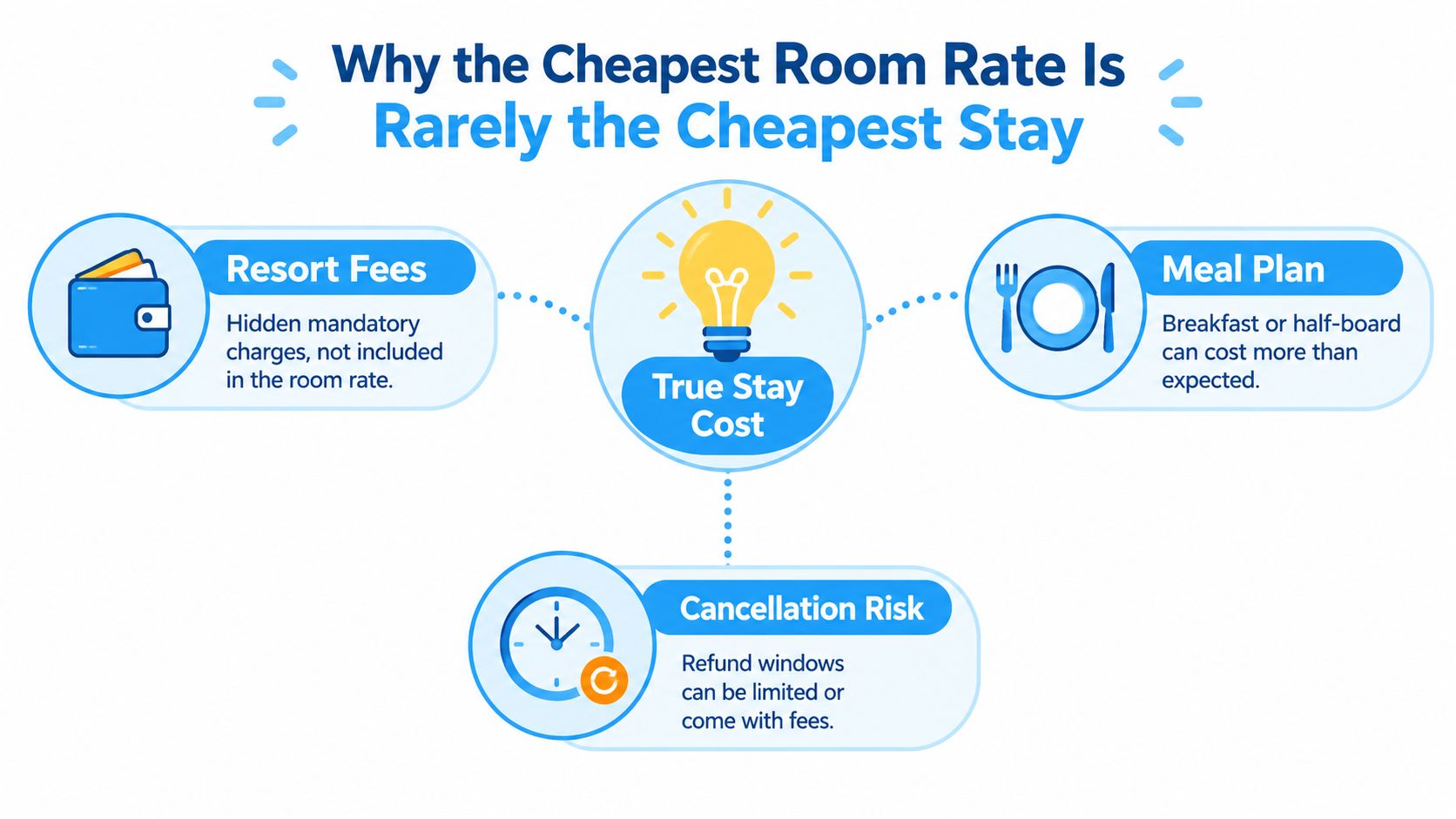
A cheap headline rate is often just a teaser. The final bill can jump once the booking flow adds mandatory taxes, service charges, resort or destination fees, parking, or other required costs that were never visible on the first screen.
That's why the room with the lowest nightly price is not automatically the cheapest stay. In one review of U.S. hotels, resort fees averaged about $33 per night, with examples ranging from roughly $15 to $50, and the FTC's May 2025 rule requires mandatory fees to be included in the upfront total price (Fox News Travel report on hotel fees). A rate that looks smaller at the start can easily lose once those charges show up.
True total cost beats sticker price
For any trip, rank the offer on the mandatory all-in total, not the glossy nightly number. That means the price you can't avoid, including taxes and required fees, plus any pay-now or pay-later condition that changes the final cost of the stay.
Practical rule: if a site won't show the full mandatory total early, assume the final price will be worse than it looks.
The cleaner way to think about it is simple. The room rate is just one line in the cost of the stay. Breakfast, Wi-Fi, parking, and cancellation terms can all change whether the “cheaper” listing is cheaper for your dates and your travel style.
Booking control is the second price tag
The other thing most travelers ignore is risk. A nonrefundable room can look cheaper than a flexible one, then become expensive the moment your plans shift.
That's why the smartest comparison isn't just “what's lowest today?” It's “what's lowest after I account for the chance I'll need to change or cancel it?” Once you start reading hotel offers that way, a lot of fake savings disappear fast.
The Three Layers of Price Sources You Should Be Checking
You need three different views of the market, not one. Metasearch tools widen the funnel by scanning lots of booking channels, online travel agencies package inventory and promotions, and direct hotel sites sometimes win on loyalty pricing or flexibility.
Metasearch gives you the market map
Start with metasearch because it tells you who's in the race. It's the fastest way to see whether the hotel's own site, an OTA, or a smaller reseller is undercutting the others on the same room.
That said, metasearch is only the starting line. It sends you off to another site to finish the booking, which is exactly why you still have to open the final checkout page and verify the all-in cost there. Easy Travel Bookings fits this layer well because it aggregates hotel prices from many providers in one search, including large booking platforms and smaller local systems, so you can widen the comparison before you commit.
OTAs are useful, but they're not neutral
OTAs like Booking.com, Expedia, and similar platforms are good at surfacing broad inventory and bundled offers. They can also be the place where a lower public rate shows up first, especially when the hotel is pushing a promotion through a reseller.
The catch is control. If the reservation needs a change, cancellation, or correction, you may have to deal with the OTA instead of the hotel, and that adds friction at exactly the wrong moment.
Direct booking still matters
Hotel websites deserve a separate check every time. A direct site can offer member rates, loyalty benefits, or better cancellation terms, and it sometimes beats third-party pricing when the room itself is the same.
Direct isn't automatically cheaper. It's often cleaner.
Use the direct site as the final comparison point, not a default choice. If the price is close, the direct booking usually has the better upside because the hotel owns the reservation from the start.
An Apples-to-Apples Workflow That Actually Compares Offers
The only comparison that matters is one that matches the same hotel, the same room, and the same rules. If the occupancy, currency, breakfast, or cancellation policy changes, you're not comparing like for like, you're comparing noise.
Lock the variables first
Define the property using a stable hotel identity, then match the room type, number of guests, dates, currency, meal plan, cancellation deadline, payment timing, and member status. If any of those differ, the lower price may be attached to a different product.
A simple rule keeps you honest, compare the mandatory all-in total only after the variables match. If one listing is refundable and the other is not, or one includes breakfast while the other doesn't, they're different offers even if the hotel name looks the same.
Build a price breakdown before you rank anything
Use a basic schema for every quote:
- Base room cost, the room before extras
- Mandatory taxes, unavoidable government or lodging taxes
- Mandatory fees, resort, destination, or service fees that can't be skipped
- Pay-later charges, anything due at property or after arrival
- Cancellation penalty, what you lose if plans change
- Payment currency, the currency used for the booking
Then normalize every offer to the same number of nights and the same currency. If the site shows local taxes payable at the property, keep them visible but separate. Don't hide them, and don't let them distort the ranking.
Check the final page, not just the search page
Always advance to the final pre-payment screen. That's where booking sites often disclose the charges they kept out of the teaser price.
A useful habit is to spot-check a random sample of results at checkout and compare the search total with the final total. If the final price keeps coming in higher, the search layer isn't giving you a true picture of the stay cost. When you want a practical example of choosing the right room setup, the guide at how to get a hotel deal is a good companion.
Reading Past the Headline Rate
A displayed rate is only honest if you read the whole fence around it. The headline number can be right and still be misleading if the rules attached to it are different from the other offer you're comparing.
The four traps that change the real price
The fee trap is the one most travelers miss. One site shows a lower rate early, then adds resort, destination, parking, or service charges at checkout.
The refundability trap is nastier. A nonrefundable rate can look like a bargain until your flight changes, your meeting moves, or you decide not to go. Then the cheaper room becomes the more expensive one because you've traded away flexibility.
The loyalty trap cuts both ways. If you're logged in, you might see a member price. If you're logged out, you might see a public rate. Either way, don't assume every screen is showing the same offer.
The currency trap is simple but annoying. A room shown in a foreign currency can look cheaper until the exchange and rounding work against you.
If the cancellation terms aren't identical, the price comparison isn't finished.
What to check before you trust a number
| Trap | What It Looks Like | What to Check | Where to Find It |
|---|---|---|---|
| Fee trap | Low headline price, higher checkout total | Mandatory taxes and fees | Final payment page |
| Refundability trap | Cheaper nonrefundable rate | Cancellation deadline and penalty | Rate details and policy text |
| Loyalty trap | Different price when logged in | Member status and logged-in state | Account banner or rate label |
| Currency trap | Strong-looking foreign currency rate | Currency used for payment and conversion | Search page and checkout summary |
Read the policy text before you commit. A room can be cheaper on paper and worse in practice if the cancellation window is tighter or the required payment timing is less favorable.
OTA Versus Direct Booking and How to Choose
OTA and direct booking are trade-offs, and the smartest choice comes down to two questions. Which option gives you the lowest true total, and which one leaves you with more control if the stay changes?
When the OTA wins
Book through the OTA when the true total cost is lower and the cancellation rules still work for you. That is the cleanest reason to use a third party.
SiteMinder reported that 18% of travelers who start on an OTA end up booking directly with the hotel, up 3.3 percentage points year over year, and that direct booking reached 40% in its cited U.S. research (SiteMinder direct booking report). The same broader point shows up in practice: travelers often start cheap and finish direct when the hotel makes the direct offer stronger.
When direct booking wins
Go direct when the price gap is small and the hotel gives you better control. That usually means easier changes, one place to contact if something goes wrong, loyalty credit, or clearer handling of special requests.
A separate rate-parity analysis found OTA prices undercutting hotel-direct prices in 33.8% of searches, so direct is not automatically the expensive option (June 2026 rate-parity analysis). If the direct rate is close to the OTA total, take the booking with less friction. For more tactics on timing and negotiation, see the guide on how to get a hotel deal.
Use this decision rule
- Pick the OTA when the all-in total is clearly lower and you are fine letting the OTA handle changes.
- Pick direct when the gap is small and you want better control over cancellation, refunds, or room preference.
- Do not book blindly when one offer is refundable and the other is not, because that is not a real comparison.
The question is not “Which site is cheapest?” It is “Which booking gives me the better total value once I factor in fee transparency, refund risk, and who controls the reservation?”
Your Pre-Booking Playbook
Use a metasearch first, then open the two or three lowest offers at checkout and compare the final all-in total. Save the screenshot, copy the cancellation text, and check the payment currency before you click book.
A fast routine that keeps you out of trouble
- Run the broad search first. Use a metasearch layer to widen the funnel across big booking sites and smaller local systems.
- Recheck the finalists at checkout. Don't trust the search card alone, move to the final page and confirm the actual total.
- Normalize the offers. Match room type, meal plan, occupancy, payment timing, and cancellation deadline.
- Compare risk, not just price. If the OTA is cheaper but less flexible, decide whether the savings are worth the control you give up.
- Save proof before paying. Screenshot the total, the cancellation terms, and the payment currency so you have a clean record.
When you do this every time, you stop overpaying for bad comparisons. The winner is usually the booking that looks boring at first, then proves clean at checkout.
For a step-by-step booking reference, the guide on how to book a hotel room is worth keeping handy.
Easy Travel Bookings helps you compare hotel prices online across major booking platforms and smaller local systems in one search, which is exactly what you need before you rank total cost and booking control. If you want a quicker way to screen offers before you book, visit Easy Travel Bookings and use it to check the final total, not just the headline rate.