
You've landed late, your suitcases are finally off the carousel, and your hotel is across the city. The train has stopped running, your phone battery is low, and the cheapest ride you found earlier no longer looks straightforward. Before choosing an airport transfer service, ask what happens if you reach arrivals later than expected. That answer matters more than a reassuring vehicle photo.
Table of Contents
- What an Airport Transfer Service Covers and Why It Matters
- Shuttle, Private Car, Rideshare and Limo Side by Side
- What Airport Transfers Cost and What Moves the Price
- What Happens When Your Flight Is Late
- Matching Your Trip to the Right Transfer Type
- Book Your Airport Transfer in Five Steps
What an Airport Transfer Service Covers and Why It Matters
An airport transfer service is a pre-arranged, point-to-point ride between an airport terminal and a home, hotel, or business address. Unlike a taxi picked up at the rank or a scheduled bus, its pickup and destination are set in advance.
The booking should make clear where the ride starts, which vehicle is assigned, how much luggage it can carry, and how the operator handles changes. These details matter most when a flight runs late: a low fare may come with a missed pickup or extra charges, while a higher quote may include flight monitoring or a defined waiting period. Check those terms before comparing prices.
Road access matters because travelers may need a car when public transport does not suit their route, schedule, or luggage. A U.S. Government Accountability Office review of airport access documents public-transit use across airports, but those figures cover access modes broadly, not pre-booked transfer services.
What counts as car-based access
Car-based access includes drop-offs, taxis, rideshares, limousines, private vehicles, airport parking, and rental-car shuttles. It does not measure pre-booked transfers alone, so use it as context, not as a reason to assume a car is right for every trip.
Before booking, check three things:
- Vehicle fit: Can your party, luggage, and mobility equipment travel together?
- Arrival procedure: Will the driver track your flight, or must you arrange a ride after landing?
- Financial exposure: If the pickup is missed or delayed, what happens to the fare?
A shared shuttle, private car, rideshare, or limo can each suit a different trip. Judge the quote by what happens if your flight is late, as well as by the fare and travel time. A practical air-travel preparation checklist can help align your ground transport with the rest of your arrival arrangements.
Shuttle, Private Car, Rideshare and Limo Side by Side
Airport transfer types compared on the criteria that matter
| Transfer type | How it works | Capacity | Flexibility | Best for |
|---|---|---|---|---|
| Shared shuttle | Seats booked on a vehicle serving multiple passengers or hotels | Shared seating with a stated luggage allowance | Governed by departure arrangements and other bookings | Budget-conscious travelers without urgent onward plans |
| Private sedan | A dedicated car reserved for your party | Confirm passenger and bag limits for the actual vehicle | Depends on the booked pickup and amendment terms | Solo travelers and couples wanting a direct journey |
| Private van or SUV | A larger dedicated vehicle booked in advance | Confirm usable luggage space with child seats installed | Private scheduling, subject to operator terms | Families and groups with bulky luggage |
| Rideshare | An app matches your request with an available driver | Depends on the selected vehicle category | Depends on driver availability and current pricing | Light travelers comfortable arranging transport after arrival |
| Limo or black car | A pre-booked chauffeured vehicle | Depends on the specific sedan or stretch vehicle | Can include coordinated arrivals support if booked | Client arrivals, business travel, and special occasions |
Read the capacity column as a verification requirement, not a vehicle-class guarantee. “SUV” doesn't tell you whether a folded stroller fits behind occupied rear seats. “Limo” doesn't establish how much usable luggage space remains.
Ask the operator to approve your full load in writing. Describe large suitcases, ski equipment, wheelchairs, and child seats separately rather than entering everything as bags.
Meet-and-greet isn't curbside pickup
Meet-and-greet means an agreed meeting inside the terminal, potentially with a name board. Confirm the exact location and whether the person meeting you is the driver or an arrivals representative.
Curbside pickup means meeting the vehicle at an authorized external pickup point. Don't assume that means the nearest exit or that the driver can remain there while you collect luggage.
Airport curb management depends on vehicle dwell time and successful passenger matching, as documented in Airport Cooperative Research Program curbside surveys. For the passenger, the sensible procedure is to finish collecting your party and bags before asking a staged vehicle to approach.
Practical rule: A driver waiting nearby isn't necessarily a driver waiting at the terminal door. Get the meeting procedure, not just the pickup label.
Check what private actually means
A private transfer should identify whether the whole vehicle is exclusively yours. If a shuttle listing uses the word private, ask whether anyone else boards and whether other hotel stops remain on the route.
A black car can be worth paying for when the booking includes useful coordination and assistance. Premium upholstery alone doesn't solve an unclear pickup arrangement.
If you're considering driving throughout the trip, compare car-rental prices separately from the arrival transfer. Include parking and the responsibility of driving after your flight.
Once the vehicle fits, focus on timing, pickup effort, and budget.
What Airport Transfers Cost and What Moves the Price
Typical one-way airport transfer costs by vehicle type
| Transfer type | Typical one-way cost | Cost for four travelers | Main cost drivers |
|---|---|---|---|
| Shared shuttle | Obtain a route-specific per-person quote | Price every seat and any luggage extras | Hotel stops, booking conditions, extra bags |
| Private sedan | Obtain an all-in vehicle quote | Check whether the party and luggage require another vehicle | Distance, waiting, tolls, airport pickup charges |
| Private van or SUV | Obtain a quote for the confirmed vehicle size | Compare the whole-party total | Vehicle size, child seats, night supplements |
| Rideshare | Check the app for the selected trip and category | Confirm whether a larger category or separate cars are needed | Demand-based pricing, traffic, pickup location |
| Limo or black car | Obtain a written chauffeur-service quote | Confirm vehicle and luggage suitability before comparing | Vehicle class, gratuity, waiting arrangements |
There's no defensible universal fare for a “standard city trip.” Without a named airport, destination, date, vehicle, and service terms, a price band can make an expensive quote look reasonable or a legitimate quote look excessive.
Compare the amount your entire party will pay, not the most prominent number on the listing. A per-person shuttle price and a per-vehicle car price aren't directly comparable until you account for everyone traveling.
Build an all-in quote
Ask each provider to identify these items as included, excluded, or payable only under stated conditions:
- Airport charges: Pickup access, terminal fees, parking, and any meeting-service charge.
- Road costs: Tolls and route-dependent supplements.
- Driver payment: Whether gratuity is included, optional, or added under the service terms.
- Waiting: The included allowance, its starting point, and the charge after it expires.
- Special requirements: Child seats, oversized luggage, additional stops, and out-of-hours service.
- Changes: Amendment, cancellation, and no-show charges.
Don't treat an unlabeled item as included. If checkout adds a mandatory fee, use the final checkout amount in your comparison, not the earlier search result.
For a return journey, price each direction on its actual arrangements. A hotel pickup and an airport arrival involve different meeting procedures, so don't assume identical conditions.
Compare like with like
Send competing providers the same destination address, arrival details, luggage description, and pickup requirement. Otherwise, the cheaper quote may cover less.
Ask whether the price changes if traffic forces a different route, whether waiting is charged in billing increments, and whether additional payment goes through the booking provider or directly to the driver. Those answers should be available before payment.
A low fare is only a saving if the service you need is included and the conditions are workable.
The cheapest practical option may still be a shuttle or rideshare. Choose it because its constraints suit you, not because the headline price excludes the parts you haven't checked.
What Happens When Your Flight Is Late
The cheapest quote isn't always the lowest-risk option. A transfer becomes expensive when you lose the original fare, arrange replacement transport, and spend your arrival sorting out the dispute.
Flight disruption isn't a theoretical concern. EUROCONTROL's summer 2025 delay briefing recorded 12,742,882 minutes of air-traffic-management delay, down 27% from summer 2024, with an average still reaching 3.9 minutes per flight.
Those figures describe air-traffic-management delays, not how long an individual passenger will take to reach a driver. Your booking needs to accommodate the actual arrival process.
Separate landing from being ready
A flight-tracked pickup should adjust to the aircraft's actual arrival under the operator's stated policy. A fixed pickup appointment may remain tied to the clock even when the aircraft doesn't.
After landing, you still need to leave the aircraft, clear any border formalities, collect bags, and reach the meeting point. Flight tracking alone doesn't tell the driver when you've completed those tasks.
The key question is when the waiting allowance begins. It might be tied to actual landing, a scheduled pickup, or another defined event. Never assume the clock starts when you enter the arrivals hall.
The visual below highlights protections to look for, but each must be confirmed in your own booking terms.
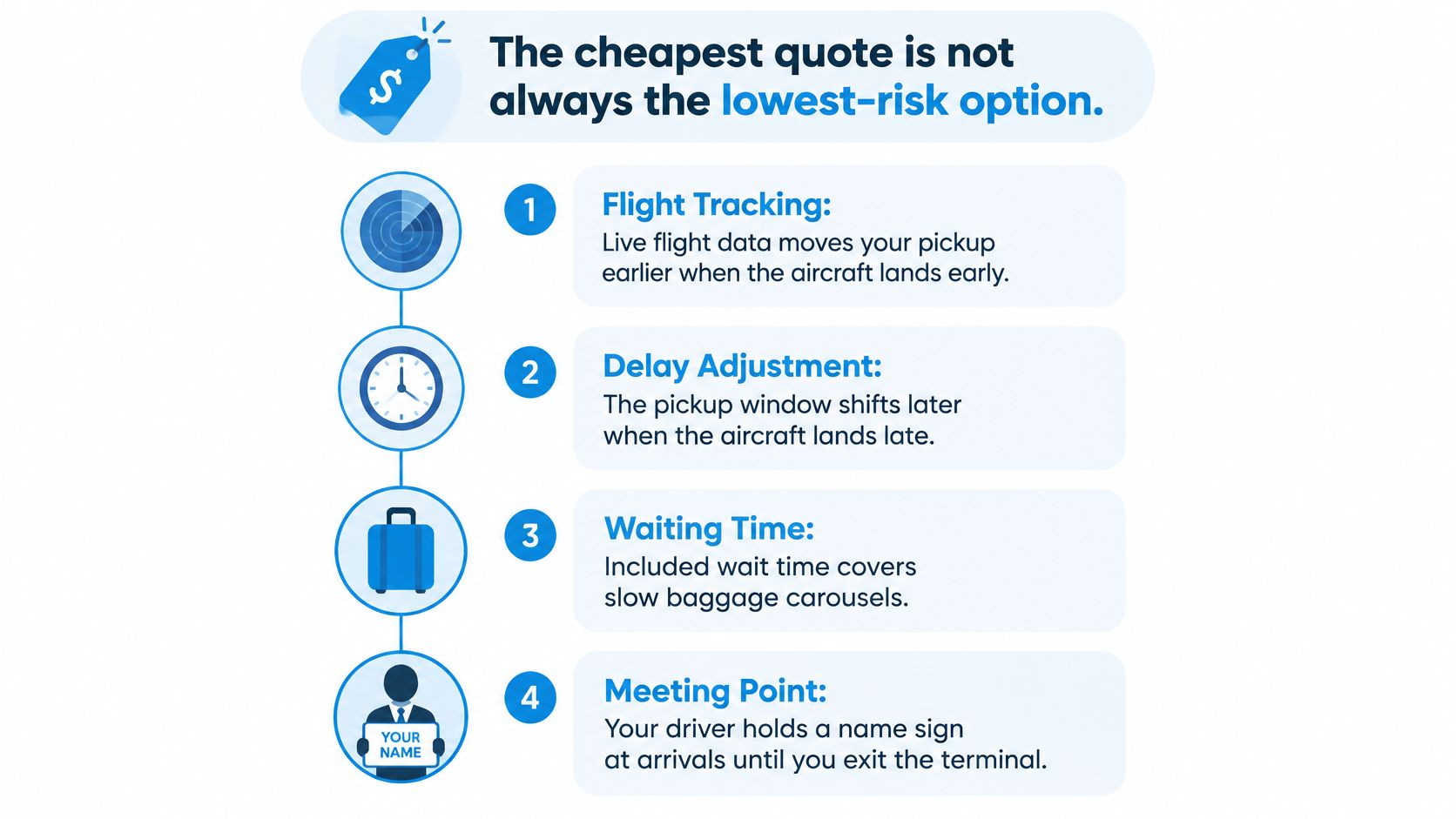
Transfer protections to confirm before you pay
| Protection | What to confirm | Red flag |
|---|---|---|
| Flight tracking | Whether live flight status changes pickup automatically and what limits apply | The flight number is collected without an adjustment commitment |
| Grace period | Included waiting, its starting event, extension charges, and contact procedure | No written allowance or unclear no-show timing |
| Meeting point | Named location, terminal, driver contact, and terminal-change procedure | Instructions that rely entirely on calling after landing |
| Delay and cancellation policy | Written rebooking, refund, diversion, cancellation, and no-show rules | A no-show charge without accessible terms |
Ask about the awkward cases
A delayed flight and a diverted flight aren't the same operational problem. Ask whether the operator can serve a different airport, whether that requires a new fare, and who must authorize the change.
Likewise, a terminal change can require a different meeting point. Find out whether dispatch updates the driver or expects you to make contact.
If slow baggage delivery keeps you inside, notify the operator through the specified channel before the waiting allowance expires. Keep the message and the response.
For an onward flight, ask what remedy applies if the transfer operator arrives late. Don't infer reimbursement for missed travel from a general promise of reliability.
A higher fare can be the better financial choice when it buys usable flexibility. It isn't automatically better, though: judge the written protection, not the premium label.
Matching Your Trip to the Right Transfer Type
A family landing late at a regional airport may have tired children, bulky suitcases, and child seats to manage. The lowest fare is a poor fit if the vehicle cannot carry everyone safely with their luggage. Start with the capacity you need, then check how the pickup will work if the flight arrives late.
A carry-on traveler arriving in daylight near a useful rail connection has a different problem. Choose for the actual arrival, not a universal ranking of transfer types. For any option, ask what happens if the flight is late: does the service adjust pickup, or will you have to arrange a ride after landing?
Airport size alone cannot tell you which transfer to book. Check the specific airport's current timetable and available transfer services for your arrival time. Late-night family arrivals call for a confirmed vehicle and a clear pickup arrangement.

Best transfer type by traveler situation
| Traveler | Situation | Best fit | Why it wins |
|---|---|---|---|
| Solo business traveler | Evening arrival, carry-on only, work the next morning | Pre-booked sedan or a rideshare arranged on arrival | A direct journey avoids shared hotel stops. The rideshare depends on driver availability after landing. |
| Family with children | Child seats and large suitcases | Confirmed private van or suitably sized SUV | It can accommodate the group when seating and luggage capacity are confirmed. |
| Couple in a rail-served city | Central hotel and daytime arrival | Rail or a well-routed shared shuttle | Compare these options when the connection is practical and the shuttle schedule fits. |
| Ski group | Bulky sports equipment and shared luggage | Private minibus or coordinated vans | Equipment space can be arranged in advance. |
| Executive with a client | Arrival assistance and a named greeting required | Black car or chauffeured service | It can provide a coordinated welcome when that service is explicitly included. |
| Late arrival at a remote airport | Public-transport timetable doesn't cover the arrival | Pre-booked private car | An agreed pickup avoids relying on an unverified connection. |
Change the recommendation when the trip changes
Checked luggage can turn a comfortable rail connection into an awkward choice. A frequent direct train near the hotel may make a private car unnecessary. Mobility needs can matter more than either fare or journey time.
For family bookings, ask which child-seat type will be supplied and how it will be installed. A checked box beside “child seat” does not establish that the equipment suits your child. Use this guide to airport transfers with car seats to prepare questions, then get confirmation from the operator providing the vehicle.
For a shared shuttle, check the departure procedure and likely hotel sequence. A reserved seat does not mean a direct ride to your address. If the flight is late, confirm how that affects the shuttle departure and whether you can still use the booking.
Make the environmental comparison honestly
A “green” label doesn't tell you how the journey will run. Consider occupancy, route length, empty repositioning, vehicle size, and extra stops. The review of landside airport-transport sustainability considers airport access as a wider system rather than judging a trip by its fuel label alone.
Rail or a scheduled bus is worth comparing when the connection works for your arrival and luggage. Shared transport makes sense when it combines passengers efficiently, rather than adding a long circuit or an uncertain wait.
An electric transfer depends on workable charging arrangements as well as the vehicle. A techno-economic assessment of airport electric-shuttle charging examines the relationship between energy needs and charging infrastructure. Ask whether the electric vehicle is confirmed for your trip or only advertised as an option.
Choose shared transport when the route, departure arrangements, and luggage allowance suit your arrival. A cheaper seat is a risk decision if a late flight leaves you waiting without a clear pickup plan.
Book Your Airport Transfer in Five Steps
Use a repeatable booking process so the final choice reflects the whole journey, not just the fare. Resolve unanswered questions before paying, especially when another company will operate the vehicle.
The booking sequence below is a useful reminder of what to gather and verify.
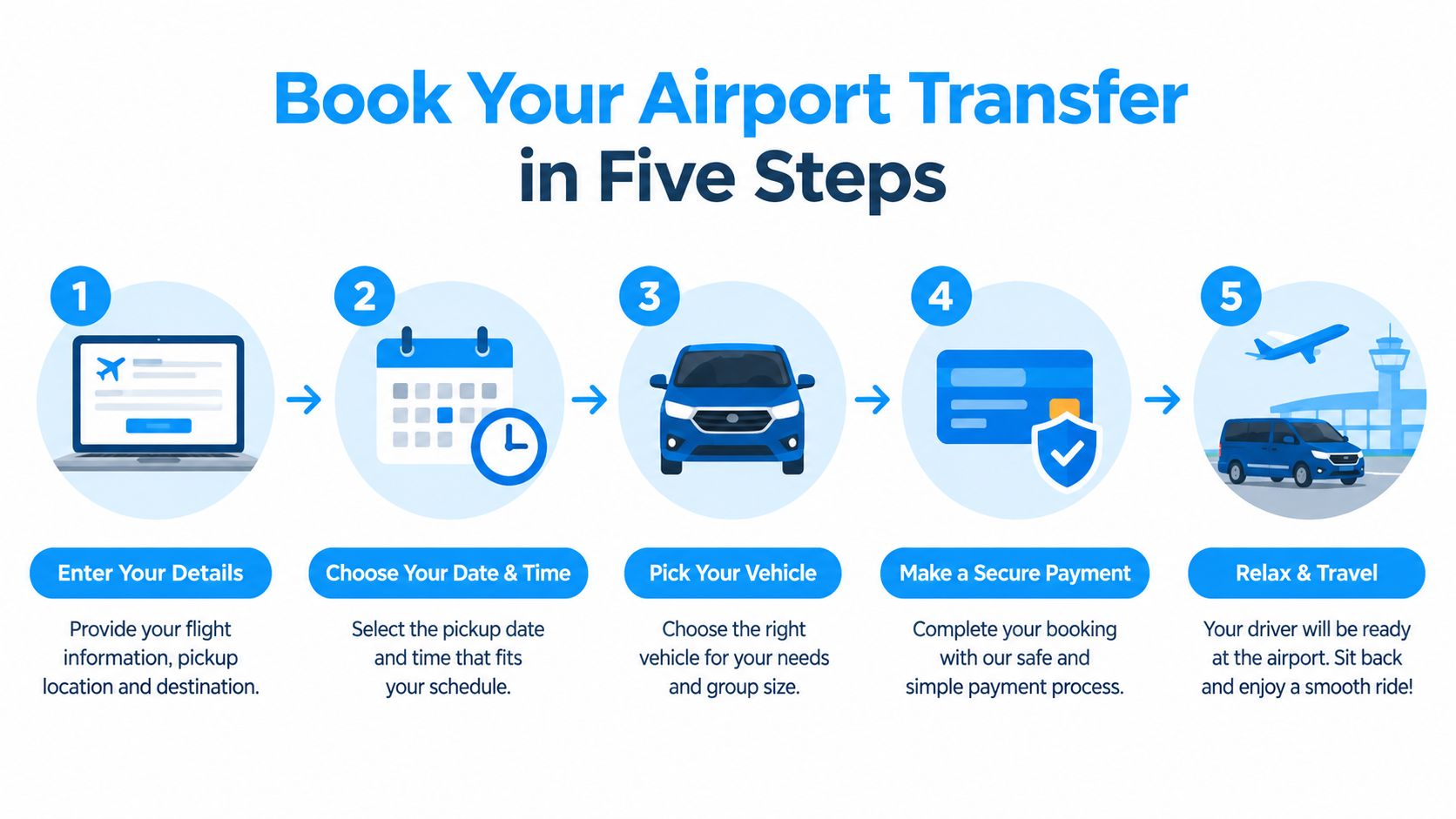
Record the complete trip requirement, because dispatch needs enough information to assign an appropriate vehicle and meeting arrangement. Include passenger details, luggage sizes, flight number, terminal if known, destination address, and any child-seat or accessibility requirements. For a hotel with multiple entrances, identify the intended drop-off rather than relying on its trading name.
Request comparable written quotes using identical requirements, because a lower price means little if it covers a smaller vehicle or a different pickup service. Use the all-in checklist above and keep a copy of the final offer. If the vehicle is described as “or similar,” ask what capacity and features are guaranteed regardless of the model supplied.
Apply the disruption-protection check, because the arrival terms decide whether the booking remains useful when your plans change. Read the actual policy rather than relying on search-result badges. Identify who handles urgent problems: the booking platform, local dispatch office, or driver.
Book once the requirements and terms are settled, because leaving a specialist vehicle request unresolved gives you less opportunity to arrange an alternative. This matters particularly for group transport, accessible vehicles, and child-seat requests. If your itinerary is still uncertain, favor workable amendment terms rather than assuming an early reservation will be flexible.
Save the confirmation offline, because you shouldn't need reliable mobile data to find the meeting point or emergency contact. Share it with another adult in your party where appropriate. Check that the telephone number can be dialed from your phone abroad and distinguish the driver contact from the support contact.
Check the confirmation before departure
A complete confirmation identifies the pickup point, vehicle suitability, waiting allowance, total price, and change procedure. It should also make clear which company fulfills the service and whom to contact if the assigned vehicle doesn't appear.
If something remains vague, send a focused question. Ask “Which arrivals exit should we use?” rather than “Is everything confirmed?” The former produces information you can act on.
This travel video can accompany your broader trip preparation.
Before flying, review any messages from the operator for changed instructions. If your flight details change, use the required amendment channel rather than assuming the driver will discover the change independently.
The booking is ready when you can explain the arrival procedure to someone else without opening a search engine. You know where to go, what vehicle has been arranged, when to make contact, and what happens if the original plan fails.
Easy Travel Bookings brings airport transfer options together with flight, hotel, and car-rental comparisons to help you coordinate your trip. Visit Easy Travel Bookings to compare options for your destination, then check the fulfilling provider's all-in fare and disruption terms before you book.