

A car rental cost for a week in the United States commonly runs about $400–$600 before taxes, insurance and fuel. The payable total is usually higher once mandatory charges are added.
The biggest budgeting mistake is treating the vehicle rate as the trip budget. A useful comparison separates the rental charge, unavoidable fees, chosen protection, driving costs and the temporary card hold. Otherwise, a low advertised price can look cheaper than a genuinely more inclusive offer.
Table of Contents
- Weekly Car Rental Cost Benchmarks at a Glance
- Why Season, Location and Timing Move the Price
- Building the Full Weekly Total From the Base Rate
- Choosing Damage and Liability Coverage Without Paying Twice
- Matching the Vehicle Type to Your Route
- Ways to Cut a Week's Rental Bill
- Compare All-In Quotes Before You Book
Weekly Car Rental Cost Benchmarks at a Glance
A weekly benchmark is useful only when its vehicle class, market and pricing basis match your trip. A government ceiling, a consumer quote and a reported average measure different things.
The U.S. General Services Administration ceiling-rate schedule sets maximum weekly government-contract rates of $378 for economy through midsize sedans, $402 for large sedans, $558 for small or medium SUVs and $828 for large SUVs. These are contract ceilings, not standard retail prices.
Weekly rental benchmarks by market and vehicle class
| Market and vehicle class | Weekly figure | Basis |
|---|---|---|
| United States, economy to midsize sedan | $378 | GSA government ceiling for short-term rentals |
| United States, large sedan | $402 | GSA government ceiling for short-term rentals |
| United States, small or medium SUV | $558 | GSA government ceiling for short-term rentals |
| United States, large SUV | $828 | GSA government ceiling for short-term rentals |
| United States, typical full-week rental | $400–$600 | Consumer-finance analysis of major brands |
| United States, full-size car in major destinations (2025) | About $670 | CarInsuRent research reported by EIN Presswire |
| Europe and other sampled destinations, compact car, peak-summer week (2026) | £373 average | iCarhireinsurance.com comparison across 12 destinations and six major companies |
| Europe, medium-compact, booked one week ahead (2024) | £306.27 | iCarhireinsurance.com comparison across seven destinations |
| Barcelona, Faro, Larnaca, Nice and Tenerife, medium-compact (2024) | £225 average | iCarhireinsurance.com research reported by London Loves Business |
These consumer figures describe different vehicle classes, destinations and booking conditions. The £373 comparison includes destinations outside Europe, so it is not a Europe-only average. The U.S. full-size figure applies to selected major destinations, not every U.S. rental market.
The GSA rates show how much the base rental ceiling can rise with vehicle size, but they do not predict a retail checkout price. Use the closest matching consumer benchmark as a reference, then compare the actual quote's inclusions and payable total.
Budgeting rule: Match the benchmark to your vehicle class and travel dates. Check the quote before adding charges, since some may already be included.
Why Season, Location and Timing Move the Price
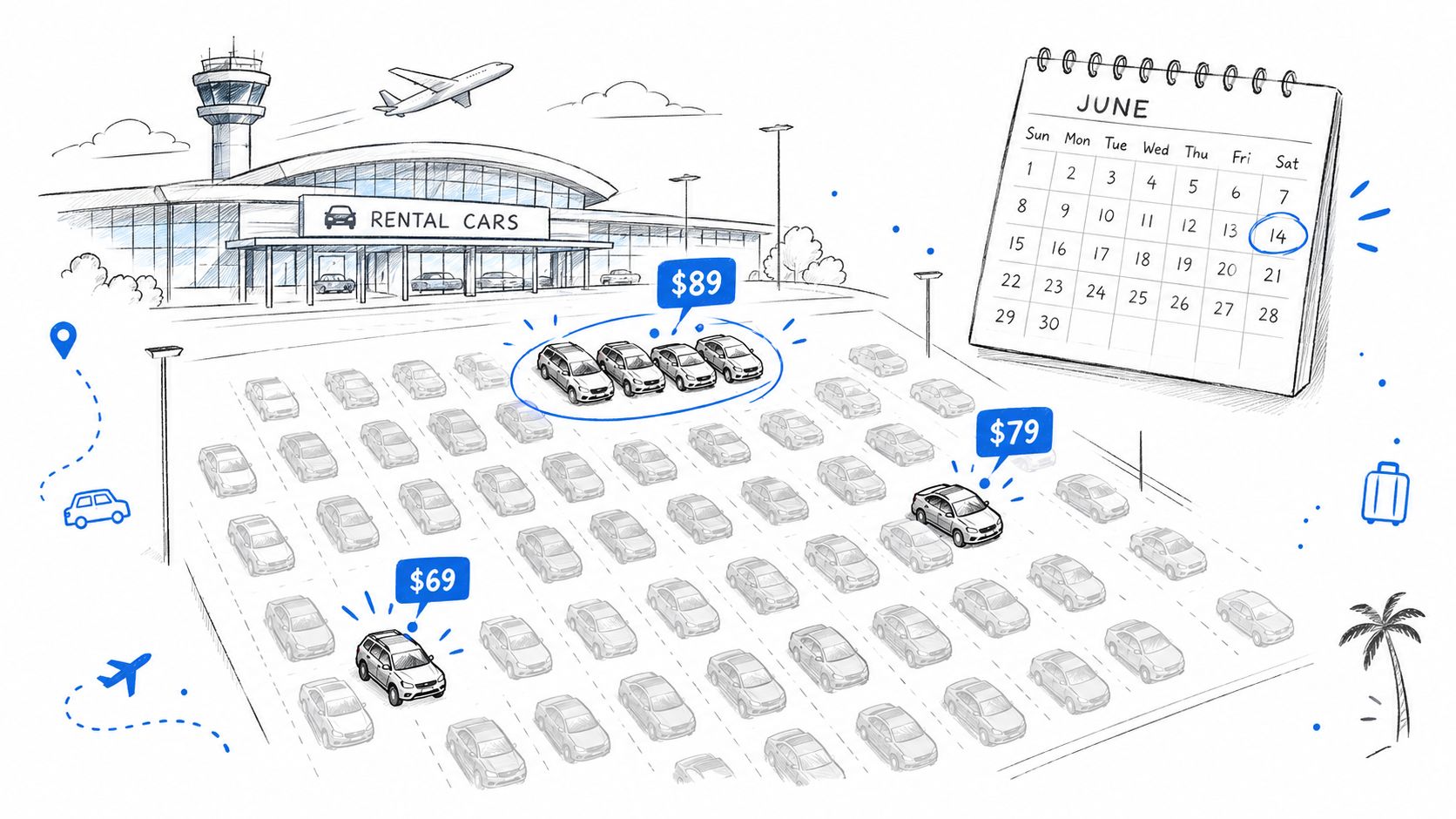
A weekly quote is a snapshot of inventory under pressure. A rental operator earns nothing from an unused car, so when travelers concentrate on the same pickup dates and vehicle classes, the selection that remains gets narrower and the cheapest acceptable offer can disappear first.
The facility illustration shows why there is no single price for every car on the lot.
Separate seasonal pressure from destination differences
The iCarhireinsurance.com peak-summer comparison found an average compact-car quote of £373 for a week in 2026 across 12 destinations and six major companies, with Munich averaging £292 and Florida £338. Read it as a summer basket for named markets and suppliers, then price your own branch instead of treating £373 as a universal weekly rate.
That keeps the test clean. To measure seasonality, hold the pickup branch, vehicle category and inclusions steady, then move only the dates. To measure location, keep the week and class steady, then change the pickup point.
- Season: Compare your intended week with a quieter travel window if your schedule allows. Keep the car category and inclusions unchanged.
- Destination: Search the actual pickup city rather than budgeting from a national average. Nearby branches may offer different inventory and terms.
- Lead time: Reserve a suitable refundable offer when the total works for you. Recheck it, because neither early nor last-minute booking wins every time.
Price the itinerary, not just the calendar
Pickup location changes more than convenience. An airport branch may carry facility-related charges, while an off-airport collection can require paid transport and time. The cheaper map pin can be the slower or costlier door-to-door option.
Choose the vehicle by passenger and luggage load. Start with the smallest category that genuinely accommodates passengers, luggage and child seats, then compare upgrades instead of selecting an SUV by default.
- Rental duration: Request a continuous weekly quote and an alternative shorter booking if the car will sit unused for part of the trip. Check whether the daily rate changes when the trip length changes.
- Return location: Enter the actual drop-off branch before judging the price. A one-way itinerary can produce a different total from a round trip.
The working method is controlled variation: dates, pickup points, class and duration move one at a time, while the payable total stays fixed as the comparison metric. The variable that lowers that total is the lever worth using.
Building the Full Weekly Total From the Base Rate
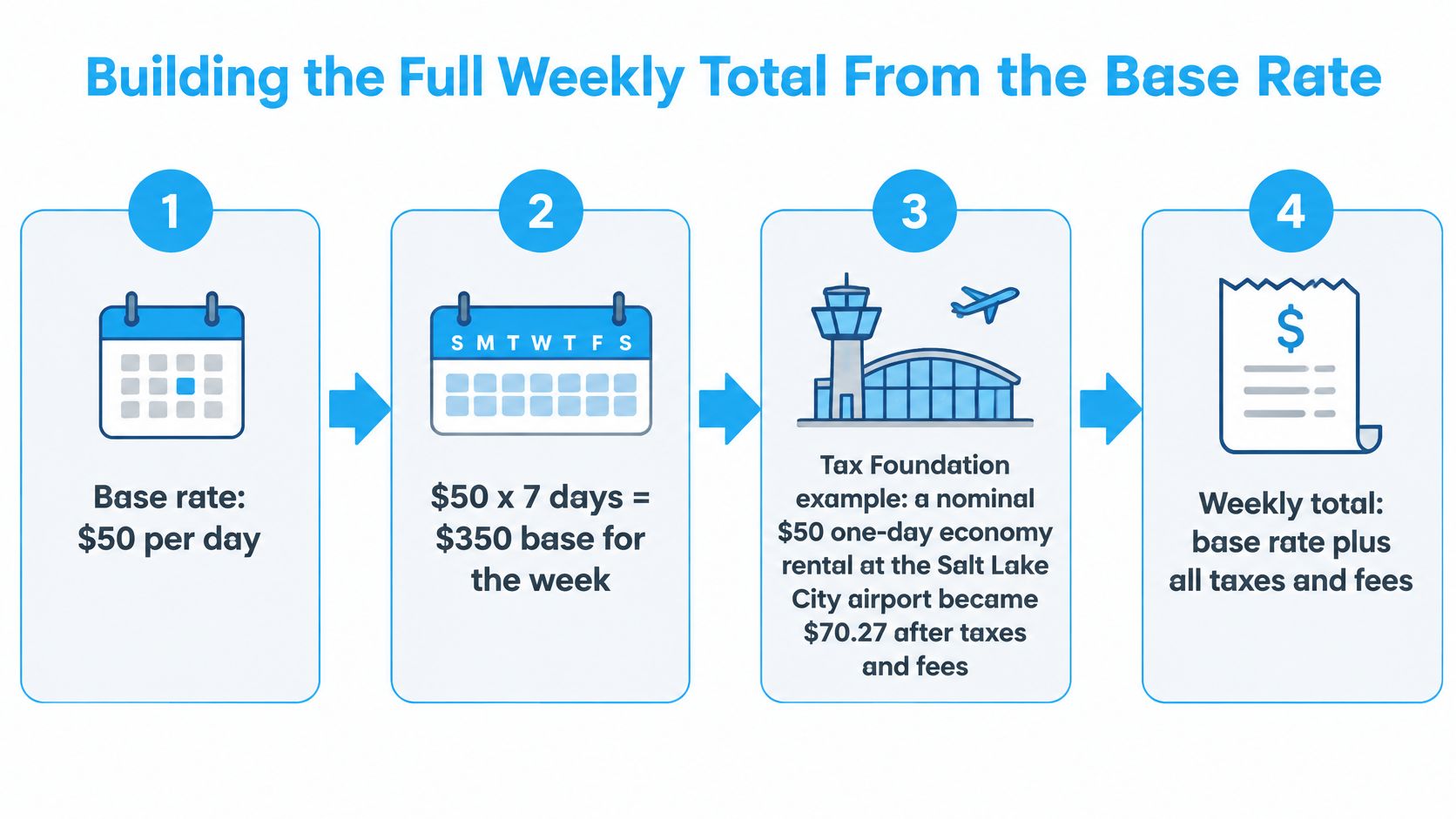
A base rate tells you what the vehicle costs before the rest of the rental contract is priced. In the Tax Foundation's Salt Lake City airport example, a nominal $50 one-day economy rental became $70.27 after taxes and fees; if that daily structure held for seven days, the $350 vehicle rate would become approximately $491.89 before optional extras.
The flow below shows the distinction between multiplying the headline rate and calculating the payable rental charge.
Read the charges in billing order
Start with the vehicle subtotal. Then identify the concession-recovery fee, customer-facility charge and license-cost fee before checking the rental, tourism and sales taxes.
Don't assume every line multiplies identically. A per-day charge repeats for each billable day, a per-rental charge applies once, and a percentage charge uses the taxable amount specified in the quote. The example supports an illustrative weekly extrapolation, not a guarantee that every airport uses the same structure.
Itemized weekly cost from base rate to total before extras
| Line item | Amount for seven days | Notes |
|---|---|---|
| Base rate at $50 per day | $350 | Nominal vehicle rate in the Tax Foundation example |
| Taxes and airport-related charges | About $141.89 | Implied difference if the example's daily structure held throughout |
| Estimated total before extras | About $491.89 | Approximately 41% above the base rate, calculated from the example |
| Refundable deposit | $200–$500 | Skyscanner's reported typical range; temporary authorization, not rental spending |
| Fuel or charging | Planned distance × energy consumption × local energy price | Apply the return-fuel or charging rule |
| Tolls and transponder | Route tolls plus contracted service charges | Check whether administration charges apply per use or per day |
| Additional driver | Quoted driver charge × applicable billing days | Check exemptions and which drivers qualify |
| Optional insurance | Selected protection price × applicable billing days | Include only products you choose or must purchase |
The deposit belongs in a cash-availability calculation, not in the final spending subtotal. A card authorization reduces available credit until it's released; release timing and deductions follow the rental and card arrangements.
Keep two budgets: what the trip consumes and what your card must accommodate. A refundable hold affects the second without necessarily increasing the first.
At Easy Travel Bookings, we charge no booking fee or mark-up. We present prices without extra charges or hidden fees, and the price shown is exactly the price paid; separately chosen products and usage-dependent spending still need their own budget.
For an additional rental-planning overview, watch the accompanying video.
Before accepting a quote, label every remaining amount as included, optional, usage-dependent or refundable. That prevents both missing charges and double-counting.
Choosing Damage and Liability Coverage Without Paying Twice
Full coverage isn't one standardized product. Damage protection addresses the rental vehicle, liability addresses claims involving other people or property, and personal accident or effects products address different risks again. Quoting them as one bundle hides which part of the daily add-on price is actually buying something new.
The FTC's rental-car guidance advises checking existing coverage and confirming that mandatory charges are included while optional insurance is priced separately. That separation drives the weekly arithmetic: a waiver quoted per day multiplies across every billing day, so a daily price in the tens of dollars can add a few hundred dollars to a seven-day total before liability products are even counted. Counter pricing at major suppliers can also run well above general estimates, which is why the waiver line deserves the same scrutiny as the base rate.
Rental coverage types, prices and what to check
| Coverage type | Daily cost | Check before you skip it |
|---|---|---|
| Collision or damage waiver | Planning estimates put it at $10–$30 per day, or $70–$210 across a week; a major supplier's counter price can run higher | Whether personal auto, credit-card or travel protection already covers rental damage, plus deductible and loss-of-use treatment |
| Supplemental liability | Priced separately per rental day | Whether existing liability protection applies at the destination and has suitable limits |
| Personal accident and effects cover | Use the separately itemized quote | Check health, travel and home-policy benefits for overlapping protection |
A damage waiver isn't interchangeable with liability insurance, and a credit-card rental benefit doesn't automatically settle every cost the rental company might claim. Treat each product as a separate line in the same calculation used for the base rate: daily price times applicable billing days, added only where a real gap exists.
Check the contract before declining protection
- Contact the card issuer and insurer. Request written confirmation for the destination, vehicle category, rental duration and named drivers.
- Record exclusions and the claims process. Check deductibles, theft, loss of use, administrative charges and any restrictions on roads or border crossings.
- Choose by coverage type. Establish whether existing protection is primary or secondary, then fill actual gaps rather than accepting or rejecting a bundle.
- Carry the necessary documents. Save policy wording, confirmation letters and emergency claim contacts where you can access them offline.
The most defensible option at the lowest cost is the least expensive arrangement that protects against the risks you're unwilling or unable to absorb yourself. A lower premium offers no real savings if it leaves a significant exposure uninsured.
Declining a waiver also doesn't set the deposit amount. Check the authorization requirement for the precise protection arrangement you'll use, rather than assuming existing insurance removes the hold.
Matching the Vehicle Type to Your Route
The lowest weekly vehicle rate doesn't necessarily produce the lowest trip cost. A car that's inexpensive to reserve can become a poor choice once mileage limits, energy costs and return requirements are applied.
Skyscanner's rental-cost guide gives a general collision-damage-waiver estimate of $10–$30 per day and a typical deposit range of about $200–$500, reinforcing why the reservation charge and temporary authorization should be assessed separately. Those are planning ranges, not promises for a particular branch or vehicle.
Which vehicle option usually costs less on each route type
| Route or use pattern | Usually cheaper option | Why it changes the total |
|---|---|---|
| Long-distance touring with sparse charging | Gasoline or diesel car is the practical starting comparison | Check whether charging detours and return requirements outweigh an EV's rental savings |
| City-centered week with reliable public charging | Electric vehicle, if its combined rental and charging total is lower | Compare available chargers, session fees and the return-charge requirement |
| Short hops within one region, low mileage | Smallest suitable class at the lowest inclusive rate | A higher energy-efficiency premium may not repay itself over little driving |
| High mileage with limited included kilometers or miles | Unlimited-mileage car when avoided excess charges exceed its price premium | Calculate expected distance beyond the allowance before booking |
| Route with frequent tolls | Car with the lowest combined toll-service cost | Compare tolls, transponder charges and administrative terms |
The Mordor Intelligence North American rental-market overview reports public pay-per-use charging prices of $0.28–$0.58 per kWh, with possible session fees of $0.50–$2.00. Actual route economics still require the vehicle's consumption and the chargers you can realistically use.
Calculate energy and distance together
For a gasoline car, multiply expected distance by consumption, then apply the fuel price. For an EV, calculate energy use and add session charges, parking costs at chargers and any contractual return-charge fee.
Don't choose an unlimited-mileage plan solely for its label. Compare its premium with the excess-distance charge your itinerary would realistically trigger.
A weekly discount is only useful if the vehicle and contract still suit the driving you'll do.
For a city stay with little driving, also compare a shorter car booking with the cost of renting a bike. The meaningful comparison is the complete transport plan, including luggage transfers, rather than a car's weekly rate in isolation.
Ways to Cut a Week's Rental Bill
Savings come from removing costs you don't need, not from selecting the lowest number on the first search screen. Keep passenger comfort, driving safety and contractual obligations fixed while you test cheaper arrangements.
Use this checklist to identify changes worth pricing.
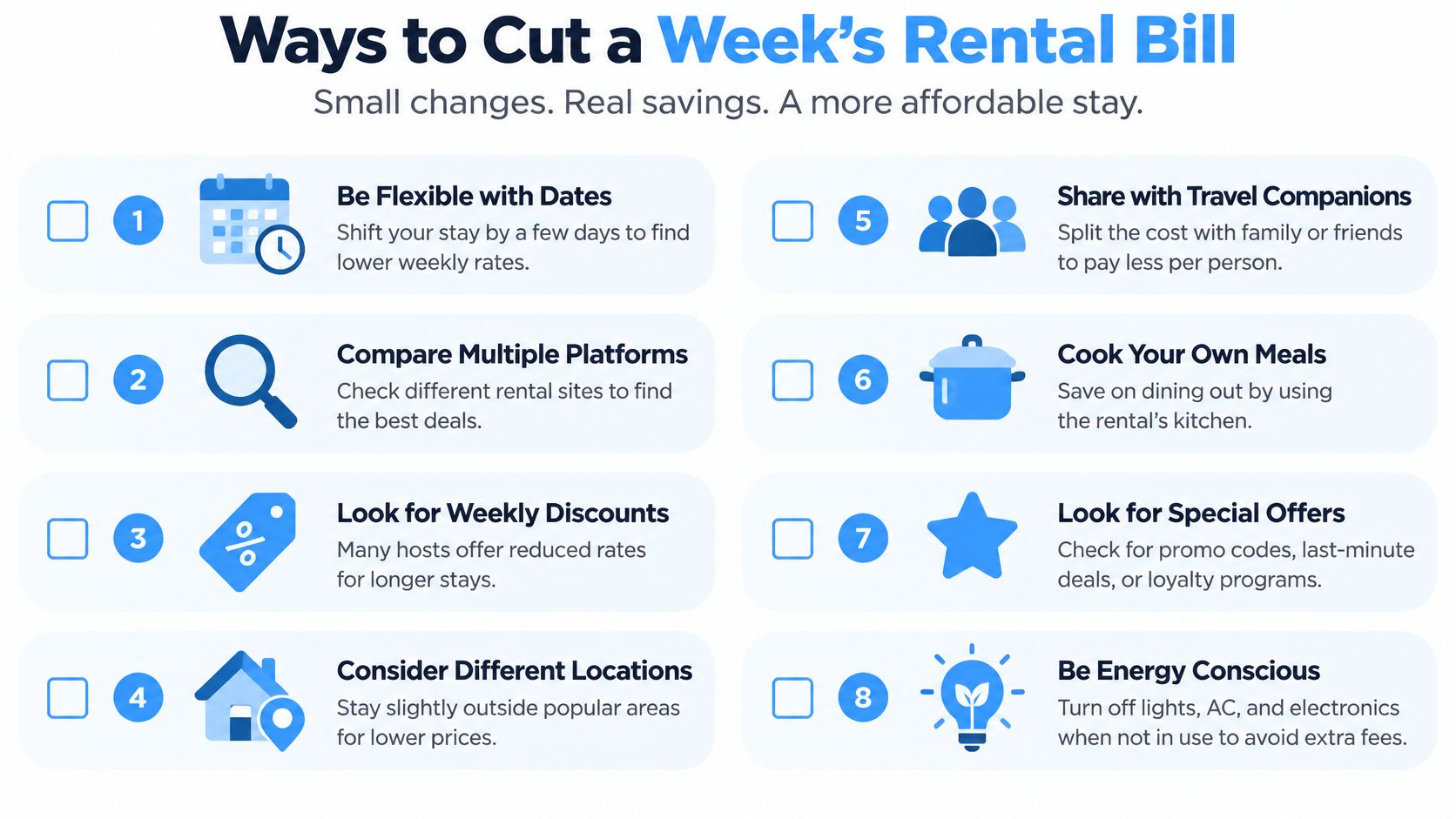
Test changes that reduce the complete bill
- Price both the shorter stay and the full week. Weekly pricing can make the longer reservation competitive. Don't assume you can return early without changing the agreed rate.
- Compare collection arrangements. An off-airport offer only saves money if its rental savings exceed the transport needed to reach it. Include branch opening hours and the return journey.
- Fit the car to the luggage. A smaller suitable category avoids paying for space you won't use. Don't downsize so far that you need another vehicle or an expensive counter upgrade.
- Choose a workable fuel policy. Refilling yourself lets you pay for the fuel you use. A prepaid arrangement needs closer scrutiny if you're unlikely to return with an empty tank.
- Use existing protection where it genuinely applies. Remove overlapping products only after confirming the policy terms. Similar product names don't establish equivalent cover.
- Challenge the one-way itinerary. Compare a loop with a different-city return. Keep the one-way option when avoiding backtracking is worth more than its fee.
- Register only necessary drivers. Don't purchase unused driving privileges. Equally, never let someone drive merely because you chose not to register them.
- Replace a booking only when cancellation permits. A lower replacement quote can reduce spending on the same itinerary. Secure the new reservation before canceling the old one and check refund conditions.
Remove rental days you won't use
A car parked throughout a resort stay still needs to be justified against other transport. If you only need transport between the airport and accommodation, compare what an airport transfer involves before reserving a vehicle for the whole stay.
Make changes individually and save the resulting quote. Otherwise, you won't know whether a cheaper collection point, different category or revised duration produced the saving, or whether the offer quietly removed something you need.
Compare All-In Quotes Before You Book
Book the lowest payable total for a suitable car and contract, not the lowest headline rate. A quote is comparable only when its dates, drivers, category and selected protection match your requirements.
Keep three fields distinct: payable today, estimated final spending and temporary authorization. Don't add a refundable hold to spending, and don't confuse a small advance payment with a low final bill.
Use a consistent comparison process
- Enter the exact itinerary. Include destination, pickup and return times, driver details and the actual return branch. Save each offer with the time you checked it.
- Compare across booking channels. Our search covers over 70 travel providers, including major booking websites and smaller local systems. You enter your destination and dates, then receive prices and offers to choose from.
- Normalize the inclusions. Record taxes, airport charges, selected protection, mileage, fuel policy and equipment in the same columns for every offer. Mark the deposit separately.
- Resolve omissions before paying. An unclear mandatory charge makes an offer incomplete, not cheap. Keep the itemized price and rental conditions with your confirmation.
- Choose and preserve the terms. Select the lowest suitable total, record cancellation conditions and retain the confirmation you'll need at pickup.
For a consistent way to organize offers, use our guide to comparing car rental prices. The point isn't to collect the most quotes; it's to make the quotes you collect genuinely comparable.
The winning offer is the one that remains affordable after you apply your real itinerary, not the one that looks cheapest before you enter it.
Run a search for your exact dates and complete an itemized comparison for each shortlisted offer. Leave no mandatory fee unclassified, and keep usage estimates separate from the fixed reservation price.
Easy Travel Bookings brings major booking websites and smaller local systems into one search, with no booking fee or mark-up. Enter your destination and travel dates, compare the available car-rental offers, and choose using the full price and terms that fit your trip.