
Montana's commercial-airport network is concentrated in four major gateways that handle 92.5% of the state's enplanements, and Bozeman Yellowstone International Airport led in 2024 with 1,321,790 boardings. If you're trying to decide where to fly, that concentration matters because the right airport can save you hours on the road, while the wrong one can turn a simple trip into a long, weather-sensitive transfer.
Most travelers run into the same problem the moment they book a Montana trip. The airfare looks fine, the destination is fixed, and then the key question appears, which airport truly makes sense once you factor in driving time, flight frequency, and winter conditions? In Montana, that choice is rarely as obvious as "closest on the map."
Table of Contents
- Choosing the Right Montana Airport for Your Trip
- Montana Commercial Airport System Overview
- Major Airports and Airline Coverage
- Navigating Each Major Airport
- Matching Airports to Your Montana Destination
- When to Drive to a Larger Airport
- Understanding Essential Air Service Routes
- Booking Smart for Montana Flights
- Montana Airport Decision Matrix
- Seasonal Considerations and Weather Impact
- Your Montana Airport Planning Checklist
Choosing the Right Montana Airport for Your Trip
A traveler heading for the Flathead Valley often starts by comparing Kalispell and Missoula, then realizes the decision isn't only distance. It's whether the extra drive buys a better flight, fewer connections, or less risk if weather turns ugly. That's the Montana airport problem in a nutshell.
Start with the trip, not the airport
The smartest choice usually comes from matching the airport to the actual trip plan, not the ZIP code. If your final stop is near Yellowstone's west side, Bozeman may be the easiest flight into the state, even if it isn't the shortest drive for every itinerary. If you're headed to Whitefish, Glacier Park International is usually the cleaner fit because it's built for that corridor, while Billings works best when your destination is in eastern Montana.
Practical rule: if a closer airport has weak schedules or a fragile connection, the “convenient” option can become the expensive one.
I've seen travelers book the nearest airport, then spend the next day fighting rebookings, rental car shortages, or a long winter drive on top of a late arrival. That's why the right approach is simple, compare the airport's route quality, the road from the airport to your final stop, and your tolerance for delays.
For airports in Montana, the usual winning strategy is to treat the airport as part of the trip, not just the start of it. Once you do that, the trade-offs become clearer and the itinerary gets easier to manage.
Montana Commercial Airport System Overview
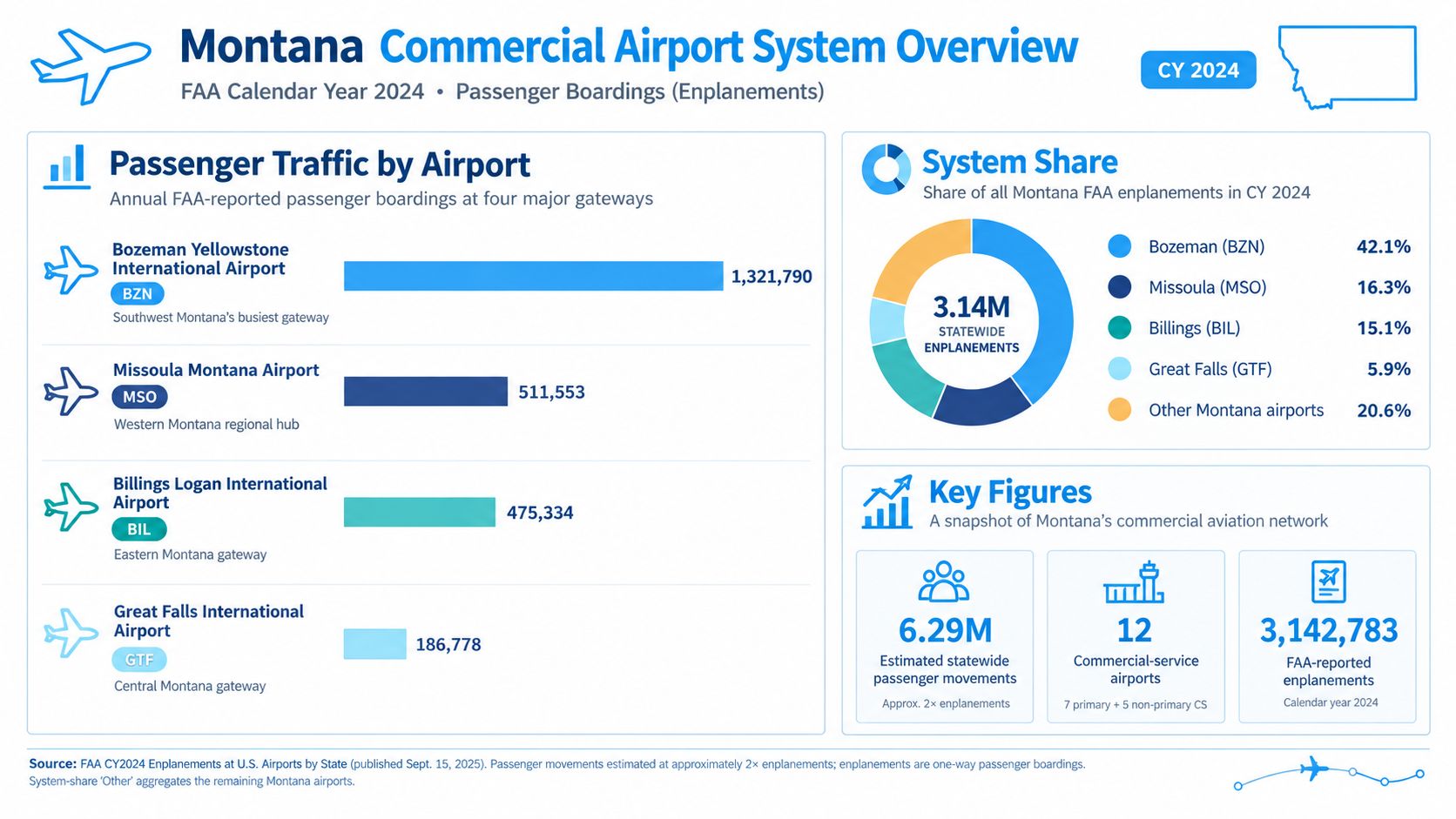
Montana's commercial system is centered on a handful of airports that handle most scheduled airline travel. FAA calendar year 2024 data show 3.04 million enplanements across the state's commercial-service airports, and four airports account for almost all of that volume. For trip planning, that concentration is the first thing to understand. FAA 2024 enplanement counts for Montana commercial service airports
| Airport | IATA Code | 2024 Enplanements | Share of State Total |
|---|---|---|---|
| Bozeman Yellowstone International Airport | BZN | 1,321,790 | about 43.5% |
| Missoula Montana Airport | MSO | 511,553 | about 16.8% |
| Glacier Park International Airport | FCA | 503,816 | about 16.6% |
| Billings Logan International Airport | BIL | 475,334 | about 15.6% |
Bozeman handled more boardings than Missoula and Billings by a wide margin. The four largest airports together accounted for about 92.5% of the state total. That matters because the busiest airports usually have the strongest schedules, the best connection banks, and the most forgiving backup options when weather or a missed connection disrupts a trip. If you want the widest set of flight choices, start with one of these four gateways.
The smaller commercial airports serve real travel demand, but they operate on a different scale. Great Falls recorded 186,778 enplanements, Helena 101,591, Butte 15,773, West Yellowstone 9,569, and Glasgow 2,970. Those airports can be the right answer for local access, but they do not offer the same route depth or recovery options as the state's largest airports. Smaller markets often save drive time, then give some of that back through fewer nonstop flights, tighter schedules, and less flexibility if plans change.
A useful way to read the numbers is straightforward. Enplanements count commercial boardings, so the figures measure passenger demand and airport usage rather than trip distance or the number of flights a traveler took. That is exactly the lens you want when comparing Montana airports, because the busiest fields are usually the ones airlines can support most reliably.
Major Airports and Airline Coverage
The four largest airports each solve a different travel problem. Bozeman offers the broadest commercial pull, Missoula anchors the west-central corridor, Glacier Park International serves the Flathead and Glacier region, and Billings remains the main gateway for eastern Montana. When you compare them properly, the question isn't which airport is “best,” but which one lines up with your destination and schedule.
| Airport | IATA Code | 2024 Enplanements | Primary Service Area | Key Airlines |
|---|---|---|---|---|
| Bozeman Yellowstone International Airport | BZN | 1,321,790 | Southwest Montana, Yellowstone access, broader statewide catchment | Varies by season and hub connectivity |
| Missoula Montana Airport | MSO | 511,553 | Missoula, University of Montana area, western recreation corridors | Varies by season and hub connectivity |
| Glacier Park International Airport | FCA | 503,816 | Flathead Valley, Whitefish, Glacier National Park corridor | Varies by season and hub connectivity |
| Billings Logan International Airport | BIL | 475,334 | Eastern Montana, regional business travel, broad eastern access | Varies by season and hub connectivity |
What the traffic split means for you
Bozeman's scale gives it an edge when you want more schedule choice and a better chance of finding a workable connection. Missoula and Glacier Park International are smaller, but each fits a specific travel pattern well, especially if your destination is already in western Montana. Billings is the practical choice when the trip is centered on the east side of the state or when you want a true regional base rather than a tourism gateway.
The airline mix changes by season, and that matters more in Montana than in many other states. Bigger airports usually absorb disruptions better because they have more arrivals, more departures, and more routing alternatives. Smaller airports can still be the right choice, but they demand more flexibility from the traveler.
If your schedule is tight, prioritize the airport with the strongest rebooking options, not the shortest line on a map.
That's the key difference between the Montana gateways. A good flight plan here isn't just about landing near the destination, it's about landing in a place where the rest of the trip can still recover if something shifts.
Navigating Each Major Airport

The easiest way to move through Montana's bigger airports is to plan the ground piece before you land. Rental cars, shuttles, parking, and terminal layout can shape your trip as much as the flight itself. For a practical overview of how airport transfers work, see this guide on airport transfer basics.
Bozeman and Billings
Bozeman is the busiest gateway, so build in a little more patience for curbside traffic, rental counters, and peak-season congestion. It tends to reward travelers who want more route options and are comfortable moving through a busier regional airport. Billings is usually easier to read at a glance, and it's often the more direct fit for eastern Montana trips or business travel that starts on that side of the state.
Missoula and Glacier Park International
Missoula works well when your trip centers on the city, the university, or nearby outdoor recreation. Glacier Park International is the airport to use when the Flathead Valley, Whitefish, or Glacier National Park is your destination. At Glacier Park International, the FAA lists a long primary runway, instrument procedures, and cold-weather considerations, which is a reminder that this airport is built for commercial operations in a region where weather and approach capability matter. FAA data for Glacier Park International
What to do at the airport
- Check ground transport first. If you need a car immediately, confirm rental pickup before you book.
- Plan for peak days. Busy seasons can slow down security, baggage claim, and car rental lines.
- Keep your code straight. Use the correct airport code when you search, especially where city and airport names are similar.
- Leave buffer time. Montana airports can look simple, but weather and transfers can still eat up your margin.
The biggest mistake I see is assuming a smaller terminal means a simpler trip. Sometimes it does, sometimes it just means fewer backup options if your connection slips.
Matching Airports to Your Montana Destination
The best Montana airport depends on where you're sleeping, driving, and spending the most time. If you're going to the north entrance of Yellowstone or exploring southwest Montana, Bozeman often gives you the best balance of flight access and onward driving. If the plan is Glacier, Whitefish, or the Flathead Valley, Glacier Park International is the natural choice because it puts you closer to the northern tourism corridor.
Billings earns its place when the trip is east of the mountain divide. It works as the principal commercial gateway for that side of the state, so it's often the sensible airport for family visits, regional business, or trips toward the Badlands and nearby reservoirs. Missoula sits in between, useful when you want western access without committing to the far northwest or southwest edges of the state.
For destination planning, think in terms of the full arrival chain. A cheaper fare into the “wrong” airport can cost you more in car rental, road time, or winter driving stress. A slightly pricier fare into the better-fit airport can save the whole trip from feeling stretched.
The best airport is usually the one that keeps your final day simple.
That rule holds up across most of Montana. If the airport and the destination naturally match, the trip feels smoother from the moment you land.
When to Drive to a Larger Airport
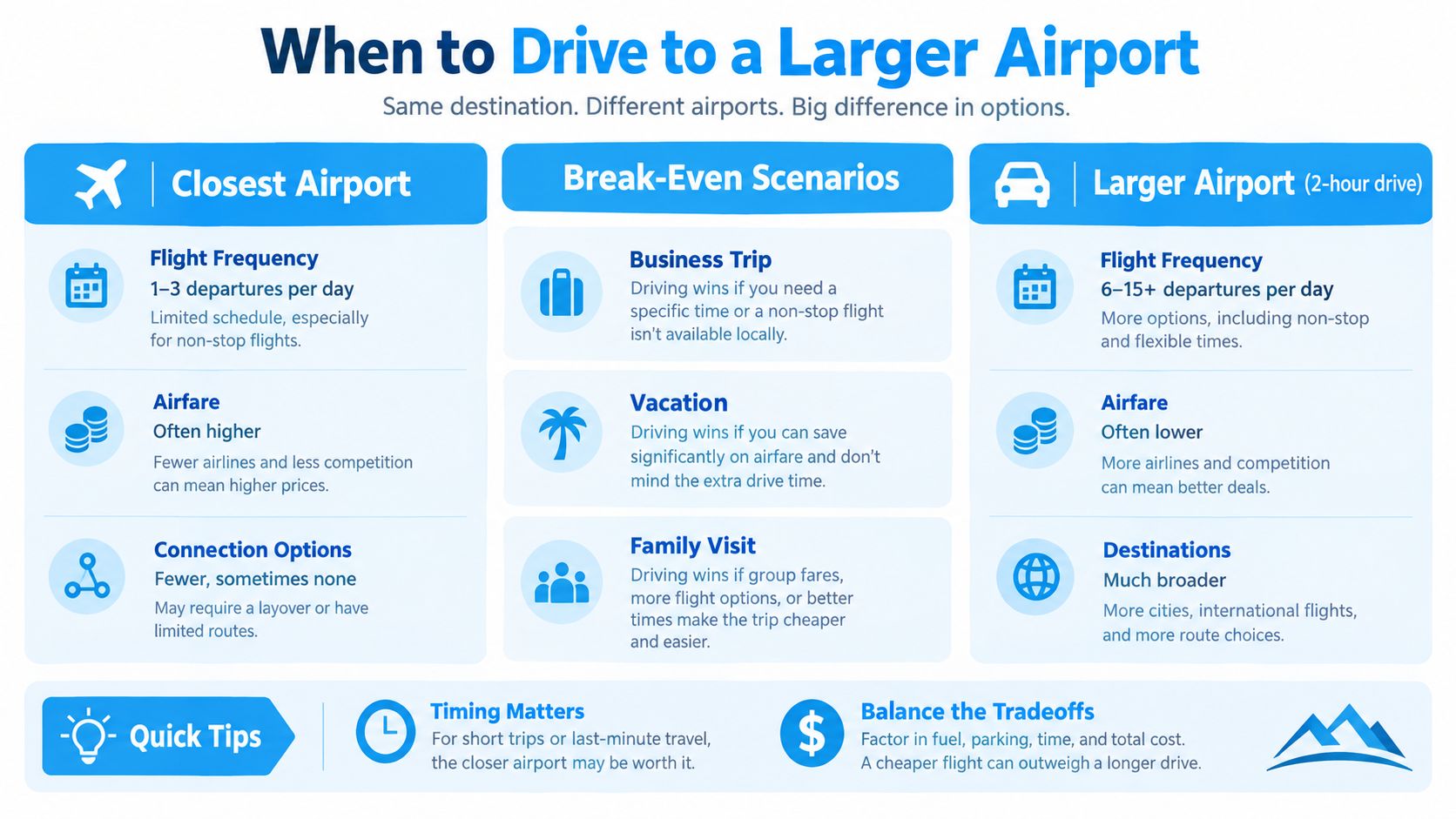
The closest airport isn't always the smartest one. In Montana, driving to a bigger gateway can be the better move when it gives you more reliable service, a better schedule, or a lower total trip cost once you include ground transport. I've had travelers save themselves a missed connection just by starting the trip with a longer drive and a stronger airport.
The trade-off that actually matters
Small airports can be convenient, but they often come with limited frequency and less room to recover when something goes wrong. Larger airports usually give you more daily options and a wider spread of destinations, which matters if your trip has to stay on time. If you're traveling for work, meeting a tour departure, or connecting beyond Montana, that extra flexibility can be worth the drive.
Use a total-cost mindset, not an airfare-only mindset. A lower ticket from a nearby airport can disappear fast once you add a more expensive car rental or the cost of rebooking after a disruption. That's why comparing nearby airport choices is more useful than locking onto the nearest dot on the map.
For car price checks and pickup planning, this car rental comparison guide is a useful companion when you're deciding whether the longer drive pays off.
When the drive wins
- Business trips when a missed flight would ruin the schedule.
- Family visits when you need the broadest backup options.
- Winter travel when weather can make a small airport feel fragile.
- Complex itineraries that depend on a same-day connection elsewhere.
The four big Montana airports handle most of the state's commercial traffic, so they're often the safer bets when your itinerary has no room for improvisation. That doesn't mean you should ignore local airports. It means you should weigh convenience against resilience before you book.
Understanding Essential Air Service Routes
Montana's smaller-airport story is different from the major-gateway story. Some communities depend on subsidized service because commercial demand alone wouldn't support the route. That's where Essential Air Service comes in, and it's also where traveler expectations need to stay realistic.
Glasgow is a good example. The community relied on twice-daily nine-seat Cape Air aircraft to Billings, with the route supported by about $2.2 million in annual federal subsidies. Without that service, travelers faced a 2.5-hour drive to Williston or a 4.5-hour drive to Billings. Montana Free Press on rural air access
What small-airport service can't do
A subsidized flight gives access, but it doesn't turn a small airport into a major hub. Frequency is limited, aircraft are small, and weather has a bigger impact on the whole itinerary. If a connection fails, the backup plan may be a long drive rather than a quick rebooking.
That's why travelers should treat these routes as access services, not full network alternatives. They work best when the main goal is to reach a remote community efficiently and you've built some margin into the schedule. They work worst when you need the same flexibility you'd expect at a large commercial airport.
In practice, I advise travelers to ask one question before booking a small-airport route, what happens if the flight doesn't go? If the answer is weak, the larger airport may be the safer choice even if the drive is longer.
Booking Smart for Montana Flights
The best booking strategy for Montana is to search more than one airport at once and compare the entire trip, not just the fare. A flight that looks cheap can become expensive after you add a car, a hotel night, or a missed connection. That's especially true when your itinerary crosses a long distance inside the state.
Start with flexible date searches across Bozeman, Missoula, Glacier Park International, and Billings. Then compare the total trip cost, including ground transport from the airport to your final stop. If two fares are close, choose the airport with the better schedule buffer and the cleaner drive.
How I'd search it
- Run multiple airport searches. Don't stop at the closest one.
- Compare total cost. Include rental cars, transfers, and any extra hotel night.
- Check the route quality. A nonstop into the right airport can beat a cheaper connection every time.
- Watch timing. Montana flights can swing in price and availability around peak travel periods.
If you want a practical timing reference, this best day to book flights guide can help you think about when to finalize the purchase rather than guessing.
Once the flight is narrowed down, look at arrival time and what happens after landing. A late arrival into a remote airport can make a simple transfer much harder than it looks on paper. If you're connecting onward, give yourself a buffer instead of betting everything on a tight window.
The right booking habit is boring, but it works. Search widely, compare the full itinerary, and book the option that gives you the best chance of arriving calm.
Here's a practical reminder from the booking screen perspective, and it's one I keep seeing in Montana itineraries. The cheapest fare is not always the best value if it leaves you stranded with a long transfer or a poor backup option.
Montana Airport Decision Matrix
The cleanest way to choose an airport is to rank your priorities before you compare fares. If speed matters most, the airport closest to your final stop may win. If reliability matters more, the largest airport in reach usually deserves a hard look.
| Your Priority | Best Airport Choice | Why It Works | Best For |
|---|---|---|---|
| Broadest flight options | Bozeman Yellowstone International | Strongest commercial scale in the state | Busy leisure trips, complex connections |
| Western access | Glacier Park International | Best fit for the Flathead and Glacier corridor | Whitefish, Kalispell, park trips |
| Eastern Montana access | Billings Logan International | Logical base for the east side of the state | Business travel, regional visits |
| City-centered trip | Missoula Montana Airport | Good fit for Missoula-focused itineraries | University, local recreation, west-central Montana |
| Lowest risk from disruption | Largest reachable airport | More rebooking flexibility and schedule depth | Tight itineraries, winter travel |
For family travel, the airport that reduces car time often wins even if the airfare is a bit higher. For business trips, I'd usually favor the airport with the strongest same-day backup options. For outdoor travel, the airport closest to the trailhead or park entrance usually makes the trip feel easier from day one.
The matrix is simple on purpose. It keeps you from overvaluing one cheap fare while ignoring the cost of the rest of the trip. That's the most common mistake I see when people book airports in Montana for the first time.
Seasonal Considerations and Weather Impact
Winter changes the airport choice quickly. A route that looks fine in July can become a harder call once snow, wind, and cold-weather procedures enter the picture. In Montana, that means leaving more room in the schedule and choosing an airport with a realistic backup plan.
Glacier Park International is a good example of the operational side. FAA data for KGPI show instrument approaches and cold-temperature operating guidance, which is the kind of detail that matters when the weather turns. The point is not that delays are automatic. It is that airport capability should sit beside fare and drive time in your decision.
Summer brings a different pressure, passenger volume. Tourism pushes more travelers through the same gateways, especially the airports tied to Yellowstone, the Flathead, and the state's larger hubs. When demand rises, rental cars, shuttles, and parking can tighten even if the flight itself arrives on time.
A simple seasonal habit
Add a little extra time to the itinerary when the weather looks uncertain. That can mean arriving earlier in the day, choosing the larger airport, or avoiding a connection that leaves no room for a delay. A missed connection costs more in Montana when the backup airport is hours away.
The safest travelers I work with do not chase the cheapest route first. They choose the airport that gives the trip some room to absorb a change without putting the whole plan at risk.
Your Montana Airport Planning Checklist
Before you book, check the airport against the trip, not just the ticket price. Montana rewards travelers who think through the ground segment, the weather window, and the backup plan. That small amount of planning usually saves a lot of stress later.
- Match the airport to the destination. If the airport doesn't reduce the total trip, keep looking.
- Compare at least two gateways. A wider search often reveals a better schedule or a safer connection.
- Check the full transfer. Car rental, shuttle, or hotel pickup can change the value of a fare.
- Look at season and weather. Winter and peak summer both deserve extra caution.
- Keep a backup option in mind. If a small airport disrupts the trip, know your nearest larger alternative.
- Search for route quality, not just price. Nonstop or well-timed flights often beat a slightly cheaper connection.
If you're still unsure, choose the airport that makes the arrival day easiest. That's usually the one that protects your itinerary, your budget, and your energy at the same time.
Easy Travel Bookings helps travelers compare flights, car rentals, transfers, and destination options in one place, which is exactly what you need when Montana airport choices come down to more than just airfare. If you're planning a trip and want a faster way to weigh Bozeman, Missoula, Glacier Park International, or Billings against the full cost of getting there, visit Easy Travel Bookings and start building the trip around the airport that fits your route.